
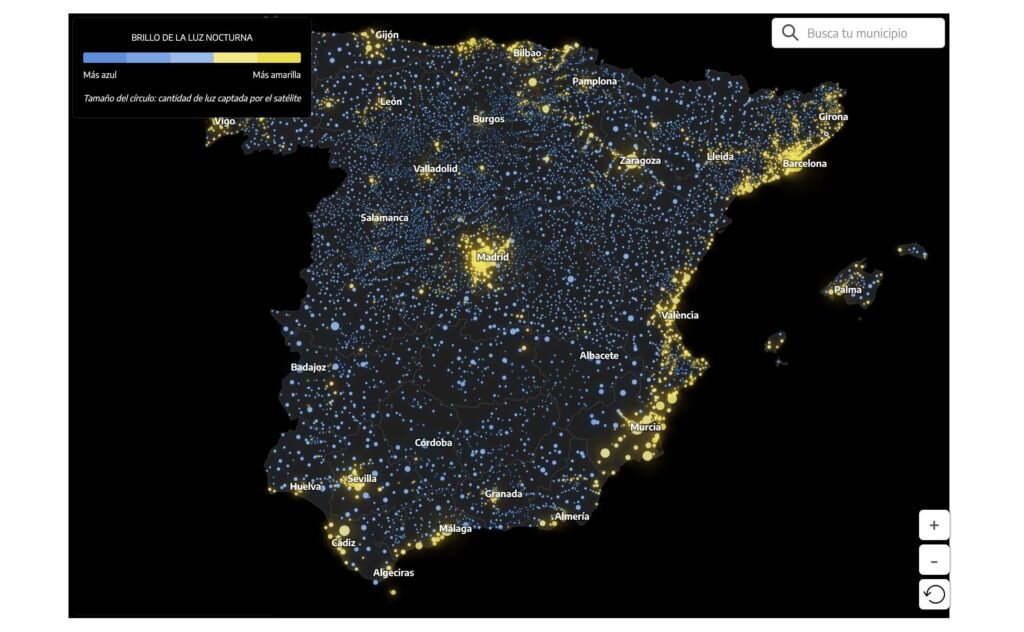
Spain looks at itself at night from space and the image leaves an uncomfortable conclusion: it’s increasingly difficult to find truly dark skies. An analysis of the light footprint of over 8,000 Spanish municipalities with populations over 1,000 reveals quite clearly where cities and towns shine the most, what types of light they emit, and how the color of the night is changing across much of the country.
The results confirms something anyone can suspect when leaving a big city, but adds an important nuance. Madrid, Barcelona, Zaragoza, Seville, and Murcia appear among the points with the highest light pollution. Yes, but the problem isn’t limited to large urban areas. In many small towns, especially in rural Spain, the old orange glow has been replaced by blue-rich white LED lighting, which is more energy-efficient but also more disruptive for astronomical observation and the natural environment.
The map, published by elDiario.es based on scientific and urban planning data, not only shows how much each municipality shines. It also helps us understand a transformation that has gone largely unnoticed by many local governments and residents: Spanish nights are no longer just brighter, but also more blue.
Major cities shine more, but rural areas are also worsening
At first glance, the distribution of night light in Spain depicts a very recognizable pattern. The peninsular center is dominated by Madrid’s glow, while the coast contains many of the other large light spots. This pattern is closely linked to population distribution, infrastructure, economic activity, and traffic.
When analyzing the data, big cities perform poorly. They emit the most light and therefore make it harder to observe the night sky. But the analysis also allows us to read the map in the opposite way: if you want to find a relatively better place to stargaze, it’s best to avoid large urban centers and instead look for towns with a smaller light footprint.
Among the less affected are Saldaña, in Palencia; Ayllón, in Segovia; and San Sebastián de La Gomera, in Santa Cruz de Tenerife. That doesn’t mean they are absolute darkness sanctuaries. Even in these cases, it’s advisable to leave the urban core and seek a mountain or remote environment for a clearer sky. Still, their position on the map indicates they are better positioned than most of the country.
The most striking part of the study is not just the amount of light but its color. Provincial capitals tend to more often emit warm or yellowish tones, associated with older lighting technologies. In contrast, many small municipalities now emit a bluish light, a result of replacing traditional lamps with modern white LEDs.
This change may seem minor, but it isn’t. Blue light disperses more in the atmosphere and worsens the visibility of the stars. It also has stronger effects on the biological rhythms of animals and humans. The problem is that, for years, white LEDs have been associated with efficiency, savings, and modernization, often without fully considering their impact on the nocturnal environment.
Rural Spain turns blue
One of the most important findings is that rural Spain is turning blue. According to astrophysicist Alejandro Sánchez de Miguel, one of the world’s leading experts on light pollution, the shift from old sodium lamps to LED lighting has occurred with little planning in many small municipalities.
For decades, the night glow of many Spanish localities had warm tones. Twenty-five years ago, large parts of the map would have shone in yellow. Today, many villages with fewer than 5,000 inhabitants, often surrounded by valuable natural spaces, emit a strongly bluish light.
There are several reasons for this change. White LEDs have been cheaper and more energy-efficient. Also, many small local administrations lacked specialized technical advice and chose solutions promising quick savings. According to the expert, public subsidies during years encouraged the renewal of lighting systems without sufficient attention to the environmental impact of the light’s color.
This results in a curious paradox. The areas with the most sustainable lighting are often the larger cities, not because they’ve always done better, but because retrofitting their extensive lighting infrastructure is more costly and they haven’t been able to replace all sodium lamps quickly.
This can make the map misleading at first glance. A large city emitting yellow light still shines brightly and heavily pollutes the sky. But many spaces previously perceived as dark have now become more blue, which is more harmful despite emitting less overall light than a major city.
Fewer dark skies remain
The main conclusion is quite clear: it’s increasingly difficult to find truly dark skies. And this isn’t just a Spanish phenomenon. NASA’s Black Marble data shows a net 16% increase in total radiance of artificial night light worldwide from 2014 to 2022.
This global growth concerns us for various reasons. The first is astronomical: more blue-rich artificial light makes sky observation harder and complicates work for amateur astronomers, astrophotographers, and observatories. The second is ecological: there is broad scientific consensus that blue-rich white LED lighting has significant effects on insects, birds, mammals, and other organisms that depend on the natural light-dark cycle.
It’s also a cultural and everyday issue. The night sky has stopped being part of the usual experience for many people. In thousands of municipalities, especially in densely lit areas, seeing the Milky Way or having a genuinely dark night has become rare. When that reference disappears, excessive lighting is no longer perceived as a problem.
The European Commission, through its scientific service, has already recommended shifting towards warmer outdoor lighting and reducing blue-rich light emissions at night. The goal isn’t to turn off towns and cities but to improve illumination—less excess, better technologies, and criteria that consider not only electricity consumption but also the impact on the sky and biodiversity.
Spain’s light footprint map serves precisely that purpose. It offers a fascinating night-time view of the country, encouraging us to rethink public lighting. Light pollution is not just a minor nuisance or a matter solely for astronomers. It has environmental, scientific, energy, and health implications.
The good news is that action is possible. Technology doesn’t always have to make the night sky worse. We can use warmer lights, reduce intensities, avoid unnecessary emissions to the sky, and design smarter lighting. The bad news is that recent trends are discouraging. Without correcting course, nights will continue to lose darkness, and Spain will have fewer and fewer places from which to observe the stars without interference.
Frequently Asked Questions
Which Spanish cities have the worst light pollution?
Major cities like Madrid, Barcelona, Zaragoza, Seville, and Murcia rank among the municipalities with the highest light footprints in Spain.
Which villages are among the least affected by light pollution?
Places like Saldaña (Palencia), Ayllón (Segovia), and San Sebastián de La Gomera (Santa Cruz de Tenerife) are among the better positioned, although it’s still advisable to leave town centers to better observe the sky.
Why is white LED light such a concern?
Because blue-rich white light disperses more in the atmosphere, hampers astronomical observation, and has stronger biological impacts on animals and natural rhythms.
Is light pollution increasing worldwide?
Yes. Data from NASA’s Black Marble project shows a 16% increase in total radiance of artificial night light globally from 2014 to 2022.
