
The race for low Earth orbit is no longer only measured by satellites launched. It’s also fought in the records maintained by the International Telecommunication Union (ITU), the organization that coordinates global spectrum usage and orbital slots. China has submitted plans to deploy over 200,000 satellites to the ITU—a figure that vastly exceeds its current fleet and has reopened debates about spectrum hoarding amid intense space competition.
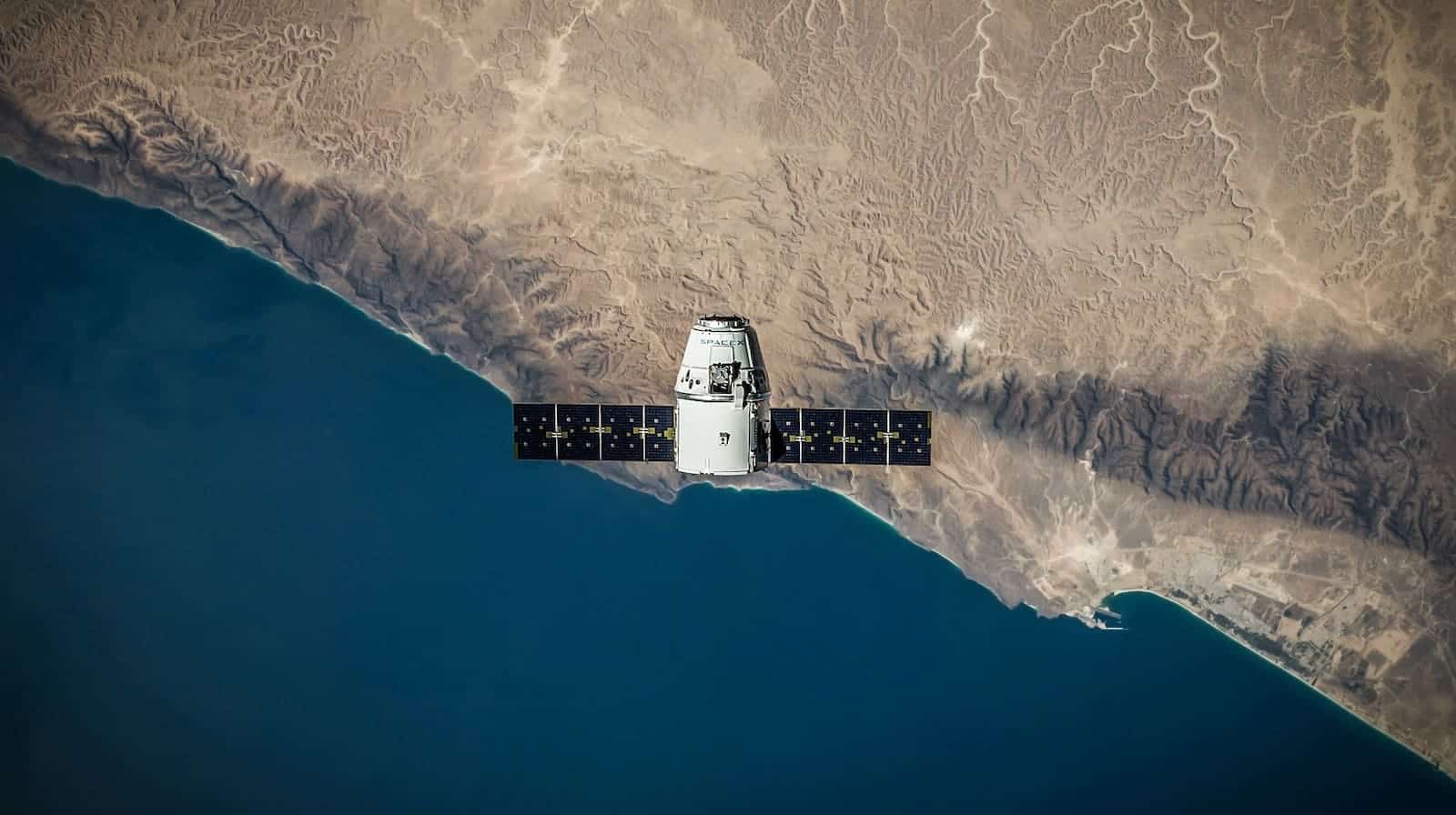
The contrast with SpaceX is striking. Elon Musk’s company physically dominates low Earth orbit with Starlink, a constellation that now exceeds 10,600 active satellites according to recent counts, and maintains a launch pace that’s hard to match thanks to Falcon 9. Meanwhile, China’s orbital presence is much smaller, but it has taken regulatory steps by submitting requests covering massive-scale constellations.
The issue goes far beyond satellite connectivity. Low Earth orbit is becoming a critical layer for internet, military communications, Earth observation, navigation, distributed artificial intelligence, direct-to-cell services, and infrastructure resilience. Whoever secures spectrum and orbital capacity will hold an advantage in commercial markets, as well as in technological autonomy and geopolitical influence.
SpaceX dominates the physical space; China advances in regulatory space
SpaceX has transformed the space market with an approach that’s difficult to replicate: reusable rockets, mass production of satellites, and a sustained launch cadence. Starlink is now the world’s largest active constellation and has changed how we view low Earth orbit networks. Where once we talked about dozens or hundreds of satellites, now it’s thousands.
China isn’t starting from zero. Its space program has grown strongly, with the U.S. Space Force estimating that in 2025 China conducted 93 launches and placed nearly 370 payloads into orbit. By the end of that year, China reportedly had over 1,353 satellites in orbit. It has also begun deploying its own mega-constellations, such as G60 and SatNet, and companies like Shanghai Yuanxin Satellite Technology, responsible for the Qianfan constellation, are accelerating their plans.
However, the gap between China’s current orbital assets and what it has registered with the ITU is enormous. China Daily reported that the country has submitted requests for over 200,000 satellites, split among more than a dozen constellations. The two largest, CTC-1 and CTC-2, would include 96,714 satellites each and are believed to have been filed by the Institute of Radio Spectrum Utilization and Technological Innovation.
| Indicator | SpaceX / USA | China |
|---|---|---|
| Active Starlink satellites | Over 10,600 | — |
| Chinese satellites in orbit, according to U.S. Space Force | — | Over 1,353 by end of 2025 |
| Chinese launches in 2025 | — | 93 |
| Chinese payloads launched in 2025 | — | Approximately 370 |
| Requests to the ITU | — | Over 200,000 satellites |
| Maximum estimate cited in some analyses | — | Up to 244,000 orbital slots |
| Registered largest constellations | — | CTC-1 and CTC-2, with 96,714 satellites each |
| Current position in low Earth orbit | Physical dominance via Starlink and high launch cadence | Smaller deployment, but strong regulatory advances |
| Main visible strategy | Launching and operational satellite deployment | Massive spectrum reserving and orbital slot filings |
| Competitive advantage | Reusable rockets, mass production, operational constellation | State planning, industrial scale potential, ITU filings |
| Analysts’ noted risk | Private concentration of orbital infrastructure | Possible spectrum hoarding or “spectrum squatting” |
| Key ITU rule | Applicable to non-geostationary constellations | 10% deployment in 9 years, 50% in 12 years, 100% in 14 years |
The most optimistic interpretation for Beijing is that this reflects long-term planning. Deploying a low Earth orbit constellation requires registering frequencies, coordinating interference, defining orbital parameters, and reserving capacity years in advance. Submitting requests to the ITU doesn’t mean satellites are ready to launch.
A more critical view suggests that some analysts see these filings as a way to occupy regulatory space before possessing sufficient industrial and launch capabilities. Known in the sector as spectrum warehousing or, more colloquially, spectrum squatting: reserving spectrum and orbital resources to hinder competitors or buy time in a highly tense race.
What the ITU can do and where the problems lie
The ITU doesn’t allocate “spatial parcels” like land, but it does coordinate frequencies and orbital slots to prevent harmful interference. For non-geostationary constellations, like those in low Earth orbit, the process is complex because satellites are constantly moving and share bands with other systems.
To prevent operators from registering enormous constellations without deploying them, the ITU approved a milestone system. Non-geostationary constellations must deploy 10% of their satellites within an initial timeframe, 50% afterward, and 100% by the end of the regulatory period. Failure to comply requires adjusting the request to match actual deployment.
| ITU Regulatory Milestones | Objective |
| First milestone | Deploy 10% of the constellation |
| Second milestone | Reach 50% |
| Final milestone | Complete 100% |
| Purpose | Prevent spectrum hoarding and orbital resource monopolization |
The question is whether these rules are strict enough for constellations now measuring in tens or hundreds of thousands of satellites. A request for 200,000 satellites makes even 10% a massive figure—deploying 20,000 satellites would be an industrial-scale logistical challenge.
This highlights the tension between regulation and physical reality. China can submit large-scale requests, but it needs manufacturing facilities, rockets, launch platforms, ground stations, supply chains, international coordination, and space traffic management infrastructure. Its progress is rapid, but SpaceX still holds a clear operational advantage through reusability, launch frequency, and experience with large constellations already in orbit.
Low Earth orbit as strategic infrastructure
This isn’t just a commercial debate. The U.S. Space Force warns that China and Russia are developing space capabilities to enhance military efficacy and reduce reliance on U.S. space services. Chinese sources mention over 510 satellites with ISR (intelligence, surveillance, reconnaissance) capabilities, alongside advances in orbital inspection systems, close maneuvering, ground-based lasers, and potential anti-satellite capabilities.
This military dimension doesn’t mean every commercial constellation is a weapon, but it explains why major powers treat low Earth orbit as a strategic domain. Satellite networks can provide resilient communications, continuous observation, low latency, and redundancy. They are also hard to neutralize completely because they consist of many nodes.
SpaceX has highlighted this importance with Starlink, especially in emergency connectivity, mobile communications, maritime services, aviation, and conflict scenarios. China seeks its own alternative and cannot depend on U.S.-dominated infrastructure if it aims for technological independence and global capacity.
Adding to this is a new frontier: satellites for AI computing. SpaceX has shown interest in orbital designs capable of hosting high-power computing loads, with radiators, deployable solar panels, and processing modules. While still filled with technical and economic questions, this trend clearly signals that space may evolve from solely being a communications network to becoming a layer of distributed computing.
Europe’s awkward position
The SpaceX-China rivalry leaves Europe in a delicate spot. The continent has space capabilities, established operators, and projects like IRIS², but currently lacks a low Earth orbit commercial constellation comparable to Starlink or a scale strategy similar to China’s. Reliance on external services could become problematic if satellite connectivity becomes vital for critical communications, defense, transportation, energy, or rural zones.
For Europe, the debate over spectrum hoarding should serve as a warning. International regulation can enable actors with significant political and financial power to secure positions before others are ready. If Europe reacts too late, the opportunity to deploy its own services may diminish.
Space sustainability is another concern. More satellites mean more maneuvers, collision risks, tracking needs, coordination demands, and orbital debris management. Although low Earth orbit is vast, it isn’t infinite. Filling it with massive constellations without stricter rules could escalate collision risks and hinder safe access to space.
The overarching question is whether the current international system is prepared for a future with 50,000, 100,000, or 200,000 satellites. ITU rules were designed to coordinate spectrum and prevent interference but are not equipped to solve all problems related to space traffic, orbital sustainability, or concentration of technological power.
China may deploy a significant portion of what it has registered, given its proven industrial capacity in other sectors. However, it’s also reasonable to question whether these requests reflect realistic plans or are a strategy to reserve regulatory space before competition intensifies further.
Meanwhile, SpaceX maintains a tangible advantage: operational satellites, customers, reusable rockets, and a mature launch chain. China has responded with a long-term regulatory game, but the race for low Earth orbit is now about who will have the right to operate there, with which frequencies, and under what rules.
Frequently Asked Questions
How many satellites does China want to register with the ITU?
China has submitted plans for over 200,000 satellites to the International Telecommunication Union, according to reports from China Daily based on ITU filings.
Why is spectrum hoarding discussed?
Because some analysts see registering extremely large constellations beyond current deployment capacities as a way to reserve spectrum and orbital resources before others can access them.
How many satellites does SpaceX have in orbit?
Starlink now exceeds 10,600 active satellites in low Earth orbit, according to recent counts after its latest launches.
What role does the ITU play in this race?
The ITU coordinates international spectrum and orbital resource use to prevent interference, and it establishes deployment milestones to ensure registered constellations actually deploy satellites and progress toward operational status rather than just reserving capacity.
Sources: chinadaily and spaceforce.mil
