
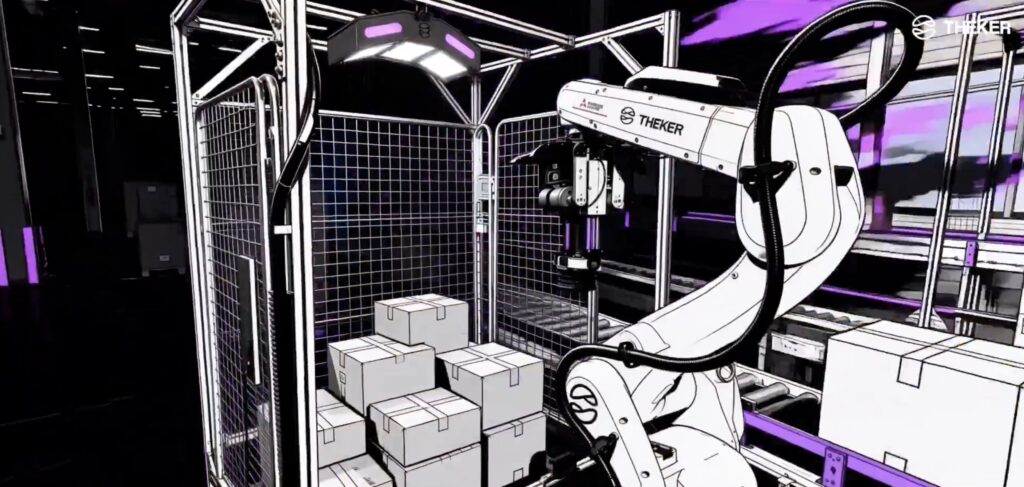
European robotics just received one of those signals that can’t be ignored. THEKER Robotics, a Barcelona-based company specializing in industrial robots with Artificial Intelligence, has closed a Series A round of $85 million, approximately €73 million, in what the company describes as the largest Series A funding for robotics raised so far in Europe.
The round was led by CRV and backed by Samsung, LVMH, Cathay Innovation, 20VC, Henkel Ventures, Korelya Capital, and Bright Pixel Capital, among others. Existing investors such as Inditex, Kfund, Kibo Ventures, Itnig, Mission, and Carles Reina also participated. For the Spanish ecosystem, this move has a clear message: Barcelona is once again on the global tech map, this time not for consumer software but for robotics applied to factories, logistics, and real industrial operations.
THEKER was founded by engineers Carla Gómez Cano and Jiaqiang Ye Zhu. The company develops general-purpose, AI-native robots designed to adapt to changing industrial environments without the need for constant manual reprogramming. This addresses one of the main limitations of traditional robotics: it works very well in stable, repetitive, and predictable settings, but its effectiveness diminishes when products, shapes, workflows, or operational conditions change.
Robots Already Operating in Production
According to the company, THEKER’s promise isn’t just laboratory demos. Their robots are already deployed in real production environments across Europe, assisting manufacturers, logistics operators, and retail companies to increase capacity, reduce downtime, and address shortages of specialized labor.
What sets THEKER apart is the integration of proprietary hardware, computer vision, control systems, and AI. The company aims for its robots to learn during operation, adapt to mixed product references, and work in environments where variability is routine. It’s not just about installing robotic arms on a line but about creating systems capable of operating with greater flexibility.
| Key Details | Information |
|---|---|
| Funding round closed | $85 million |
| Approximate equivalent | €73 million |
| Type of round | Series A |
| Led by | CRV | Sede of the company | Barcelona |
| Founders | Carla Gómez Cano and Jiaqiang Ye Zhu | Sector | Industrial robotics with AI |
| Main use | Automation in manufacturing, logistics, and retail |
This funding comes less than a year after THEKER closed an €18 million seed round, considered one of the largest in recent Spanish tech history. The rapid jump between rounds reflects how quickly the company evolved from building technology to attracting major industrial and financial investors.
Why Samsung, LVMH, and Inditex Are Investing in Robotics
The list of investors helps illustrate the significance of this news. Samsung represents the interest of big tech groups in so-called “physical AI,” or AI applied to the physical world. LVMH provides insight from the luxury and high-precision manufacturing industries. Inditex, which had already supported the company, connects the project to retail, logistics, and large-scale operations.
The appeal of such robots is clear. Many industries need automation but can’t always rely on rigid robots designed for exact, repetitive movements over years. In warehouses, production lines, sorting centers, or processes involving irregular products, reality is too variable. This is where flexible robotics begins to make real sense.
THEKER claims that its systems can be deployed in days, learn during operation, and adapt to complex environments. This will need to be proven at scale across various sectors with increasingly demanding clients. The recent funding will be used to accelerate deployments with major industrial operators, strengthen the technological platform, and grow teams in software, electronics, mechanical engineering, and operations.
The round also coincides with Europe’s attempt to bolster its presence in strategic technologies. While generative AI has garnered much attention, the next frontier involves applying these advances to the physical realm: robots, factories, logistics, maintenance, agriculture, healthcare, energy, and infrastructure.
Barcelona Aims to Lead Next-Gen Robotics
Historically, Spain has not been a global leader in industrial robotics compared to Germany, Japan, South Korea, or the United States. However, cases like THEKER show that a new cycle of AI-enabled robotics can open different opportunities. Success now depends less on building the most precise robotic arm and more on integrating sensors, learning models, control, software, operational data, and rapid deployment.
Barcelona has several assets to compete in this arena: international talent, universities, technological centers, a mature entrepreneurial community, industrial connections, and an ecosystem that has gained visibility through events like the Mobile World Congress and 4YFN. Landing a deal of this size from the city reinforces that position.
This movement also sends a message to the job market. THEKER has announced plans to hire across various disciplines, from software development to mechanical, electronic, and industrial deployment engineering. Next-generation robotics isn’t built solely by AI researchers; it requires teams capable of manufacturing, installing, maintaining, and improving machinery that must operate daily in real-world settings.
The challenge will be balancing ambition with execution. Promising technology is relatively easy in robotics; operating reliably in production is far harder. Factories and logistics centers tolerate no ongoing errors, unexpected shutdowns, or systems that only work in ideal conditions. Therefore, the most important metric isn’t just the size of the funding round but the fact that their robots are already working in live operations.
If THEKER can scale this capability, it could become a leading name in European robotics. Failing that, the round will stand as another example of the investor excitement around applying AI to the physical world. For now, the move has already made an impact: Barcelona has positioned an industrial robotics company on the radar of global investors and major corporations.
This news signals where the future of automation is heading. The next generation of robots won’t just be faster or more precise—they will need to be more adaptable. If successful outside labs, this adaptability could transform factories, warehouses, and supply chains.
Frequently Asked Questions
What is THEKER Robotics?
THEKER Robotics is a Barcelona-based company specializing in industrial robots with Artificial Intelligence, computer vision, and proprietary hardware designed to operate in complex production environments.
How much money has THEKER raised?
The company closed a $85 million Series A round, approximately €73 million, which it claims is the largest Series A funding for robotics in Europe.
Who has invested in THEKER?
The round was led by CRV with participation from Samsung, LVMH, Cathay Innovation, 20VC, Henkel Ventures, Korelya Capital, and Bright Pixel Capital, alongside previous investors such as Inditex, Kfund, Kibo Ventures, Itnig, Mission, and Carles Reina.
What will the funds be used for?
THEKER will use the funding to accelerate industrial deployments, strengthen its robotics and AI platform, and expand its teams in software, electronics, mechanical engineering, and operations.
