
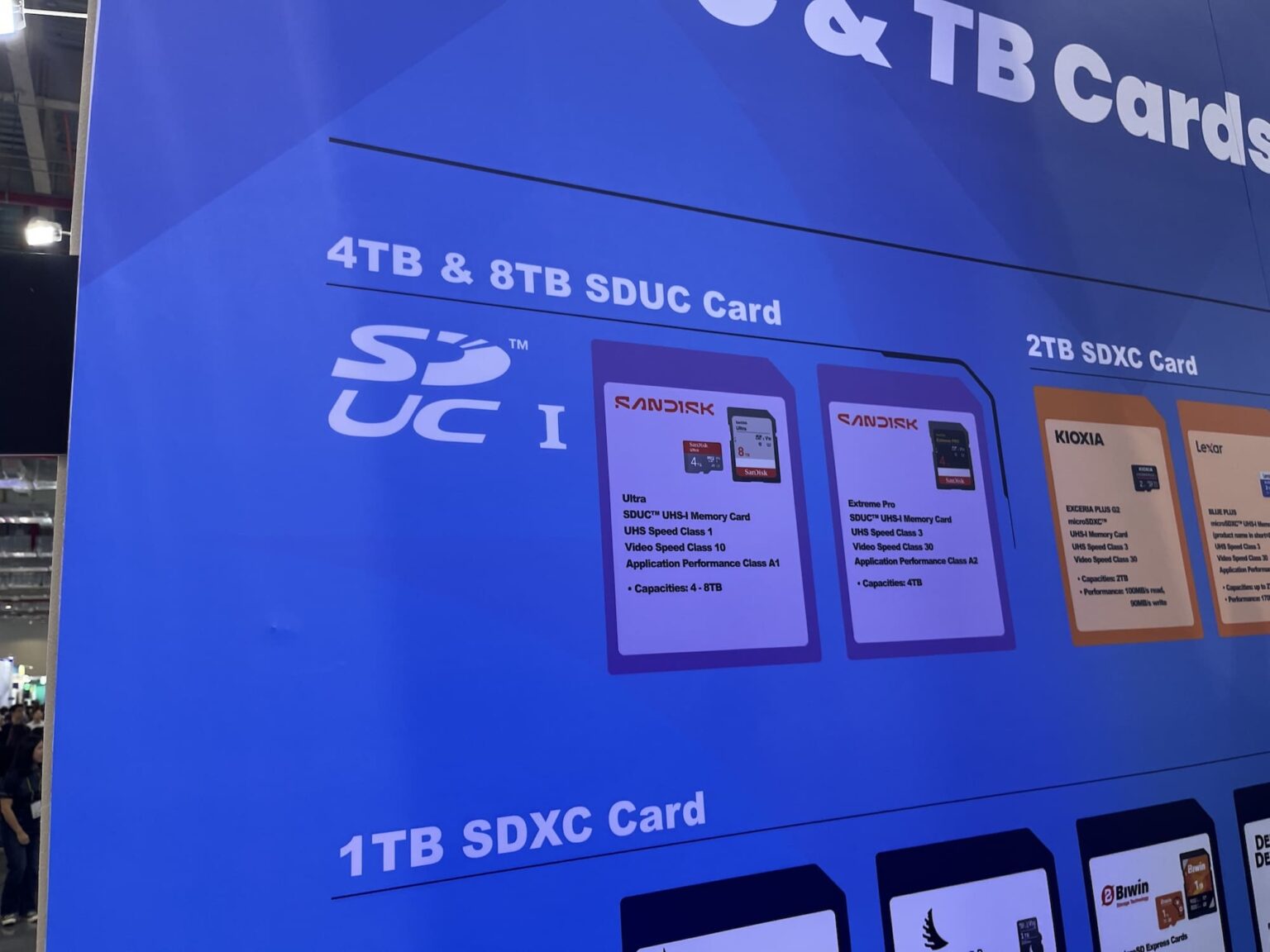
SanDisk is reportedly preparing to launch its first high-capacity SDUC cards, with models up to 8 TB in SD format and microSDUC options that could reach 4 TB. The information comes from Computex, where clear signals of these new cards’ arrival were exhibited at the SD Association’s booth, and several present companies confirmed that the launch is near.
This news is significant because SanDisk already announced SDUC cards for 2024, but those products never actually reached the market. They were originally scheduled for 2025. Now, based on the information gathered at the fair, the company appears to be making a second attempt and may directly surpass the 8 TB barrier in SD cards—a capacity that until recently seemed more suited for portable SSDs rather than small-form-factor removable storage.
What cards is SanDisk developing?
The new lineup would be divided between the Ultra and Extreme series. The Ultra series will be available in both microSDUC and standard SDUC formats. For full-size SD cards, the maximum anticipated capacity is 8 TB. The microSDUC version is expected to be around 4 TB.
The Extreme Pro range is associated with a 4 TB SDUC card. There are no major changes from SanDisk’s initial announcement, though detailed specifications regarding speeds, performance classes, durability, warranty, and price are still pending.
| Series | Format | Expected Capacity | Status |
|---|---|---|---|
| SanDisk Ultra | SDUC | Up to 8 TB | Upcoming, per Computex |
| SanDisk Ultra | microSDUC | Likely 4 TB | Upcoming |
| SanDisk Extreme Pro | SDUC | 4 TB | Announced, details pending |
| Compatible readers | SDUC / UHS-II / SD Express | Next-generation models | Required for usage |
The jump in capacity could be highly appealing for professional cameras, drones, recording devices, laptops, portable consoles, and users working with video, RAW photography, creative projects, or large multimedia libraries. However, small print is important: these cards won’t work properly with current card readers unless they support SDUC.
The big issue: new readers will be necessary
The most delicate aspect of the launch isn’t capacity but compatibility. SDUC cards will require new readers. According to published info, even recent SD Express readers cannot handle SDUC cards. The SanDisk Pro Reader, currently out of stock, is mentioned as a possible hint that new compatible readers might be coming.
This stems from the evolution of the SD standard itself. Over recent years, technologies like UHS-II, SDUC, and SD Express have developed in parallel and are not always compatible with each other in existing devices. This creates confusion for users: a card might look identical to a standard SD, but require a specific reader to function.
| Standard or technology | User knowledge needed |
| UHS-II | Common in high-performance cards, but doesn’t imply SDUC compatibility |
| SD Express | Performance boost, but current readers may not support SDUC |
| SDUC | Enables larger capacities, but requires compatible readers |
| Current readers | May not recognize SDUC cards |
| Upcoming combined readers | Expected models to support UHS-II, SDUC, and SD Express |
According to information from Computex, this year might see the debut of readers capable of supporting UHS-II, SDUC, and SD Express within a single device. This would be crucial to avoid another fragmentation cycle, where each user must carefully verify if their reader, camera, laptop, or console truly supports the latest standards.
Why an 8 TB card changes the SD format’s usage
An 8 TB SD isn’t just an incremental upgrade; for certain profiles, it could reshape how devices are used. A video creator could record entire shoots without changing cards. Photographers might use a single card for long sessions. Portable console or device users could carry an enormous media library without relying on internal storage.
There are also professional applications where large-capacity cards simplify logistics: audiovisual production, event recording, security cameras, field equipment, research, drones, or industrial systems. But bigger capacity also entails greater risk if misused. Losing, damaging, or corrupting an 8 TB card could mean losing a massive amount of content in one go.
| Advantages | Risks |
| High capacity in a small form factor | More data concentrated in a single card |
| Fewer card swaps | Greater impact if it fails |
| Better logistics for video and photography | Frequent backups needed |
| Useful for consoles and portable devices | Compatibility not guaranteed |
| Could reduce reliance on external drives in mobility | Likely higher initial cost |
For many users, balancing capacity and security remains advisable. A huge card is convenient but doesn’t replace a solid backup strategy. For professional workflows, splitting recordings across multiple cards and promptly copying data to redundant storage is often safer.
Pricing will be the big unknown
SanDisk has not yet announced prices or specific availability. Official responses to inquiries about the new cards and the pending SD Express reader were generic: the company said no statements could be made at this time.
Nevertheless, promotional material at the SD Association booth and confirmations from several present companies suggest that the launch is imminent. Details on cost, initial markets, and compatible devices are still to be confirmed.
Price will be critical. High-capacity cards tend to have a premium initial price, especially when employing new technologies or requiring specific readers. Over time, costs may decrease, but initially, these cards are likely aimed at professionals and enthusiasts with clear needs.
| Unanswered questions | Current situation |
| Price | Not announced |
| Exact release date | Not confirmed |
| Read/write speeds | Full specs pending |
| Compatibility with current cameras | Depends on SDUC support |
| Compatibility with current SD Express readers | Not guaranteed |
| New SanDisk readers | Not officially confirmed |
| Global launch | Details pending |
Not all devices will be able to take advantage
Even though SDUC cards maintain the same physical format, it doesn’t mean all devices will support them. Cameras, laptops, consoles, USB readers, and professional equipment will need explicit compatibility. Some may require a new external reader; others might simply not recognize the capacity.
This is especially important for users of portable consoles, older cameras, or laptops with integrated readers. Buying a 4 or 8 TB card without verifying compatibility could lead to a frustrating experience. The advent of SDUC might necessitate checking beyond the card’s logo and reviewing the full standard supported by the device’s reader.
| Device | What to check before buying |
| Professional cameras | SDUC support and sustained speed |
| Drones | Capacity support and write requirements |
| Portable consoles | Maximum recognized card size |
| Laptops | Type of integrated reader |
| USB readers | Specific SDUC support |
| Video recorders | Speed, stability, and temperature handling |
| Older equipment | Likely lack of compatibility |
The confusion could increase since many users already associate SD Express with “cutting-edge” technology. But current SD Express readers don’t necessarily support SDUC. Explicit support for the right standards will be essential.
A useful step forward, but with a tricky transition
The arrival of 4 and 8 TB SDUC cards would be a major development for removable storage. The SD format has thrived despite competition from external SSDs, cloud storage, and increasing internal memory. Its advantages—compact size, ease of use, broad compatibility, and widespread presence in cameras, laptops, and portable devices—remain compelling.
However, this transition may be inconvenient. Users will need new readers, manufacturers will need to clarify compatibility, stores will need to avoid confusing messaging, and buyers must understand differences in capacity, speed, performance class, and standards.
This development fits a larger trend: removable storage continues to grow as content creation and data accumulate relentlessly. 4K/8K videos, RAW photography, larger games, local models, datasets, and creative workflows are making previously extreme capacities practically necessary.
SanDisk seems poised to usher in a new phase for SD and microSD cards. If these cards launch this year, the question will not only be who needs 8 TB on an SD but also how many devices will truly support them without requiring extensive ecosystem changes.
Frequently Asked Questions
What is an SDUC card?
SDUC is an evolution of the SD standard aimed at larger capacities. In this case, SanDisk plans to develop models up to 8 TB in SD format.
Will the new SDUC cards work with current readers?
Not necessarily. According to available info, SDUC cards will require new compatible readers, and even recent SD Express readers might not suffice.
What capacities is SanDisk preparing?
The Ultra series will go up to 8 TB in SDUC format and likely 4 TB in microSDUC. The Extreme Pro line is associated with a 4 TB SDUC card.
When will they be available?
No official date or pricing has been announced. While Computex hints at a near launch, SanDisk has not confirmed specific details.
via: notebookcheck.net
