
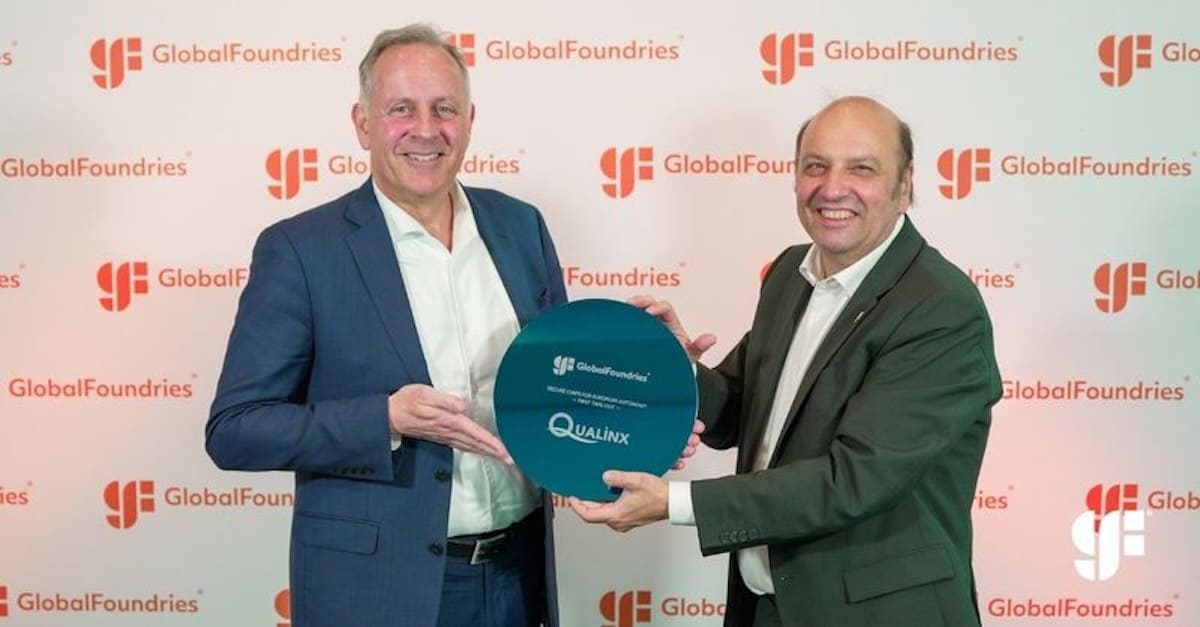
GlobalFoundries and Qualinx have completed the first end-to-end European semiconductor manufacturing flow at GF’s Dresden facility, a significant milestone for sectors where chip origin, design custody, and process traceability are as critical as performance. The goal is to meet the growing demand for “trusted” production for aerospace, defense, critical infrastructure, Internet of Things, and sensitive consumer electronics applications.
This milestone goes beyond wafer fabrication within Europe. The key is that the entire process chain, from design reception and mask services to wafer manufacturing, remains within Europe. According to GlobalFoundries, neither sensitive design data nor physical materials leave Europe during this flow, a condition increasingly important to governments, system integrators, critical infrastructure operators, and clients linked to national security.
A European-centric flow for trusted chips
The operation utilized GlobalFoundries’ FDX technology at its Dresden plant. Qualinx acted as the launch customer with its GNSS QLX3xx SoC, aimed at secure positioning, navigation, and timing applications, a field known as PNT by its acronym in English.
These applications are more critical than they appear. Precise synchronization supports telecom networks, electrical systems, industrial operations, navigation, financial services, defense, and edge-connected devices. When infrastructure depends on GNSS signals, the integrity of the chip processing that information becomes a matter of resilience and security.
| Milestone Element | Announced Details |
|---|---|
| Impacted Companies | GlobalFoundries and Qualinx |
| Factory | GF Dresden, Germany |
| Technology Used | GF FDX |
| Launch Customer | Qualinx |
| Validated Chip | QLX3xx GNSS SoC |
| Main Application | Secure PNT, navigation, and synchronization |
| Flow Scope | Design, mask creation, and manufacturing within Europe |
| Automation Goal | Automated trusted European flow before end of 2026 |
| Access for New Customers | Planned from 2027 for aerospace, defense, and critical infrastructure |
GlobalFoundries’s message is clear: Europe can rely on an operational industrial flow for complex and sensitive ASICs without depending on critical steps outside the continent. Manfred Horstmann, Senior Vice President and CEO of GlobalFoundries, pointed out that collaboration with Qualinx demonstrates that designs relevant to defense, aerospace, and critical infrastructure can now be industrialized via a trusted European manufacturing route.
Why not removing design data from the equation?
In semiconductors, sovereignty isn’t just about having a factory. A chip can be designed in one country, send data to a mask provider in another, fabricated elsewhere, tested in a third, and assembled in a fifth. While this dispersion has allowed industry scaling, it also introduces risks in sensitive applications.
Design data holds valuable information. For chips used in defense, communications, synchronization, industrial security, or critical infrastructure, such data can reveal architecture, functions, limits, attack points, or technical decisions that are hard to protect if it crosses multiple jurisdictions.
| Risk in a dispersed global chain | European GF flow response |
| Exposure of sensitive design data | Custody kept within Europe |
| Dependence on external mask services | Mask services consolidated within the EU |
| Reduced process traceability | Controlled end-to-end flow |
| Regulatory uncertainty | Aligned with European security standards |
| Risk for defense or critical infrastructure clients | Manufacturing via a trusted route |
| Fragmented suppliers | Coordination through a European fab |
GlobalFoundries’s progress doesn’t solve all challenges of European semiconductor autonomy, but it addresses a specific point: operational trust. That is, managing sensitive designs when transitioning from electronic design to actual manufacturing.
Qualinx and the strategic value of PNT
Qualinx used this flow for its QLX3xx GNSS SoC, a chip dedicated to sovereign positioning, navigation, and timing systems. Secure PNT has become a priority for governments and operators because many infrastructures depend on reliable time and location signals.
It’s not just about knowing where a device is. Precise timing synchronization enables coordination of communication networks, data centers, financial systems, power grids, industrial sensors, or transport infrastructure. If that synchronization fails or is manipulated, the impact can be far beyond a simple signal loss.
| Use of secure PNT | Why trust is required |
| Telecom networks | Require precise synchronization between equipment |
| Critical infrastructure | Depends on reliable timing for control and operation |
| Defense and aerospace | Demand resilience against interference or manipulation |
| Edge devices | Require low power consumption and reliable positioning |
| Industrial synchronization | Coordinates distributed processes and sensors |
| Sovereign GNSS systems | Reduce dependency on uncontrolled chains |
The QLX3xx is tailored for such scenarios, with low-power GNSS receivers and resilient synchronization networks. Having Qualinx as the launch customer provides GlobalFoundries with a tangible example that its model is not just political rhetoric but a capable foundry process for complex designs.
Dresden’s growing role in Europe’s semiconductor strategy
GlobalFoundries’s Dresden plant plays a central role in this strategy. Germany is already a key hub for European semiconductor manufacturing, and GF’s case reinforces Saxony’s position as an industrial node for specialized chips, automotive, communications, defense, and now trusted manufacturing.
GlobalFoundries aims to establish a fully automated, trusted European flow in Dresden by the end of 2026. From 2027, the company expects that aerospace, defense, and critical infrastructure clients can access this automated flow through standard foundry relations.
Automation will be crucial for scaling. A manual or overly artisanal trusted flow may suffice for niche cases but isn’t scalable for a broader customer base. If GF manages to implement controls over security, data management, mask services, and manufacturing in an automated scheme, this model could extend to more European-designed chips.
| Planned stage | What it means |
| Qualinx milestone | First operational end-to-end European flow |
| 2026 | Goal for an automated trusted European flow |
| 2027 | Access for aerospace, defense, and critical infrastructure customers |
| Collaboration with Deutsche Telekom | Assessment of secure processing, transport, and storage of data |
| GF’s roadmap | Silicon photonics, advanced packaging, and specialized processes |
GlobalFoundries is also working with Deutsche Telekom to evaluate secure processing, transportation, and storage of European data across the semiconductor supply chain. This expands focus from physical manufacturing to the digital infrastructure supporting the industrial process.
Practical sovereignty, beyond just industrial policy
This announcement arrives at a time when Europe aims to reduce dependencies in strategic areas. Discussions about semiconductors often focus on cutting-edge nodes and large fabs, but technological sovereignty also hinges on specialized technologies, low-power chips, secure communications, sensors, automotive, defense, and industrial processes that don’t always need the latest process node.
GF isn’t competing here to produce the most advanced AI training processors. Its focus is on providing a reliable, traceable, and European route for chips that cannot be treated as generic commercial components.
This distinction matters. In critical sectors, the best chip isn’t always the smallest or fastest, but the one that can be manufactured with guarantees, under regulatory control, with traceability, and without exposing sensitive information in undesirable jurisdictions.
An opportunity for European suppliers
The Qualinx case can serve as an example for other European chip designers. Many startups and specialized companies hold valuable IP but depend on foundries, mask services, and global supply chains. Having access to a trusted European flow can facilitate entry into defense, space, telecom, or critical infrastructure projects, where certification and design custody influence purchasing decisions.
It might also attract integrators and operators who find it challenging to meet certain security requirements with fragmented processes. If GF makes the Dresden flow accessible by 2027, Europe could have an industrial solution for sensitive chips without having to resort to case-by-case improvisation.
Cost will be a key factor. Keeping the entire process within Europe might be more expensive than optimized global chains. However, in critical applications, costs aren’t just about wafers; security, supply continuity, compliance, traceability, and reducing geopolitical exposure are equally important.
A concrete step in an still-incomplete supply chain
GlobalFoundries and Qualinx’s progress doesn’t make Europe self-sufficient in semiconductors. The supply chain still depends on materials, equipment, software, packaging, testing, talent, and international investment. Nor does it eliminate the need to cooperate with the US, Taiwan, Japan, South Korea, or other key players.
What it does demonstrate is that sovereignty can start with concrete flows and specific applications. Producing a secure GNSS chip within a controlled European chain is less flashy than announcing a mega-fab but can have a more direct impact on critical infrastructure and defense.
Europe’s industry needs both: large investments and real operational pathways. Dresden’s milestone belongs to the latter. It shows that the discourse on trusted chips can materialize into foundry processes, specific clients, and automation timelines.
If GF achieves its 2026 target and opens the flow to more clients in 2027, Dresden can play a significant role in a segment where Europe has room to stand out: producing sensitive chips under European rules of control, security, and trust.
Frequently Asked Questions
What did GlobalFoundries and Qualinx announce?
They completed the first end-to-end European semiconductor manufacturing flow at GF’s Dresden plant, using FDX technology.
Which chip did Qualinx use in this flow?
Qualinx used its GNSS QLX3xx SoC, designed for secure positioning, navigation, and timing applications.
Why is it important that design data stay within Europe?
Because in defense, aerospace, or critical infrastructure chips, design data can be sensitive. Keeping it within Europe improves traceability and reduces exposure risks.
When will this flow be available to more clients?
GlobalFoundries aims to have a fully automated trusted European flow in Dresden before the end of 2026, opening to aerospace, defense, and critical infrastructure clients from 2027.
via: qualinx.io
