
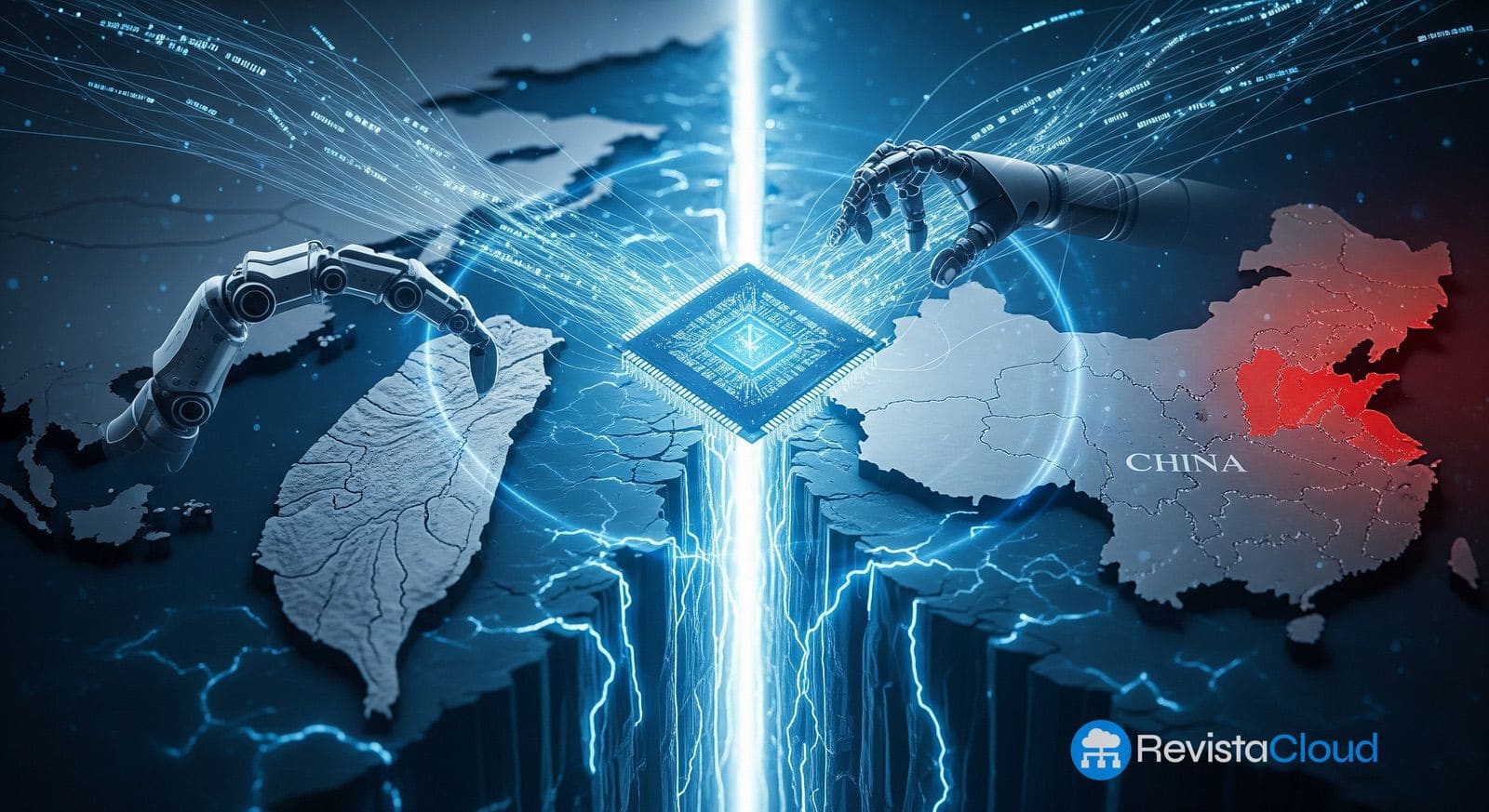
China is designing one of the world’s most ambitious artificial intelligence infrastructure plans: a national network of interconnected data centers, largely operated by major state telecom companies and primarily powered by domestic technology. According to information published by Bloomberg and reported by other international media outlets, Beijing is considering investing around 2 trillion yuan, approximately $295 billion, over five years to build this distributed computing mesh.
The figure is enormous, but the political goal is even more so. The plan aims for at least 80% of the underlying technology, including AI accelerators, to come from Chinese providers like Huawei. The intent is to reduce dependence on NVIDIA, AMD, and Intel at a time when the tech war with the United States has turned chips, data centers, and model training capabilities into strategic assets.
A national computing network to compete in AI
The National Development and Reform Commission would be responsible for defining the plan, while China Mobile and China Telecom would operate most of the facilities. The goal is to connect these data centers into a national computing network by 2028, capable of distributing AI workloads across regions and supporting both enterprises and government projects.
This framework aligns with China’s layered strategy of achieving technological sovereignty: domestic chips, national data centers, national networks, proprietary models, and control over data flows. It’s not just about building server-filled buildings. The idea is to create coordinated infrastructure that reduces bottlenecks and allows China to sustain its own AI race even if access to foreign hardware remains restricted.
| Plan Element | Expected or Cited Data |
|---|---|
| Initial estimated investment | 2 trillion yuan |
| Approximate equivalent | $295 billion |
| Plan horizon | Five years |
| National network goal | 2028 |
| Expected domestic technology | At least 80% |
| Main operators | China Mobile and China Telecom |
| Involved agency | National Development and Reform Commission |
| Potential cost with power grid | Over 5 trillion yuan |
Funding would be supported by sovereign debt and ultra-long government bonds. If the necessary upgrades to the electrical grid to power this infrastructure are included, total costs could exceed 5 trillion yuan. This highlights a reality often overlooked in AI debates: large-scale AI is not just software. It requires energy, land, water, fiber optics, memory, chips, cooling, operations, and industrial planning.
The biggest bottleneck: manufacturing enough accelerators
The most delicate point of the plan doesn’t seem to be securing funding, but rather filling data centers with enough domestic accelerators. Demanding that 80% of technology originates in China directly limits the use of NVIDIA and AMD GPUs, even when tailored versions compatible with export restrictions are available.
China has local AI chip providers, with Huawei’s Ascend family being the most prominent. But producing advanced accelerators at scale demands more than just chip design. It requires manufacturing capacity on competitive nodes, advanced packaging, high-bandwidth memory, software, compilers, interconnects, and a stable supply chain.
SMIC is a central piece of this puzzle. Its most advanced and stable process, known as N+2, sits around the 7 nm node. According to published information, the foundry is operating at over 93% utilization, leaving little margin to handle a surge in demand from all certified Chinese manufacturers competing for the same wafers.
| Capacity bottleneck | Why it limits the plan |
| SMIC’s capacity | Advanced production has little free margin |
| N+2 node | Approximately equivalent to 7 nm, behind leading fabs |
| National HBM memory | High-speed memory supply remains limited |
| Advanced packaging | Necessary for competitive accelerators |
| Software | CUDA remains a strong advantage for NVIDIA |
| Energy efficiency | Domestic chips may consume more power for similar performance |
| Manufacturing scale | State and private demand compete for the same resources |
High-bandwidth memory (HBM) is another critical bottleneck. Modern AI accelerators rely on very fast, close-to-chip memory. Without sufficient HBM, it’s not enough to design accelerators—assembling full systems like Ascend depends on components that China is still working to strengthen.
Huawei reportedly shipped around 812,000 chips last year and projects about $12 billion in processor revenue by 2026. Those are significant figures but also highlight supply chain tensions: if the national plan demands millions more accelerators, local production must ramp up rapidly with components that are not yet fully available.
Sovereignty versus performance
China’s plan clearly emphasizes prioritizing technological independence, even if it means accepting performance or efficiency limitations compared to U.S. solutions. For inference tasks, many domestic chips might suffice for specific workloads. Problems arise with frontier model training, where NVIDIA holds a significant advantage thanks to hardware, its CUDA ecosystem, interconnects, software maturity, and integration with frameworks.
DeepSeek is often cited as an example of this tension. The company was directed to use Huawei hardware for certain workloads but ultimately ended up relying on NVIDIA for heavy training, according to reports. This doesn’t invalidate China’s progress but shows that replacing the U.S. stack entirely is not a straightforward administrative task.
| Area | Advantages of the national strategy | Technical risks |
| Inference | Can run on domestic chips for many workloads | Variable energy cost and efficiency |
| Training | Reduces dependence on foreign hardware | Lower performance on frontier models |
| Software | Strengthens ecosystems like CANN | Less mature than CUDA |
| National security | Greater control over infrastructure | Potentially less flexibility |
| Supply chain | Boosts Chinese suppliers | Bottlenecks in wafers, HBM, and packaging |
| Political cost | Less exposure to sanctions | Risk of idle capacity if hardware is unavailable |
This dilemma is not unique to China. The U.S., Europe, Japan, South Korea, India, and Gulf countries are all linking AI, data centers, and technological sovereignty. The difference is that China faces harsher external restrictions and has a much larger state capacity to coordinate investment, debt, state enterprises, and domestic demand.
The precedent: more restrictions against foreign chips
The $295 billion plan doesn’t come out of nowhere. Beijing has already tightened restrictions on the use of foreign chips in data centers. In August, a requirement was introduced that data centers use at least 50% domestic chips. By November, projects funded with state money were directed to use only Chinese accelerators, and those less than 30% complete were instructed to withdraw components from NVIDIA, AMD, and Intel.
The direction is clear: public or state-supported infrastructure must stop relying on U.S. chips. This is a response to Washington’s export controls but also aims to stimulate demand for domestic providers.
| Regulatory milestones cited | Impact |
| August 2025 | Minimum 50% local chips in data centers |
| November 2025 | State projects aimed at excluding foreign accelerators |
| Projects less than 30% completed | Remove NVIDIA, AMD, and Intel components in certain projects |
| New national plan | Aim for at least 80% domestic technology |
| By 2028 | Connected national data center network |
The risk is that policy advances faster than industrial capacity. SMIC, Huawei, and other Chinese suppliers have made rapid progress, but AI data centers are not filled solely by political will. They require mass-produced parts with sufficient performance, stable supply, and software capable of supporting real-world models and applications.
The danger of building capacity before demand develops
Within China’s industry, doubts exist too. Zhao Haijun, SMIC’s co-CEO, warned about the risk of creating too much data center capacity before real demand or sufficient hardware exists, comparing it to building highways before traffic appears.
This caution is relevant. China has announced hundreds of data center projects in recent years, spread across regions with available energy, cheap land, or government support. But an empty or underutilized data center, or one filled with insufficient chips, offers no technological advantage. It consumes capital, energy, and maintenance resources.
The national network could help better coordinate this capacity if it truly connects dispersed resources and allows for efficient load distribution. However, it could also amplify errors if built around rigid political goals rather than actual technical demand.
| Risks of accelerated deployment | Possible consequences |
| Underutilized centers | Immobilized capital and low returns |
| Lack of domestic chips | Centers without sufficient AI capability |
| Inadequate power grid | Delays, restrictions, or higher costs |
| Immature software | Lower developer productivity |
| Regional overinvestment | Resource duplication |
| Rigid political objectives | Reduced economic efficiency |
A direct challenge to NVIDIA’s dominance
Although presented as a Chinese national strategy, its international impact targets NVIDIA directly. The U.S. company has been the leading provider in the global AI race. Even with export restrictions, China has remained a key market, initially through adapted products and later through more limited channels.
If Beijing accelerates a domestic network based on local chips, it will reduce dependency in the medium term. If not, the country could end up with costly infrastructure but limited accelerators, either due to less competitive hardware or shortages.
For NVIDIA, AMD, and Intel, the message is twofold. On one side, China’s market for strategic and state projects is closing. On the other, China’s push to replace foreign hardware could accelerate local competitors, which are currently behind but could gain volume, experience, and ecosystems over time.
History shows that forced substitutions don’t always produce top-tier technology quickly, but they can create captive markets where local providers learn rapidly. Huawei, Cambricon, Enflame, Biren, and other Chinese players have significant opportunities—along with enormous pressure—to demonstrate they can meet demand previously served by U.S. companies.
AI race turns into an infrastructure race
This development confirms that the AI competition is no longer just about models. It extends into data centers, chips, electricity, memory, networks, packaging, software, and public funding. China aims to build a national layer of computing infrastructure functioning as strategic assets, just as electric grids, railways, or telecommunications once did.
The plan could give China more control over its digital future but does not eliminate technical limitations. Producing advanced chips without full access to cutting-edge tools, scaling local HBM, replacing CUDA, improving energy efficiency, and filling centers with sufficient accelerators are challenging tasks—even with billions invested.
The most realistic outlook is that China isn’t seeking immediate parity with U.S. AI infrastructure but aims to reduce vulnerabilities. If it can meet a growing share of inference needs, public services, domestic models, and enterprise workloads with homegrown hardware, it gains strategic margins. Closing the gap in training would amplify this advantage significantly.
Currently, ambition surpasses available capacity. But in semiconductors, as in infrastructure, the direction matters. Beijing is signaling clearly: AI will be a national network, not just a private industry, and its foundations must be Chinese.
Frequently Asked Questions
How much does China plan to invest in its national AI data center network?
Reports indicate China is considering an investment of about 2 trillion yuan, or roughly $295 billion, over five years.
What percentage of domestic technology does Beijing aim to utilize?
The plan aims for at least 80% of the technology, including AI chips, to come from Chinese providers.
Who would operate the data center network?
China Mobile and China Telecom would oversee most facilities, under a plan coordinated by the National Development and Reform Commission.
What is the main challenge of the plan?
The biggest hurdle isn’t just funding but producing enough domestic accelerators, HBM memory, advanced packaging, and competitive software to fill the centers and operate them efficiently.
via: tomshardware
