
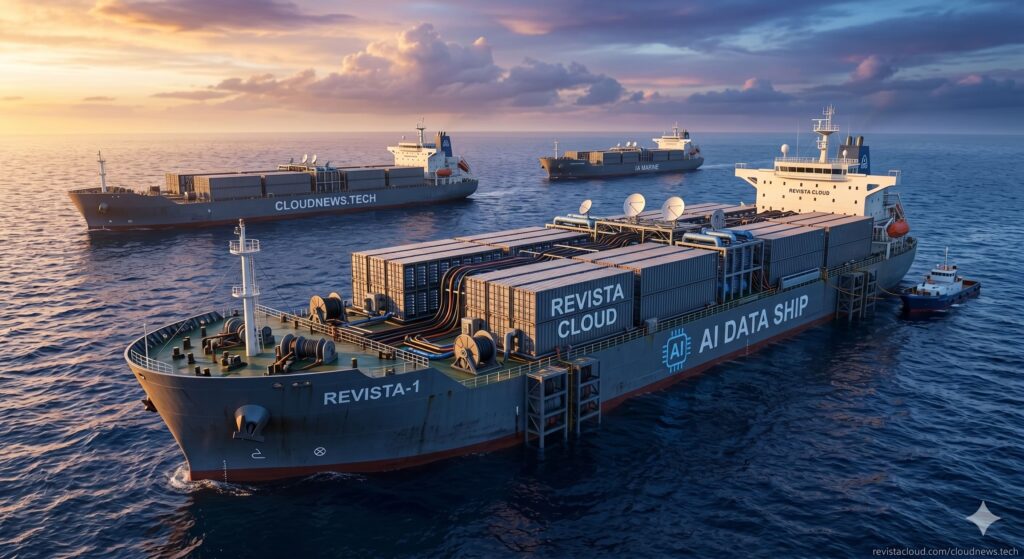
Samsung Heavy Industries aims to take part of the next generation of AI data centers off land. The South Korean company has signed an agreement with Capital Clean Energy Carriers and Lloyd’s Register to advance the design of floating data centers, a proposal that blends naval engineering, digital infrastructure, and energy generation at a time when land-based projects are increasingly limited by land availability, power grid access, and cooling constraints.
The idea is not simply to build a ship full of servers. The concept presented at Posidonia 2026 envisions floating platforms designed with naval industry techniques, capable of hosting scalable digital infrastructure, utilizing seawater for cooling, and in certain scenarios, generating some of the onboard energy. The goal is to provide an alternative to traditional data centers when network access, permits, or land availability pose a barrier.
A partnership between shipyards, maritime capital, and certification
The agreement brings together three very different profiles. Samsung Heavy Industries provides design, naval technology, and construction capacity. Capital Clean Energy Carriers, a Greek shipping firm specializing in energy transport, contributes financial expertise, project development experience, and maritime asset management. Lloyd’s Register serves as the classification and technical assurance entity, evaluating structural integrity, safety, and onboard energy generation system integration.
This combination is significant because a floating data center cannot be evaluated solely as a technological infrastructure. It is also a maritime asset. It must meet safety, operational, stability, maintenance, resilience, fire prevention, service continuity, and emerging standards compatibility criteria for a type of installation that still lacks broad commercial history.
| Partner | Expected role in the project |
|---|---|
| Samsung Heavy Industries | Design, technology, naval integration, and construction |
| Capital Clean Energy Carriers | Investment, project sourcing, and potential operations |
| Lloyd’s Register | Certification, technical assessment, and assurance |
| Lloyd’s Register Advisory | Feasibility studies, economic modeling, and business development |
| Supermicro | Validation of AI server operation in maritime environments |
Lloyd’s Register has also signed a separate memorandum with Samsung Heavy Industries to support the development and commercialization of these designs. This second effort will focus on feasibility studies, technoeconomic modeling, and business case analysis. Simply put: demonstrating that the concept can float is not enough; it must also be shown to be safe, fundable, and profitable.
Why take a data center to the water?
The growth of artificial intelligence is accelerating the demand for computing capacity. Training models, running inference, deploying agents, processing video, maintaining assistants, and operating enterprise platforms require more data centers, more energy, and more cooling. The challenge is that many land projects face physical barriers.
Available land near major electrical and fiber networks is limited. Connecting to grid infrastructure can take years. Local communities are beginning to question the electricity, water use, noise, and visual impact of new campuses. In some regions, expansion of data centers already competes with residential, industrial, and agricultural uses for energy and infrastructure.
Floating data centers aim to address part of this problem. They can be installed near ports, rivers, coastal industrial zones, energy assets, or maritime connectivity nodes. They could also move if operational models allow, offering a flexibility that traditional buildings lack.
| Issue with terrestrial centers | Potential floating solution |
| Lack of land near critical nodes | Use of marine or river platforms |
| Long electrical connection queues | Self-supply or submarine cable connection |
| Cooling costs | Use of seawater or river water in thermal systems |
| Permitting and local opposition | Offshore or port location, depending on regulation |
| Need for rapid deployment | Standardized construction at shipyards |
| Difficult infrastructure replanting | Movable or transportable asset in certain models |
Cooling is one of the strongest arguments. AI concentrates a lot of power into dense racks, especially when GPUs and accelerators are used. Efficient heat dissipation is now a core aspect of data center design. Using seawater for thermal systems can reduce pressure on conventional solutions, but requires strict controls to prevent environmental impacts and corrosion.
Onboard energy vs. land-based connection
Samsung Heavy Industries’ concept features two main power supply options. In port or coastal locations, the platform could connect to the land grid via submarine cables. In other scenarios, onboard generation could be implemented, including the possibility of using solid oxide fuel cells fueled by LNG.
This point is sensitive. From a deployment perspective, onboard generation can reduce dependency on saturated grids and speed up commissioning. Environmentally, using LNG does not eliminate emissions, but fuel cells can offer more efficient conversion with fewer local pollutants compared to other thermal technologies. The appeal will depend on the final design, fuel choice, efficiency, regulation, and whether renewable sources or clean energy contracts are combined.
| Technical element | Role in design |
| Submarine cable | Connection to land grid in ports or coastal areas |
| Onboard generation | Reduces reliance on saturated grids |
| SOFC fuel cells | Electricity generation using LNG in certain designs |
| Seawater | Supports cooling systems |
| Standardized construction | Potentially reduces timelines versus traditional civil works |
| Naval engineering | Integration of hull, energy, safety, cooling, and operation systems |
The challenge will be to demonstrate that the total cost is justified. A floating data center can save land and shorten timelines but adds complexity: maritime structures, certification, maintenance in salty environments, insurance, mooring, physical security, port permits, fiber connectivity, power, storm protection, and emergency plans.
It’s not just about placing racks on a barge
Collaboration with Supermicro addresses a key technical issue. AI servers are not initially designed to operate for years in maritime environments. Vibrations, tilt, salinity, humidity, corrosion, and environmental variations can affect GPUs, storage, power supplies, connectors, networking, and liquid cooling systems.
Samsung Heavy Industries would need to adapt position control, sealing against salt and humidity, insulation, structural protection, and environmental monitoring. Supermicro, in turn, would evaluate whether AI servers can operate stably under riverine or maritime conditions.
| Maritime risk | Potential impact on data center |
| Humidity and salinity | Component and connector corrosion |
| Vibrations | Mechanical failures or hardware degradation |
| Inclination and movement | Risks to racks, cooling, and cabling |
| Ambient temperature | Increased thermal system demands |
| Storms or waves | Need for robust structural design and mooring |
| Offshore maintenance | Higher costs and specialized logistics |
| Fire or electrical failure | Strict safety and evacuation requirements |
These challenges do not render the concept impossible but require careful handling. The maritime industry already manages complex assets at sea, from LNG platforms to FPSOs, specialized ships, and offshore energy systems. Samsung Heavy Industries can transfer some of that expertise to the digital sector. However, an AI data center has very different levels of density, availability, and sensitivity compared to other maritime assets.
Precedents from other floating data centers
Samsung is not the only company exploring this path. Nautilus Data Technologies operates a smaller-scale floating data center on a barge in Stockton, California. In Asia, submarine or floating projects have been announced, with initiatives linked to MOL and Karpowership in Japan. China has tested submarine and offshore installations to meet its digital demand.
The difference now is the influence of AI. Floating data centers are no longer just about thermal efficiency; they are a strategic deployment tool in a market where energy availability and permitting have become competitive battlegrounds. For some operators, the key may be what sector calls “speed to power”: arriving earlier on available energy.
Samsung already presented in April a 50 MW floating data center design with conceptual approvals from ABS and Lloyd’s Register. The company also partnered with ABB for power systems and with Mousterian for U.S. development. The alliance with Capital Clean Energy Carriers and Lloyd’s Register further underscores this commercial trajectory.
A useful solution but not universal
Floating data centers will not replace large land-based campuses. For many workloads, traditional buildings are still easier to operate, maintain, and scale. Major cloud regions require fiber networks, power, personnel, vendors, physical security, and auxiliary services that may be challenging to replicate offshore.
The floating model might be better suited for specific cases: high-demand coastal zones, industrial ports, regions with saturated electrical grids, areas with expensive land, temporary projects, or deployments benefiting from natural cooling options. It could also appeal to providers seeking modular capacity without waiting for years to develop a terrestrial campus.
A key question is who will buy and operate these platforms. Based on industry reports, shipowners or investors might acquire assets and rent capacity through long-term contracts, similar to how specialized ships are chartered. If this develops, floating data centers could become a new class of maritime-digital assets.
AI drives infrastructure to unexpected places
Samsung Heavy Industries’ project exemplifies how AI is pushing new physical responses. Initially, large campuses appeared in regions with cheap energy. Then, the search for liquid cooling, nuclear energy, renewables contracts, batteries, remote locations, and modular centers emerged. Now, the maritime industry seeks a role in this landscape.
The logic is straightforward: if computing demand outpaces the ability to connect new data centers via land networks, alternative deployment methods will be sought. Some will be viable; others will remain experimental. Floating data centers offer technical advantages but must prove cost-effectiveness, reliability, and regulatory acceptance.
Samsung Heavy Industries benefits from its experience building complex maritime assets. Lloyd’s Register provides credibility in maritime assurance. Capital Clean Energy Carriers brings operational and investment insights. Supermicro can assist in validating AI hardware under real marine conditions. However, transitioning from concept to operational infrastructure will require clients, permits, energy sources, connectivity, and many years of testing.
The ocean can address some terrestrial data center limitations but does not eliminate complexity. It transfers it into another harsh, salty, regulated, and costly environment. Opportunity exists, but success depends on the promise of speed, mobility, and cooling outweighing operational challenges of running an AI data center on water.
Frequently Asked Questions
What is Samsung Heavy Industries developing?
Samsung Heavy Industries is working on floating data center designs for AI, constructed with naval industry methods, intended to operate in rivers, ports, or maritime zones.
Which companies are involved?
The main agreement includes Samsung Heavy Industries, Capital Clean Energy Carriers, and Lloyd’s Register. Samsung also collaborates with Supermicro to evaluate AI servers in maritime settings.
Why take data centers to sea?
The proposal seeks to reduce land, power grid, and cooling pressures in terrestrial projects. Floating platforms could use seawater for cooling and connect via submarine cables or generate onboard energy.
What are the main challenges?
Major challenges include corrosion, humidity, vibrations, movement, maintenance, safety, certification, energy and fiber connectivity, and proving total cost competitiveness.
