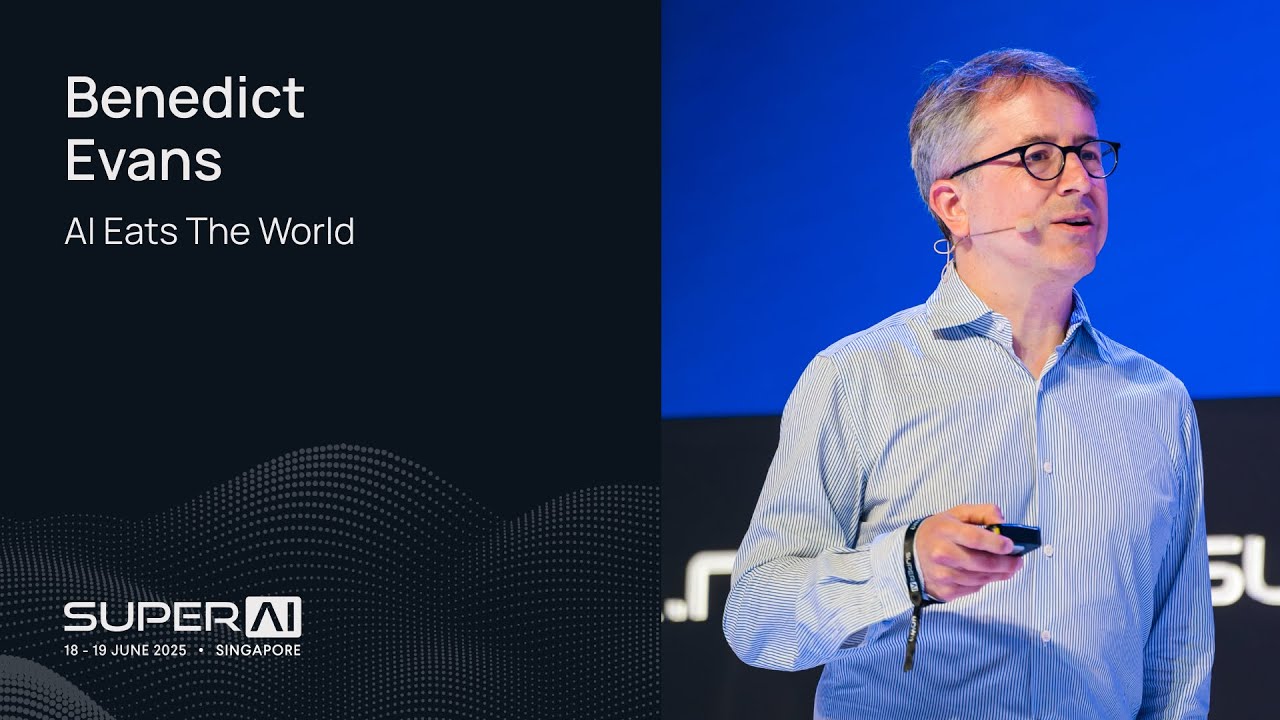
Generative artificial intelligence has attracted enormous investment, fueled the demand for data centers, and placed NVIDIA, TSMC, and the major hyperscalers at the center of the tech conversation. But one question remains open: where will the true value ultimately reside? Benedict Evans, a tech analyst and former partner at Andreessen Horowitz, addressed this uncertainty in his talk AI Eats the World during SuperAI Singapore 2025, offering a less euphoric and more structural perspective on the current moment.
His approach does not dismiss AI as a passing fad, but neither does it wholeheartedly buy into the narrative of an immediate economic transformation. For Evans, generative AI could be the next major platform shift after the PC, web, and smartphone. It might also end up as just another layer of software integrated into everyday products, becoming invisible over time. The distinction between these possibilities won’t be settled by headlines but through real deployment, enterprise adoption, and new business models.
AI Always Ends Up as Software
Evans recalls an idea attributed to Larry Tesler, a pioneer of computing: artificial intelligence is what machines still cannot do. When they do it well, we stop calling it AI and start calling it software.
This observation explains much of recent technological history. Databases once had superhuman memory capacity, but today no one considers them intelligent. Image recognition on smartphones once seemed magical, but now it’s just a standard feature in photo galleries. Machine learning was long considered the promising frontier of AI, but in many sectors it is now viewed as a normal tool embedded within applications and systems.
The question is whether large language models will follow the same path. ChatGPT appeared to break through to mainstream awareness, but moving from awe to sustained utility isn’t automatic. Evans outlines two extreme scenarios. One involves thousands of models, similar to the multitude of databases, spreadsheets, and software systems. The other envisions a kind of global supercomputer capable of solving complex tasks end-to-end. Between these extremes lie many intermediate possibilities.
| Major Question About AI | Possible Interpretation |
|---|---|
| Is it just another software technology? | It can be integrated into existing tools until it becomes invisible |
| Is it a platform shift? | It could concentrate investment and innovation akin to the PC, web, or smartphone |
| Will there be a single winner? | Evans sees no clear signs of a tech monopoly yet |
| Where will the value be? | Likely in products, workflows, data, and integration |
| Which sectors are moving fastest? | Programming, marketing, support, and specific internal processes |
| Why is there so much uncertainty? | Market structure and revenue capture are still unclear |
| Will adoption be immediate? | No. Enterprise deployment will take years, as with cloud technology |
Heavy CapEx, Cheaper Models, and Fewer Barriers Than Expected
A key highlight of the talk is the level of investment. Evans notes that the four major tech platforms spent roughly $220 billion last year on infrastructure, and this year they may surpass $300 billion in data center spending. According to his analysis, Microsoft has shifted from selling high-margin software to allocating over 30% of its revenue to CapEx—more than many telecoms spend.
The most visible beneficiary of this spending is NVIDIA, which has positioned itself centrally in the AI supply chain with quarterly data center chip sales exceeding $45 billion, Evans cites. The AI boom has triggered a race to build computational capacity, fuel models, and sustain increasingly infrastructure-intensive services.
However, this investment hasn’t yet led to a clear monopoly on models. Evans argues that frontier models are starting to resemble commodities. OpenAI changed market perceptions with ChatGPT, but today several firms can deliver comparable-quality models. DeepSeek, for instance, demonstrates that a company with a few hundred million dollars can approach the frontier—a large amount for most, but manageable for many global tech firms.
At the same time, the cost of producing a specific output with language models is falling rapidly—perhaps one or two orders of magnitude annually. This creates a paradox: despite unprecedented infrastructure spending, the unit cost of utilizing AI is decreasing. As a result, the model itself may become less differential, with increased value shifting up the stack toward applications and integrated solutions.
From Benchmarks to Real Products
Evans compares this phase to the PC industry in the 1990s, when consumers had to understand processors, MHz, memory, modems, and a long list of technical specs. Over time, this technical complexity was abstracted away. Buyers shifted from specifications to applications, user experience, brands, ecosystems, and utility.
AI might follow a similar trajectory. Currently, the conversation revolves around benchmarks, context, tokens, agents, reasoning, open and closed models, and new acronyms. But as models become cheaper and more similar, the advantage will increasingly lie not in the model itself but in the solutions and products built on top of it.
Brand still matters. Evans notes that ChatGPT appears to be becoming a verb, like Google once was. But he also reminds us that MySpace was once a verb, too. Brand prominence can offer significant advantages but does not guarantee lasting dominance.
For companies and startups, the takeaway is both uncomfortable and practical. Simply claiming a product uses AI isn’t enough. The challenge is to solve a specific task better than before. Automating billing processes for a telecom, helping migrate legacy code, improving support, organizing documentation, or speeding up marketing—these might be less glamorous than talking about superintelligence, but they are where many firms start to see tangible returns.
Real Adoption Is Still Uneven
Technological enthusiasm should not be confused with widespread adoption. Evans cites surveys indicating that only around 7-10% of people use generative AI chatbots daily, while about 20% use them weekly or biweekly. Many users have tried them once but aren’t sure how to incorporate them into their routines.
This is not surprising. Spreadsheets, for example, were initially evident primarily to those already doing financial modeling on paper. For an accountant, VisiCalc could save days; for a lawyer with no spreadsheet background, its utility wasn’t obvious. Similar patterns are emerging with large language models. Some see immediate use cases, others are left staring at blank text boxes unsure what to ask.
Developers find early utility, with Evans comparing code generation to a new form of AWS, reducing the effort needed to create and deploy software. Adoption is also growing in marketing, customer support, and among users familiar with flexible tools like Notion, Airtable, or no-code platforms.
In organizations, barriers aren’t only understanding the benefits. Many companies understand the potential but face practical obstacles: security, messy data, talent shortages, costs, regulatory compliance, and system integration. Like cloud, actual deployment often takes years rather than months, despite market enthusiasm.
AI Doesn’t Just Answer Questions: It Changes the Question
One of Evans’ most intriguing points relates to search. The usual question is what happens if users prefer ChatGPT over Google, receiving a direct answer instead of a list of links. But the deeper change might be in how questions are formulated: AI enables asking queries that weren’t search engine queries before.
For example, showing a fridge photo and asking what to cook. This doesn’t fit traditional search better than a standard query. Instead of finding ten links, it involves interpreting an image, understanding context, offering advice, and connecting to shopping, dietary preferences, and availability. If such interactions become common, they will reshape how we discover information, buy products, and target advertising.
Evans points out that about one billion dollars annually flow into advertising, heavily concentrated among Google, Meta, and Amazon. If AI shifts how we search, decide, and purchase, a portion of that ad spend could move elsewhere. But the exact direction remains uncertain.
His cautious conclusion is that some questions about AI will be answered through familiar patterns of platform shifts: gradual adoption, integration, and competition. Others are still unknown. In 1995, no one predicted that the web would generate value through search engines, advertising, and social networks. Now, it’s clear there will be AI-related “things,” but the market’s ultimate shape is still unclear.
Generative AI may disrupt parts of the world—more slowly, unevenly, and concretely than the most euphoric narratives suggest. Meanwhile, the biggest economic opportunities will continue to emerge where they always have: turning powerful technology into useful, integrated products that can transform real tasks.
Frequently Asked Questions
Who is Benedict Evans?
Benedict Evans is a technology analyst specializing in digital platforms, investment, internet, mobile, cloud, software, and artificial intelligence. He’s known for his essays and presentations on structural shifts in tech.
What does he argue in “AI Eats the World”?
Evans believes generative AI could be a major platform shift but warns that it’s still uncertain where value will be captured and whether models will provide lasting advantages.
Why compare AI to the PC or the web?
Because large technological shifts often follow cycles: initial uncertainty, gradual integration into existing products, and eventually the emergence of new uses, companies, and business models.
Where could AI business opportunities arise?
Likely in applications, integration with enterprise workflows, data utilization, user experience, and specific processes, rather than in isolated models alone.