
Anthropic has launched Claude Fable 5, its most advanced general-purpose model to date, alongside Claude Mythos 5, a restricted version initially aimed at cybersecurity defenders, critical infrastructure providers, and trusted access programs. The company is attempting to address an increasingly visible tension in the AI industry: how to open frontier capabilities to millions of users without also providing overly powerful tools to malicious actors.
Anthropic’s response has not been to release a single model for everyone, but rather to separate access and safeguards. Fable 5 enters the market with filters tailored to sensitive areas such as cybersecurity, biology, chemistry, and model distillation. Conversely, Mythos 5 retains the same core architecture but with some restrictions lifted for verified users. This decision anticipates a new phase in commercial AI: the most powerful models will be distinguished not only by price or performance, but by who can access all their capabilities.
A general model with more visible safeguards
Claude Fable 5 is, according to Anthropic, the most capable model the company has made publicly available. It improves over Opus 4.8 and Mythos Preview in many of the benchmarks published by the company, with notable results in agentic programming, knowledge work, vision, spatial reasoning, tool use, legal tasks, health, biology, and cybersecurity.
The comparison table published by Anthropic shows Claude Fable 5 and Mythos 5 achieving an 80.3% score on SWE-Bench Pro, an agentic programming-oriented test. In Terminal-Bench 2.1, related to code tasks in terminal environments, the model reaches 88%. In other assessments such as ExploitBench, the company assigns Mythos/Fable a 78%, though in that case safeguards may cause certain queries to be handled by a less sensitive model.
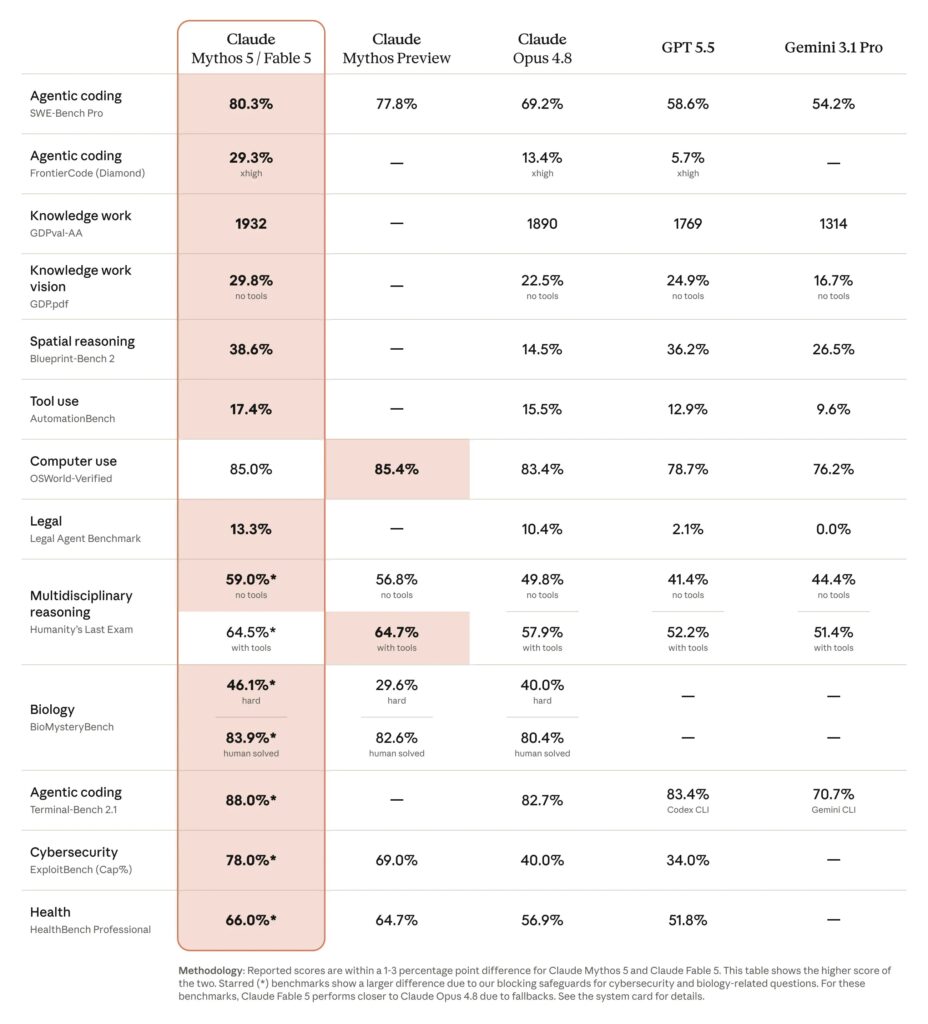
These data should be interpreted with caution. They are benchmarks published by the provider itself and do not replace independent evaluations in real-world environments. Nonetheless, they reflect the technical focus of this launch: Anthropic wants Fable 5 to be seen as a model suited for long, complex tasks with greater autonomy, not just as a more accurate chatbot.
The most novel aspect is the safety mechanism. When Fable 5 detects a request related to high-risk areas, it does not respond directly with its full capabilities. Instead, the system redirects the response to Claude Opus 4.8, an earlier but still advanced model. Anthropic ensures users are notified when this occurs, and that on average, over 95% of sessions do not trigger this fallback.
| Model | Access | Focus | Restrictions |
|---|---|---|---|
| Claude Fable 5 | General Use | Advanced model for programming, analysis, vision, and complex tasks | Classifiers and fallback to Opus 4.8 in sensitive areas |
| Claude Mythos 5 | Restricted Access | Cybersecurity, critical infrastructure, verified programs | Safeguards lifted only for certain users and domains |
| Claude Opus 4.8 | Previous advanced model | Backup response when Fable blocks a request | Less capable in high-risk scenarios |
| Claude Mythos Preview | Limited early access | Initial Mythos generation for select partners | Replaced or upgraded by Mythos 5 |
Agentic programming: fewer turns and longer tasks
Anthropic dedicates a significant part of the announcement to software engineering. The company claims that Fable 5 can work autonomously longer than previous Claude models and tackle larger problems. Early tests suggest Stripe used the model to complete a migration of a 50-million-line Ruby codebase in a single day—an effort that, according to the company’s testimonial, would have taken over two months of manual work by a team.
This may sound exceptional, but it signals a real market shift. Programming models are no longer evaluated solely based on completing a function or fixing bugs. Companies are beginning to measure whether they can execute migrations, refactorings, large repository analyses, test generation, dependency reviews, and distributed tasks across multiple tools.
Within this context, Fable 5 competes in the development agent space. Anthropic emphasizes that the model requires less scaffolding and fewer turns to complete complex tasks. It is also presented as more token-efficient—a key factor when tasks involve reading thousands of files, maintaining memory, iterating solutions, and validating results.
This jump aligns with a broader trend: AI-assisted development moving from autocompletion to delegation. Users are shifting from commands like “write this function” to requests such as “migrate this module,” “modernize this part of the system,” “find out why this integration is failing,” or “convert this prototype into a deployable app.” The longer the task, the more memory, planning, and self-correction matter.
Vision, memory, and science: beyond code
Claude Fable 5 also signifies an advance in visual understanding. Anthropic claims it can extract precise numbers from scientific figures, interpret tables, reconstruct interfaces from screenshots, and handle visual tasks with fewer external tools. One notable example is Pokémon FireRed: Fable 5 supposedly completed the game using only screenshots, without maps or additional structured information about the game’s state.
This anecdote carries more technical significance than it appears. Playing a video game from images without direct access to internal state requires visual perception, memory, planning, navigation, and error adaptation. While it does not prove general intelligence on its own, it demonstrates progress in multimodal long tasks.
In knowledge and analysis, Anthropic highlights improvements in financial benchmarks, document interpretation, and reasoning over graphics and tables. For enterprise clients, these capabilities may be more valuable than isolated programming scores. Many corporate tasks involve extensive documents, spreadsheets, contracts, presentations, financial data, and decision-making processes.
Mythos 5, meanwhile, appears linked to advanced scientific research. Anthropic states that the model has accelerated protein design efforts and generated novel hypotheses in molecular biology. It also reports conducting over a week of genomic research with limited human intervention, assembling single-cell data from millions of cells across 138 animal species, and training a smaller proprietary model that outperforms another published in Science in the targeted task.
These claims are significant, but they also explain why Anthropic imposes tighter restrictions. Capabilities that assist in therapy design or protein research can have dual-use applications. The same applies to cybersecurity: a model that helps find vulnerabilities can be used to defend or attack systems.
Security integrated into the product
The Fable 5 launch demonstrates that security is no longer just an afterthought in frontier models. Anthropic has chosen to embed it at the core of the experience. The model includes specific classifiers to detect offensive cybersecurity requests, biology, chemistry, and capacity distillation, with such requests diverted to Opus 4.8.
The company reports testing these safeguards through internal and external red teaming, as well as a bug bounty program with over 1,000 hours of testing without finding universal jailbreaks. Nonetheless, Anthropic admits that eliminating all risks is likely impossible. Their goal is to make any evasion attempts sufficiently slow and costly to detect early.
This approach will create friction. Researchers, system administrators, or security engineers may see legitimate requests rerouted to a less capable model. Anthropic acknowledges false positives and commits to reducing them. This choice highlights a difficult dilemma: the more capable the model, the higher the stakes of errors—either overtrust or undertrust.
Another significant change for enterprise users is that Anthropic will implement a mandatory 30-day retention policy for traffic to Fable 5, Mythos 5, and future models of similar or greater capabilities. The company assures these data will not be used for training new models or other purposes unrelated to security, but solely to detect complex attacks, distributed jailbreak attempts, and false positives. For organizations with stringent privacy requirements, this policy will be an important consideration before adopting the model in certain workflows.
Pricing and availability
Fable 5 is available for general use from launch. Mythos 5 is initially limited to Project Glasswing partners and will soon be accessible to certain biomedical researchers through trusted access programs. Anthropic plans to gradually expand access.
Pricing for both models is set at $10 per million input tokens and $50 per million output tokens—less than half the cost of Claude Mythos Preview, according to the company. Developers will be able to access Fable 5 via API using the identifier claude-fable-5.
Subscription plans will be more cautious. Anthropic will temporarily include Fable 5 in Pro, Max, Team, and Enterprise seat-based plans until June 22. After June 23, usage will require credits unless capacity expands to extend that window. For API and consumption-based enterprise plans, the models will be available from day one.
The technological message is clear. Anthropic is not just launching a more powerful model; it is testing a tiered distribution system for high-risk capabilities. Fable 5 will be the frontier model for the general public. Mythos 5 will serve as a trusted version where those same capabilities may also be dangerous.
This tiered access approach could influence other providers. As AI capabilities grow in programming, cybersecurity, biology, chemistry, autonomous research, and tool use, the industry will face a more complex challenge: not just which model is best, but who can use it freely, who needs safeguards, and who should be excluded.
Frequently Asked Questions
What is Claude Fable 5?
Claude Fable 5 is Anthropic’s new advanced general-purpose model, designed for complex tasks in programming, analysis, vision, knowledge, and autonomous work over long periods.
What is Claude Mythos 5?
Claude Mythos 5 shares the same base architecture as Fable 5 but with some safeguards lifted for verified users, initially focusing on cybersecurity and critical infrastructure.
Why does Fable 5 sometimes redirect responses to Opus 4.8?
Because Anthropic applies classifiers for areas like cybersecurity, biology, chemistry, and distillation. When a request is deemed sensitive, it is rerouted to Claude Opus 4.8.
How much does Claude Fable 5 cost?
Anthropic has set a price of $10 per million input tokens and $50 per million output tokens for Fable 5 and Mythos 5.
