
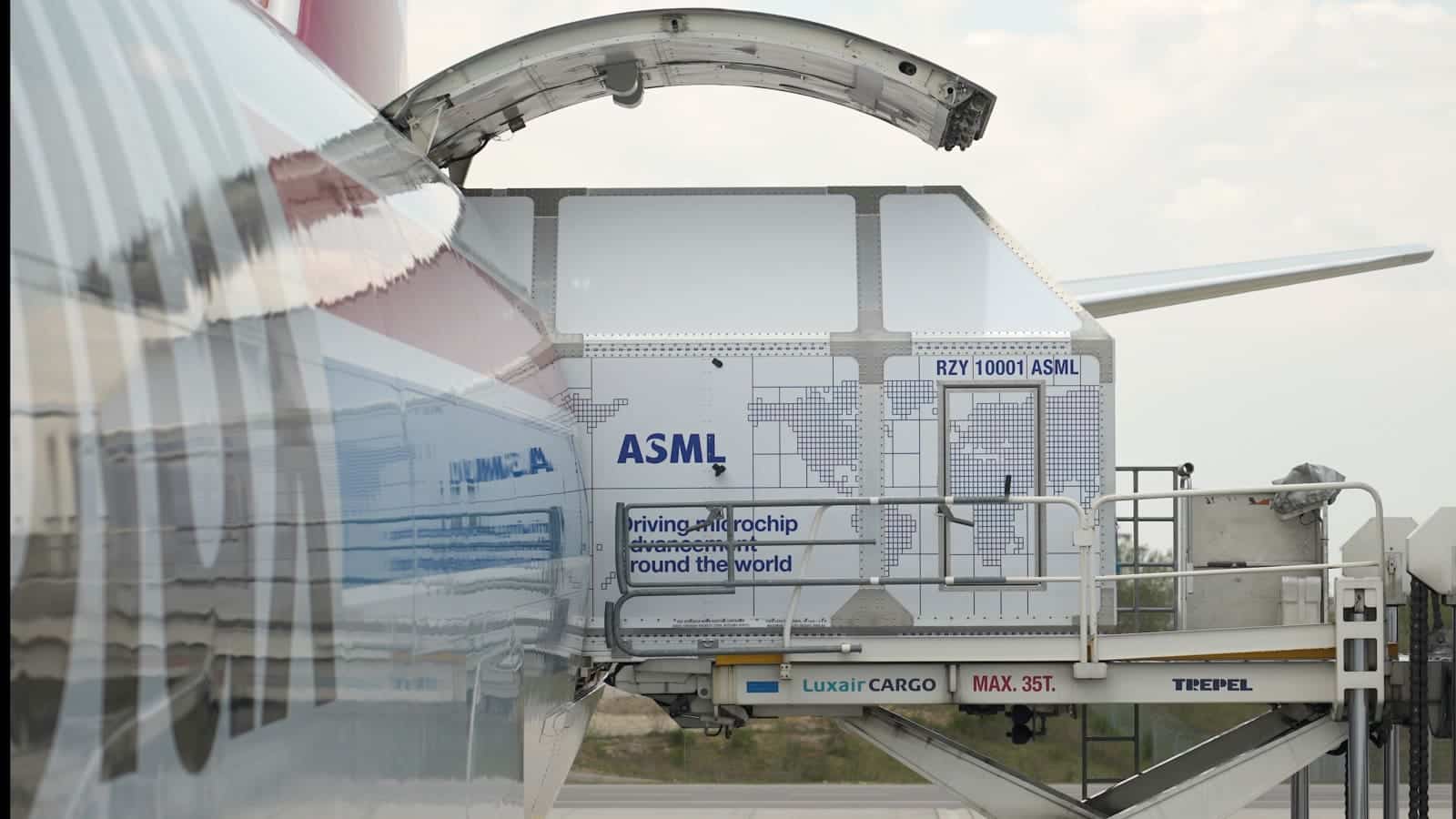
ASML has reached an unprecedented market capitalization for a European company. The Dutch firm, the sole commercial provider of EUV lithography machines used by manufacturers like TSMC, Samsung, and Intel to produce advanced chips, this week hit an intraday valuation close to $674 billion and closed Wednesday, June 3rd, around $668 billion. In nominal terms, it surpasses the record set by Novo Nordisk in 2024, when the Danish pharmaceutical company approached $650 billion.
This milestone is not solely driven by the broader enthusiasm around artificial intelligence. ASML has become one of the most difficult pieces to replace within the global semiconductor supply chain. Every new generation of AI accelerators, advanced memory, or cutting-edge processors relies, at some stage of their manufacturing, on equipment capable of printing ever-smaller structures onto silicon wafers. This is where EUV lithography makes ASML a critical industrial bottleneck.
Analysts betting on more EUV capacity
The recent market surge came after JPMorgan and Morgan Stanley raised their price targets for ASML. JPMorgan increased its estimate to €1,900 per share from €1,515, while Morgan Stanley raised theirs to €1,660 from €1,400. Both firms maintained a positive outlook on the stock, supported by the idea that the company can produce more low-NA EUV systems than the market previously discounted.
According to JPMorgan’s thesis, ASML could deliver over 110 low-NA EUV systems without adding new built capacity, exceeding the roughly 90 units some investors considered a reasonable cap. This figure is significant because ASML itself indicated in April that it expects to ship around 60 low-NA EUV systems in 2026 and potentially increase that capacity to at least 80 in 2027.
Morgan Stanley, for its part, linked part of its increased confidence to signals of expansion from ASML’s April annual meeting. The company explained that the new campus at Brainport Industries Campus in Eindhoven will proceed in phases, with construction starting in Q3 2026 and the first employees expected in Q1 2028.
| Key Data | Figure or Situation | Interpretation |
|---|---|---|
| Recent intraday market cap | Close to $674 billion | Novel nominal high for a European company |
| Market cap at close on June 3 | Approximately $668 billion | Surpasses Novo Nordisk’s record |
| Previous European record | Around $650 billion | Set by Novo Nordisk in June 2024 |
| Projected ASML sales in 2026 | €36–40 billion | Elevated outlook driven by AI-related demand and data centers |
| Expected gross margin in 2026 | 51%–53% | Indicates strength despite industrial complexity |
| Low-NA EUV systems expected in 2026 | About 60 units | Official short-term production target |
| Low-NA EUV capacity in 2027 | At least 80 units | Increase beyond previous expectations |
| JPMorgan thesis | Over 110 low-NA EUV systems possible | More capacity without new buildings |
| New BIC campus in Eindhoven | Construction scheduled for Q3 2026 | Long-term industrial reinforcement |
The Bottleneck of Artificial Intelligence
ASML’s position is difficult to compare with other tech giants. It doesn’t sell chips like NVIDIA, manufacture wafers like TSMC, or design consumer processors. Its role is more foundational and less visible: providing the machines that enable manufacturers to produce leading-edge chips.
EUV lithography uses extreme ultraviolet light to print tiny patterns on wafers. Without this equipment, the most advanced nodes would be much harder, more expensive, or slower to produce. That’s why ASML has become an investment linked to the physical infrastructure of AI. If data centers need more GPUs, and those GPUs require advanced chips, then fabs need more lithography capacity.
ASML had already increased its revenue forecast for 2026 to a range of €36–40 billion, with an expected gross margin of 51%–53%. The company closed Q1 with €8.8 billion in net sales and €2.8 billion in net profit, confirming demand strength amid pressure on semiconductor manufacturing capacity.
The paradox is that ASML remains far from the valuations of U.S. chip and software giants, despite many relying indirectly on its machines. NVIDIA, Microsoft, Apple, and Alphabet have all surpassed the $1 trillion mark, while ASML has just crossed a European record. This difference reflects both the scale of end markets and the fact that ASML operates in an extremely complex industrial sector, with long production cycles and limited capacity.
A Technological Monopoly with Still Distant Rivals
ASML enjoys a near-monopoly position in EUV, but this current dominance should not be confused with permanent immunity. Several projects aim to challenge or circumvent its advantage. Substrate, a U.S. startup backed by Founders Fund and In-Q-Tel, has raised $100 million to develop X-ray lithography based on particle accelerators. Canon has been promoting nanoimprint lithography as an alternative in certain manufacturing cases, while China is exploring ways to reduce dependency on equipment subject to export controls.
The challenge for all these contenders is the same: demonstrating a promising technique isn’t enough. Advanced chip manufacturing demands performance, repeatability, precision, low defect rates, integration with existing processes, and the capability to operate for years at high volume. Replacing an ASML EUV scanner in high-volume fabs isn’t just about cost per machine, but about the entire ecosystem.
Furthermore, ASML is not standing still. The transition to High-NA EUV, with systems like the EXE platform, aims to enable even more advanced nodes over the next decade. These systems are significantly more expensive than current low-NA models, with some estimates in the vicinity of $380 million per machine, but promise to reduce process steps and facilitate geometrical scaling for next-generation chips.
Intel has already installed a High-NA EXE:5200B for its 14A roadmap, while TSMC has taken a more cautious stance, analyzing when this technology will be economically viable for production. This variation illustrates that even within the advanced industry, not all customers move at the same pace. The cost of each technological step is enormous, and profitability depends on volume, wafer performance, and end demand.
ASML’s record reveals something deeper than a market rally. Europe has few technological companies capable of shaping the global digital economy, but ASML is an exception. Its value does not derive from consumer applications or advertising platforms, but from an extraordinarily complex industrial machine that has become indispensable for AI, data centers, mobile chips, advanced automotive systems, and technological defense.
The key question is how long it can continue to increase production without straining its own supply chain. If analysts are correct and ASML can ramp up EUV system deliveries beyond expectations, the chip industry will gain breathing room. If not, lithography will remain one of the main physical limits to AI expansion.
FAQs
Why has ASML become Europe’s most valuable company?
Because it is the only commercial supplier of EUV machines, a technology necessary to manufacture the most advanced chips. The demand for semiconductors for AI has reinforced its strategic position and boosted its stock market valuation.
What is EUV lithography?
It is a chip manufacturing technology that uses extreme ultraviolet light to print tiny patterns on silicon wafers. It enables the production of more densely packed processors and memories with higher transistor counts.
What have JPMorgan and Morgan Stanley said about ASML?
Both firms increased their price targets. JPMorgan suggests ASML could deliver more than 110 low-NA EUV systems without adding new capacity, while Morgan Stanley highlights the planned expansion in Eindhoven and the strength of shipments.
Could another company replace ASML in EUV?
It doesn’t seem likely in the short term for high-volume advanced manufacturing. Alternatives such as Canon’s nanoimprint or Substrate’s X-ray lithography are still in development and must demonstrate performance, reliability, and large-scale industrial integration.