
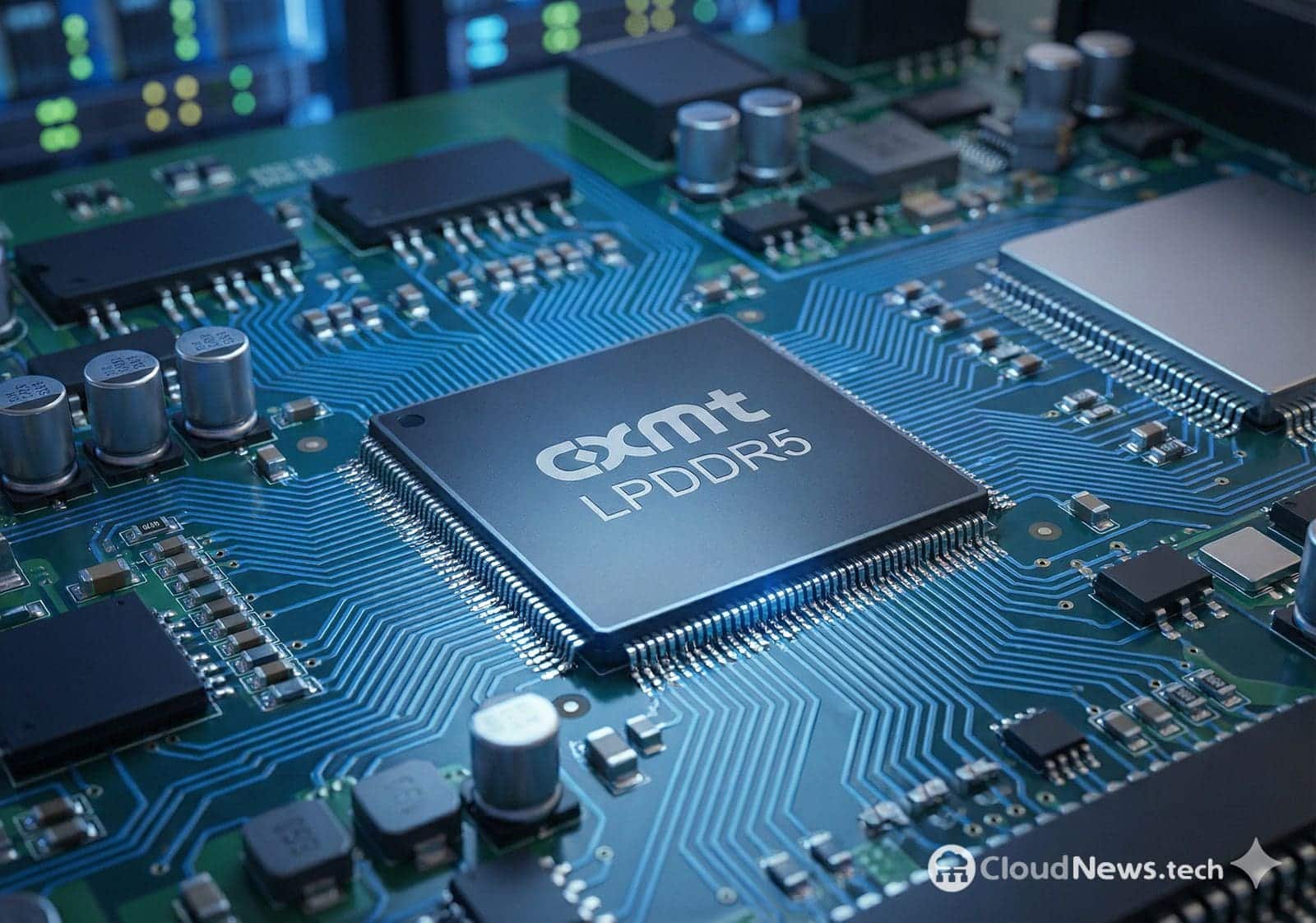
China is closing the gap in one of the most sensitive technologies in the AI supply chain: HBM memory. According to reports from South Korean media, ChangXin Memory Technologies, better known as CXMT, has reached technological capability to manufacture HBM3, a high-bandwidth memory generation that has already been key in accelerators like NVIDIA’s H100.
This news does not mean that China has caught up with Samsung or SK Hynix in the most advanced generations. South Korea remains ahead in HBM3E, HBM4, and the roadmap toward HBM4E. But it indicates a significant shift: the technological gap, which for years seemed hard to reduce due to sanctions and limited access to advanced lithography equipment, may have narrowed to about three years in the case of HBM.
The difference is noteworthy because high-bandwidth memory has become an essential component for AI systems. GPUs and accelerators need to feed their compute cores with enormous volumes of data. Without sufficient memory bandwidth, actual performance drops even if the chip has high theoretical power. That’s why NVIDIA, AMD, Google, Amazon, and other accelerator designers are competing to secure long-term HBM supply.
CXMT Enters the HBM3 Arena
The report attributed to Seoul Economic Daily indicates that CXMT has already achieved technological parity in HBM3, though with an important limitation: manufacturing yield remains an issue. In other words, the company may produce functional chips, but it still must demonstrate it can manufacture them at scale, with competitive costs and sufficient quality for demanding customers.
This nuance is key. In semiconductors, reaching a specification in the lab or limited production does not mean dominating the market. HBM memory requires advanced DRAM, vertical stacking, TSV interconnects, thermal management, complex packaging, and validation alongside the accelerator. Each step adds risk. One thing is manufacturing HBM3, and quite another is delivering millions of reliable stacks for data centers.
Still, CXMT’s progress is concerning to South Korea because it comes at a time of structural memory shortages for AI. SK Hynix dominates the HBM market, with a share close to 58% in early 2026, according to Counterpoint data cited by Reuters. Samsung and Micron share much of the rest, with around 21% each. This concentration has made HBM a strategic resource and a source of high margins for manufacturers able to produce it.
China aims to join this club for industrial and geopolitical reasons. US restrictions have limited its companies’ access to advanced NVIDIA accelerators and certain manufacturing tools. In response, Beijing is trying to strengthen its entire local supply chain: chip design, packaging, memory, servers, software, and data centers. CXMT plays a central role in this strategy because it is China’s largest DRAM manufacturer.
Production Capacity Will Be the Real Test
According to the reports, CXMT could reach a total capacity of 300,000 12-inch wafers per month by the end of 2026. Some estimates suggest that about 20%, or around 60,000 wafers monthly, could be allocated to HBM3. Earlier analyses placed initial HBM capacity at more modest levels, around 30,000 wafers per month, demonstrating ongoing uncertainty about the actual scaling pace.
The plan relies on a future IPO. CXMT has advanced preparations to list in Shanghai and could raise over $4 billion, a crucial injection to fund expansion, equipment, process development, and packaging capabilities. In a market where each new memory line requires billions in investment, access to public capital can accelerate entry into more advanced products.
| Actor | Current Position in HBM |
|---|---|
| SK Hynix | Market leader, key supplier to NVIDIA, strong in HBM3E/HBM4 |
| Samsung | Gaining ground with HBM4E samples and robust manufacturing capacity |
| Micron | Significant competitor in HBM3E and HBM4 roadmap |
| CXMT | Advancing toward HBM3, with uncertainties around yield, scale, and packaging |
| China | Aiming to reduce reliance on foreign memory for AI |
CXMT’s progress should not be viewed solely as an immediate commercial threat. It can also disrupt the entire supply chain negotiations. If China can produce enough HBM3 for its own accelerators and servers, it will reduce some dependence on South Korean and US suppliers. This won’t automatically give access to NVIDIA’s H100, B200, or Rubin capabilities, but it would strengthen its domestic AI ecosystem.
South Korea Still Several Steps Ahead
South Korea’s reaction should be measured. Narrowing the gap in HBM3 does not mean achieving parity. SK Hynix is already working on HBM4 and has demonstrated solutions like HBM4E with 48 GB in 12-layer stacks and bandwidth up to 4 TB/s. Samsung has also sent HBM4E samples to global clients. The next AI accelerators will not stay at HBM3 but will move toward HBM3E, HBM4, and HBM4E.
Generational differences matter greatly. HBM3 was crucial for the first wave of AI accelerators. HBM3E improved bandwidth and capacity for systems like NVIDIA H200, Blackwell, and other recent platforms. HBM4 changes the interface, doubles channels, and demands more advanced logic, often built on cutting-edge foundry nodes. HBM4E will add more speed and density.
CXMT still faces several hurdles: first, manufacturing performance; second, advanced packaging—where TSMC, Samsung, and others hold advantages; third, validation with high-level customers; fourth, access to export-controlled tools and materials; and fifth, energy efficiency, vital in data centers where every watt counts.
Therefore, two mistakes should be avoided. The first is dismissing CXMT as if China couldn’t compete. They are already doing so in conventional DRAM and are beginning to pressure in HBM. The second is exaggerating and portraying China as having already caught up with SK Hynix or Samsung in cutting-edge AI memory. The reality lies somewhere between: China is progressing rapidly, but the frontier is also moving.
Memory Becomes the New Geopolitical Front
The pressure on HBM reflects a broader shift in the AI economy. Throughout 2023 and 2024, the focus was almost entirely on NVIDIA’s GPUs. It then became clear that the bottleneck extended to HBM memory, substrates, packaging, power, cooling, and data center capacity. By 2026, memory is already a strategic variable on par with accelerators.
For the US, restricting China’s access to advanced chips is not sufficient if the country manages to rebuild critical parts of the supply chain independently. For South Korea, leadership in HBM is a historic opportunity but also a responsibility: it must invest, expand capacity, and safeguard its position against rivals with heavy state support. For China, CXMT offers a pathway to reduce vulnerability in a technology that will be essential for its AI models, supercomputing, and domestic cloud infrastructure.
The market could also be influenced by prices. If HBM shortages persist into 2030, as foreseen by SK Group’s president, leading manufacturers will maintain bargaining power. If CXMT scales production successfully, it could help satisfy some domestic demand and pressure prices in less advanced segments. Conversely, if yields are low or quality is insufficient, the impact will be more symbolic than commercial in the short term.
The most realistic conclusion is that China has not yet won the HBM race but has stopped being a mere outsider. CXMT’s advances in HBM3 show that a combination of domestic demand, public capital, geopolitical pressure, and industrial learning is reducing the gap. South Korea still leads, but it can no longer take for granted that its advantage will remain comfortable throughout the decade.
Frequently Asked Questions
What is HBM memory?
HBM, or High Bandwidth Memory, is vertically stacked DRAM that offers high bandwidth and low power per bit transferred. It is used in GPUs and AI accelerators.
What has CXMT achieved?
According to South Korean reports compiled by Wccftech, CXMT has reached technological capacity for manufacturing HBM3, though performance and scaling problems still exist.
Has China caught up with SK Hynix and Samsung?
Not yet. South Korea remains ahead in HBM3E, HBM4, and HBM4E. CXMT’s progress reduces the gap but doesn’t eliminate the lead of Korean giants.
Why does this matter for AI?
Because HBM is critical for powering AI accelerators. Without sufficient high-bandwidth memory, GPUs cannot leverage their full computational potential.
via: wccftech
