
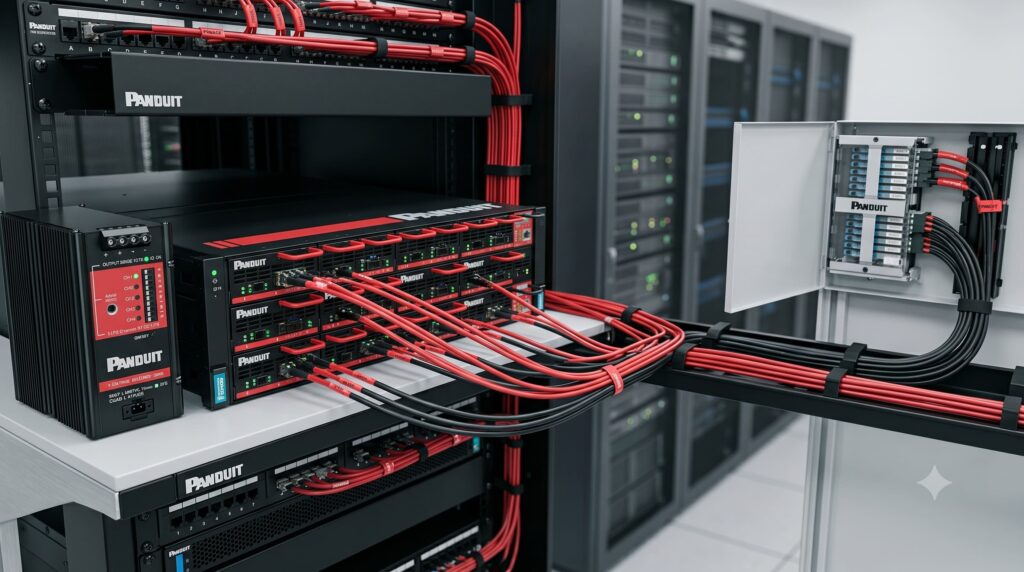
Panduit has introduced the second generation of its Fault Managed Power System, a centralized power platform designed to deliver safe energy over long distances within enterprise environments. The new FMPS Gen 2 portfolio enhances power density, expands receiver options, and reinforces an architecture aimed at reducing installation complexity in campuses, warehouses, corporate buildings, and large distributed facilities.
This announcement comes at a time when enterprise networks are evolving beyond switches, access points, and cabling. Security cameras, sensors, connected lighting, indoor wireless systems, small cells, edge devices, and building automation demand more power, greater coverage, and simpler management. Powering all these elements with traditional electrical schemes can increase costs, occupy space in intermediate cabinets, and multiply maintenance points.
Panduit’s approach relies on Class 4 electrical distribution, a category incorporated into the National Electrical Code in the United States for fault-managed power systems. Unlike conventional electrical systems, Class 4 is designed to carry more energy than PoE over longer distances, with detection and limitation mechanisms that reduce risks from outages, contacts, or faults. Panduit states that its FMPS is listed under UL 1400 and has a SIL 3 rating, reinforcing its suitability for deployments where operational safety is as important as capacity.
More power without filling buildings with distributed UPS units
One of the most significant innovations in FMPS Gen 2 is its focus on consolidated power and backup. In many corporate networks, distributed IDF cabinets include their own UPS systems to keep switches, cameras, access points, or critical systems operational during power outages. This model works but adds batteries throughout the building, increasing maintenance, space occupation, heat, and points of failure.
Panduit offers a different architecture: centralize power and consolidate UPS backup at the system’s headend. This way, energy is distributed from a controlled point to remote locations via low-voltage infrastructure with fault management. The operational advantage lies in simplifying maintenance, reducing dispersed equipment, and enabling easier future expansions without invasive modifications to active installations.
The new portfolio includes a 2 kW system comprising a 1,000 W transmitter, a 2,000 W power supply, and a 2,000 W receiver. It also includes a single-channel 600 W receiver intended for edge applications such as security, surveillance, or lighting. This combination allows energy delivery to be tailored to different scenarios without deploying an oversized solution for all points.
Mahmoud Ibrahim, senior business development manager at Panduit Ventures, noted that FMPS Gen 2 aims to make enterprise power “safer, simpler, and more efficient.” The company particularly emphasizes the ability to place power where needed, eliminate complexity in IDFs, and support new demands of modern networks without introducing new risks.
Class 4 as a bridge between PoE and traditional electrical distribution
Ethernet power delivery has been a major solution to simplify network deployments in recent years. PoE and PoE++ enable powering access points, IP cameras, phones, sensors, or small devices without separate electrical wiring. However, their limits become apparent when higher wattage, longer distances, or loads that don’t fit the traditional Ethernet model are required.
That’s where Class 4 distribution comes in. It doesn’t directly compete with PoE but can act as an upper-energy transport layer to power remote equipment, PoE++ receivers, or DC loads. FMPS Gen 2 supports both high-power DC loads and PoE++ loads, making it suitable for hybrid networks where IT infrastructure, physical security, lighting, and smart building applications coexist.
Panduit also highlights that the system uses less copper than conventional electrical distribution. This can be significant in large projects, where material costs, ease of installation, and sustainability influence infrastructure design. Less copper doesn’t always mean lower total costs, but it can reduce weight, space, and complexity in certain deployments.
Another key benefit is backward compatibility with existing FMPS installations. Panduit states that Gen 2 enables expansion or upgrades without the need for complete replacement projects. This detail can be decisive for large organizations, where infrastructure decisions are made with long lifecycle considerations and investment protection in mind.
A solution for denser networks and increasingly connected buildings
The second generation of FMPS reflects a broader market trend: energy is becoming a core component of enterprise network design. Previously, it was enough to deliver data to each point. Now, both data and power are needed for sensors, cameras, Wi-Fi access points, indoor 5G systems, smart lighting, displays, access controls, and edge equipment that must operate continuously.
This especially affects corporate campuses, hospitals, universities, logistics centers, factories, airports, large offices, and smart buildings. In these environments, combining structured cabling, centralized power, monitoring, and low voltage can accelerate deployments and reduce downtime. It also provides operational visibility, as FMPS Gen 2 incorporates monitoring and management capabilities for diagnostics, troubleshooting, and future scalability.
Tom Kelly, Panduit’s CTO, describes FMPS as a comprehensive platform integrating power, cabling, and physical infrastructure into a coordinated solution. According to the company, the new system was developed based on the experience of the first-generation Class 4 UL-listed products and responds to market evolution as well as customer and partner requests.
Adoption of Class 4 is still expanding. It won’t replace all existing electrical schemes or eliminate PoE, but it offers an appealing option where more power, longer reach, enhanced safety, and operational continuity are needed. For infrastructure channels, installers, integrators, and network managers, the key is identifying which cases justify this shift over conventional methods.
FMPS Gen 2 is not a flashy end-user product but targets a very real aspect of digital transformation: how to power securely and efficiently the thousands of devices now populating buildings, campuses, and industrial environments. As networks become denser and more distributed, electrical management shifts from a secondary concern to a central element of technological planning.
Frequently Asked Questions
What is Panduit FMPS Gen 2?
It is Panduit’s second-generation Fault Managed Power System, a Class 4 power platform designed to safely and centrally distribute energy over long distances in enterprise environments.
What does it offer compared to traditional electrical installations?
It enables centralized power, reduces the number of distributed UPS units in IDF cabinets, simplifies maintenance, uses low-voltage methods, and delivers power to remote locations with fault management.
What applications is it intended for?
It targets enterprise switches, high-power PoE++, security and video surveillance, Wi-Fi, indoor cellular systems, lighting, smart buildings, and DC loads at the edge.
What does it mean that it is Class 4?
Class 4 indicates fault-managed power systems capable of carrying more energy than traditional low-power solutions, with safety mechanisms that limit risks during electrical incidents.
vía: panduit. AI-generated simulated image.
