
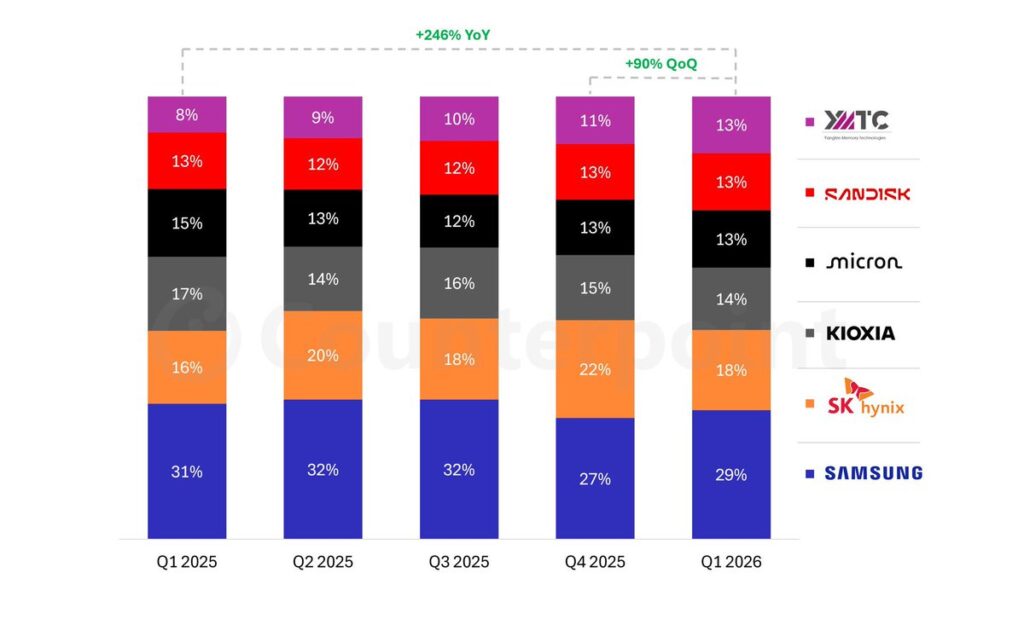
The global NAND memory market has entered a phase that just two years ago would have seemed hard to imagine. According to data attributed to the latest Counterpoint Research tracker, worldwide sector revenues reached $46 billion in the first quarter of 2026, with an almost 246% year-over-year growth and a 90% increase compared to the previous quarter. The main driver is not smartphones or personal computers, but storage demand for artificial intelligence data centers.
This data changes the market outlook. For years, NAND was closely tied to consumer cycles: smartphones, laptops, client SSDs, and electronic devices. Now, the focus shifts toward high-capacity enterprise SSDs essential for AI servers, inference systems, data storage, caches, training, context recovery, and new architectures where flash memory accompanies GPUs, DPUs, and high-speed networks.
Another major news point is geopolitical. YMTC, the Chinese NAND manufacturer, has reached a 13% revenue share, comparable to Micron and SanDisk. In just one year, its share grew from 8% to 13%, with an annual growth rate exceeding 240%, according to the tracker. China is no longer a marginal player or a long-term industrial promise in NAND; it is beginning to compete in the mid-to-high end of the global market.
Samsung leads, but the chasing group is narrowing
Samsung maintains the top spot with a 29% share in Q1 2026. Next is SK Hynix, with 18%, while Kioxia drops to 14%. Beyond that, the race tightens: Micron, SanDisk, and YMTC are tied around 13%, according to the graph from Counterpoint shared alongside the analysis.
This snapshot is important because it shows a less comfortable market for traditional players. Samsung remains the leader but is losing ground compared to previous quarters. SK Hynix remains strong, partly due to its exposure to AI infrastructure and high-margin products. Kioxia, Micron, and SanDisk compete in a very narrow band, while YMTC continues to grow supported by domestic Chinese demand, capacity expansion, and rising prices.
| Manufacturer | Q1 2026 Share |
|---|---|
| Samsung | 29% |
| SK Hynix | 18% |
| Kioxia | 14% |
| Micron | 13% |
| SanDisk | 13% |
| YMTC | 13% |
Comparing to Q1 2025 helps explain the change. Back then, YMTC had an 8% market share, versus Samsung’s 31%, SK Hynix’s 16%, Kioxia’s 17%, Micron’s 15%, and SanDisk’s 13%. A year later, the Chinese manufacturer is in the same range as two long-standing names in Western memory companies.
YMTC’s rise does not mean it has technologically surpassed all competitors or controls the industry’s most profitable segment. But it demonstrates that China is gaining scale in a critical technology despite U.S. restrictions and the difficulty accessing advanced manufacturing tools.
AI is absorbing the most profitable production
The real growth engine is in enterprise SSDs. According to shared analysis, server-oriented eSSDs represented 43% of the NAND market in early 2026 and could surpass 60% before year’s end. This evolution aligns with other industry reports pointing to a sharp increase in NAND prices driven by data center demand and capacity reallocation toward higher-margin products.
TrendForce had already forecasted strong contract price increases in memory during 2026, with NAND growing faster than DRAM in certain cycle phases. The reason is straightforward: providers are prioritizing enterprise SSDs and large cloud customer contracts, while consumer segments get less allocation or face higher prices.
AI requires storage in various forms. Models and datasets occupy vast data volumes, but SSDs are increasingly used to feed training pipelines, accelerate information retrieval, serve inference, store logs, maintain context caches, and support architectures where storage is closer to computing. In new-generation platforms, components like DPUs can even incorporate SSDs to manage context memory or data streams associated with inference.
This creates an uncomfortable consequence for consumer markets. If manufacturers allocate more capacity to enterprise SSDs, PCs, consoles, mobile devices, consumer cards, and SSDs may face relative shortages or price hikes. Not because consumer demand is particularly strong, but because factories now produce memory segments that command higher prices.
YMTC enters a decisive phase
YMTC’s progress has both industrial and financial implications. Reuters reported in May that the Chinese manufacturer had begun pre-IPO mentorship, with CITIC Securities as advisor, as part of the usual process to prepare a domestic listing. An IPO would give YMTC access to capital at a time when expanding capacity, improving yields, and reducing dependency on foreign tools require large investments.
The company already operates two factories with a combined capacity of around 200,000 wafers per month and is working on a third plant in Wuhan, according to Reuters. It has also been noted that this new phase relies more heavily on domestic equipment—a priority for Beijing since YMTC was added to the U.S. Entity List in 2022.
YMTC’s growth should not only be seen as a market story. It is part of China’s strategy to reduce reliance on South Korean, Japanese, and U.S. memory suppliers. In DRAM, CXMT follows a similar route; in NAND, YMTC is the central actor. If both succeed in attracting capital and scaling production, the global memory market will become more competitive—and more political.
For Western buyers, China’s expansion can have mixed effects. Additional capacity might ease supply tensions in the medium term, but trade restrictions, export controls, and security concerns hinder full integration of YMTC into certain products or international contracts. In China, however, its growth fosters a more complete domestic supply chain for smartphones, servers, consumer electronics, automotive, and AI infrastructure.
A less predictable memory market
The revenue surge in NAND confirms that memory has become one of the core elements of the AI economy. During the initial boom phase, the focus was almost entirely on GPUs. Then came HBM, with SK Hynix, Samsung, and Micron competing to support NVIDIA and other accelerators. Now, NAND is fully entering the conversation.
The challenge is to distinguish between revenue growth and healthy capacity growth. Part of the current leap results from much higher prices, not just increased bits sold. If prices rise due to scarcity, manufacturers gain margins short-term, but customers might delay purchases, reduce capacities in consumer products, or seek architectural alternatives.
There is also a risk of overinvestment if all producers expand capacity simultaneously expecting relentless AI demand. The memory industry has a long history of volatile cycles: excess supply, sharp price drops, investment cuts, and subsequent recovery. AI might prolong the upward cycle but does not eliminate the sector’s cyclical nature.
The key difference now is that memory is no longer a secondary component. In AI data centers, flash storage, DRAM, HBM, and networks are integral to overall system performance. Whoever controls sufficient memory, efficiently and with stable supply, will have more bargaining power with server manufacturers, hyperscalers, and infrastructure providers.
YMTC’s rise adds another layer to this transformation. China no longer merely wants to buy memory; it aims to produce, finance, and turn it into a pillar of its technological independence. Samsung remains the leader, SK Hynix stays strong, and traditional manufacturers hold significant advantages. But the NAND map in 2026 sends a clear message: AI has dramatically increased the value of storage, and China is much closer to the center of the market.
FAQs
What is NAND memory?
NAND is a type of non-volatile flash memory used in SSDs, mobile devices, memory cards, servers, and storage systems. It retains data even when the device is powered off.
Why is the NAND market booming in 2026?
Because of strong demand for enterprise SSDs for AI data centers, combined with rising prices and production shifts toward cloud and server clients.
What is YMTC’s market share in NAND?
According to Counterpoint data, YMTC reached 13% of the global NAND revenue market in Q1 2026, comparable to Micron and SanDisk.
Could this affect consumer SSD prices?
Yes. If manufacturers prioritize higher-margin enterprise SSDs, SSDs for PCs, consoles, or mobile devices may face lower supply or higher prices, even if consumer demand remains unchanged.
