
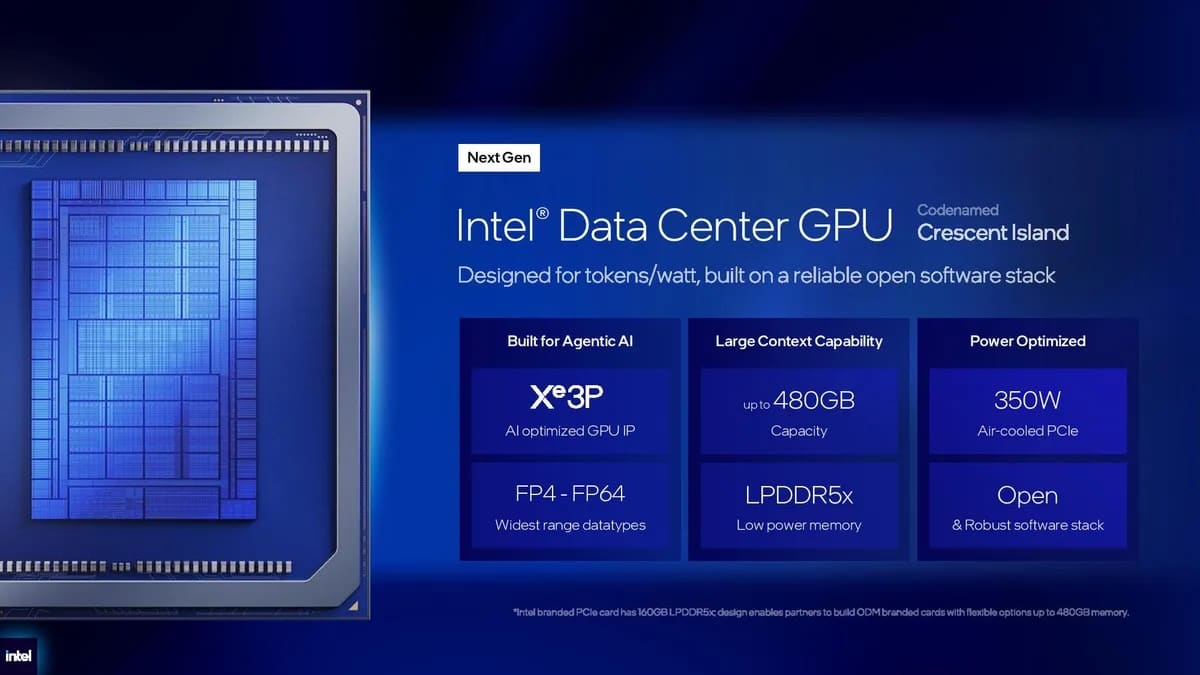
Intel has provided more details about Crescent Island, its upcoming data center GPU aimed at AI inference, and the most striking figure isn’t in teraflops or manufacturing nodes, but in memory: up to 480 GB of LPDDR5X on an air-cooled PCIe card with a power consumption of 350 W.
The proposal is notable because it diverges from the dominant path in high-end AI accelerators. While NVIDIA and AMD push systems with increasingly faster, expensive, and scarce HBM memory, Intel takes a different market approach: in many inference workloads, especially with large models and agents that require extensive context, memory capacity and power efficiency can outweigh high bandwidth.
A GPU Designed for Inference, Not to Win the Training War
Crescent Island shouldn’t be viewed as a direct competitor to the most powerful massive model training accelerators. Intel presents it as a data center GPU for inference workloads and agent-based systems, where the goal is to serve models, handle many tokens, maintain broad context, and do so with a reasonable balance of cost, power, and capacity.
The chosen architecture is Xe 3P, an evolution of Intel’s graphics approach adapted for modern AI workloads. The company guarantees Crescent Island will support a broad range of data formats, from FP4 and MXFP4 to FP64, enabling it to cover everything from highly optimized inference to more demanding compute and research tasks.
The figure of 480 GB of LPDDR5X highlights the product’s focus. Initially, Intel’s official info mentioned 160 GB, but at Computex 2026, the company expanded this to a maximum capacity of 480 GB. In a server with eight cards configured at maximum, that would mean 3.8 TB of local GPU memory—an attractive figure for running large models or multiple agents within the same chassis.
| Feature | Intel Crescent Island |
|---|---|
| Segment | AI Data Center GPU |
| Main Focus | Inference and agent workloads |
| Architecture | Xe 3P |
| Memory | Up to 480 GB LPDDR5X |
| Format | PCIe card |
| Cooling | Air |
| Power Consumption | 350 W (announced) |
| Supported Formats | From FP4/MXFP4 to FP64 |
| Objective | Capacity, efficiency, and total cost |
Why LPDDR5X Could Make Sense for AI
Choosing LPDDR5X is a strategic move. This memory type is typically used in laptops, mobile devices, and compact systems—not in high-performance AI accelerators. It offers less bandwidth than HBM but can provide higher capacity at lower cost and power consumption in certain designs.
Intel seems to accept this trade-off. For training huge models, HBM remains the natural choice due to its enormous bandwidth and proximity to the chip. But for inference workloads, many tasks require large models to reside in memory, maintain wide context windows, and respond to many requests efficiently. In such scenarios, running out of memory can be a bigger problem than having maximum bandwidth.
The HBM scarcity also explains this approach. The demand from NVIDIA, AMD, hyperscalers, and AI system manufacturers is stretching the entire advanced memory supply chain. SK Hynix, Samsung, and Micron have limited capacity for latest-generation HBM, with much of their production already committed to high-volume clients. Using LPDDR5X allows Intel to design a more manufacturable accelerator that could be more accessible to companies that can’t afford high-end systems or don’t need to train models from scratch.
This could be especially relevant for inference providers, on-premise deployments, medium-sized data centers, and organizations looking to run custom models without the high costs of the most advanced racks on the market. A 350 W PCIe card, air-cooled, fits better in traditional 4U or 5U servers than many liquid-cooled, dense, and much more expensive AI platforms.
Memory Is Now As Important as the Chip
Crescent Island arrives at a time when the industry understands that AI doesn’t scale solely by adding more compute. Large models require memory, bandwidth, fast networks, storage, capable CPUs to orchestrate workloads, and software that distributes the work effectively. If any part of the system fails, real performance drops—even if the chip on paper seems powerful.
Intel is framing its message around this system perspective. Alongside Crescent Island, they’ve announced Xeon 6+ with up to 288 efficient cores built on Intel 18A, and new Ethernet solutions like E835 offering up to 200 GbE. The message is clear: in agent AI, CPUs regain importance as control planes, networks reduce bottlenecks, and GPUs must deliver inference efficiently with ample memory capacity.
This also contextualizes Crescent Island within Intel’s overall portfolio. The company isn’t leading the AI accelerator market—dominated by NVIDIA and pressured by AMD. Gaudi offered a compelling cost and efficiency alternative but didn’t significantly displace the CUDA ecosystem. Crescent Island aims to enter through another angle: not just raw power, but a combination of large memory, simpler format, moderate power consumption, and an open software stack.
Intel states that its AI stack will be programmable, open, and designed to lower deployment barriers. Also, it points out that the Arc Pro family can serve as a development platform for validating workloads before scaling to Crescent Island. Compatibility like this will be key—as in AI, hardware without mature software makes little progress, regardless of impressive specs.
An Alternative for Companies Unable to Buy NVIDIA’s “Top”
The main challenge for Intel isn’t convincing the market that more memory is needed—that’s already clear. The real challenge will be demonstrating Crescent Island can run real models with good performance, integrate with common frameworks, provide production stability, and be competitive against NVIDIA, AMD, and other specialized accelerators.
NVIDIA’s advantage still lies in CUDA, libraries, tools, optimization, cloud provider integrations, and a vast developer community. AMD is progressing with Instinct and ROCm, especially for large clients seeking diversification. Intel needs to regain credibility in AI acceleration after years of strategy shifts, cancellations, and products that didn’t reach mass adoption.
Crescent Island can find its niche if the market more clearly splits between extreme training and efficient inference. Not all companies need to train giant models; many need to run pre-trained models, adapt workloads, host agents, serve internal users, and control costs. For these, a GPU with high memory, PCIe interface, air cooling, and 350 W could be very attractive.
There’s also an angle of sovereignty and local deployment. Many organizations prefer not to rely solely on external APIs or public cloud for sensitive workloads. Running models on their own servers requires hardware with sufficient memory and manageable power consumption. If Crescent Island can offer competitive prices, availability, and support, it could be a good fit for enterprise on-premise AI without requiring a supercomputer.
The key unanswered question is performance. Intel hasn’t released comprehensive metrics, comparisons, or detailed commercial availability beyond its roadmap. While the memory capacity is impressive, the market will soon expect details on tokens/second, real efficiency, latency, model support, framework compatibility, and cost per inference.
Crescent Island probably isn’t designed to dethrone NVIDIA at the top tier. Its more pragmatic goal might be to provide a different entry point into AI inference: large memory and lower reliance on HBM. In a market where memory has become the most contested resource, this approach could make more sense than it seemed a few years ago.
Frequently Asked Questions
What is Intel Crescent Island?
Crescent Island is an Intel data center GPU aimed at AI inference and agent workloads, based on Xe 3P architecture.
Why use LPDDR5X instead of HBM?
LPDDR5X offers lower bandwidth than HBM but can provide much greater capacity, lower power, and lower cost. Intel is leveraging this for inference workloads where available memory is critical.
How much memory can Crescent Island have?
Intel announced Crescent Island can reach up to 480 GB of LPDDR5X, up from the initial 160 GB.
Will it directly compete with NVIDIA’s most powerful GPUs?
It doesn’t seem designed for massive training; its focus is on inference, efficiency, memory capacity, and enterprise deployments cooled by air.
