
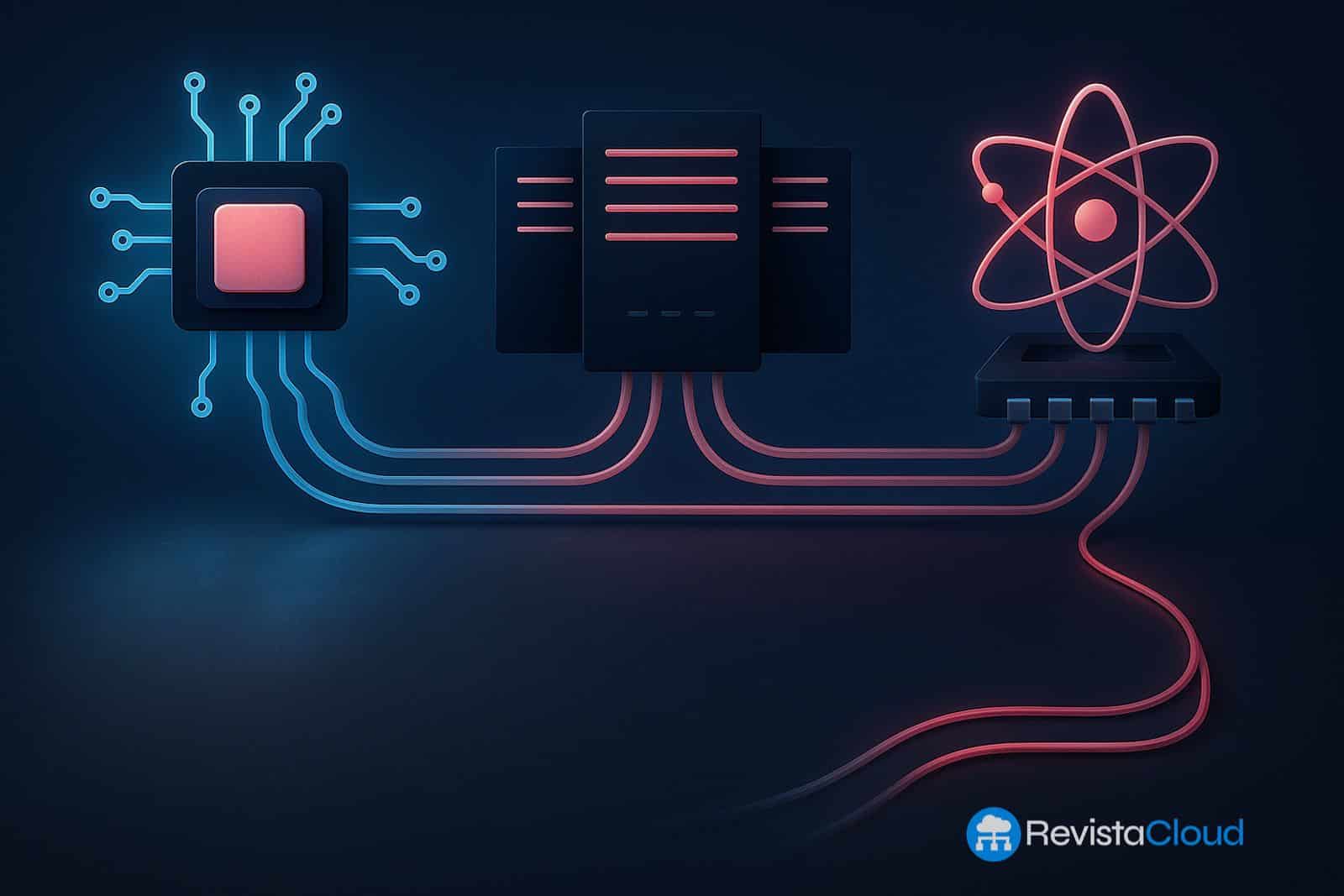
The race for artificial intelligence is pushing data center infrastructure to the limit. Models are growing, clusters are getting larger, and the movement of data between GPUs, memory, switches, and servers is starting to weigh as much as the computations themselves. In this bottleneck, photonics—the use of light to transmit or even process information—has shifted from a niche technical bet to one of the most closely watched areas by investors and manufacturers.
In China, one of the names best representing this change is Mi Lei, founder of CAS Star, a venture capital firm born from the Chinese Academy of Sciences environment. According to the South China Morning Post, Mi has been advocating for investments in photonics for over a decade, even when the market was not paying much attention to this technology. Today, with AI stressing internal data center networks, that thesis is beginning to receive much more visible validation.
Light Enters the Critical Path of AI
For years, the AI debate has focused on GPUs, HBM memory, electrical capacity, and large models. All of these remain important, but there is a less visible layer that has become equally sensitive: interconnection. In an AI infrastructure, data is not only computed; it’s constantly moved. If this traffic becomes slow, expensive, or too energy-intensive, overall performance drops.
This is where photonics comes into play. Optical connections allow for data transfer with higher bandwidth and better efficiency compared to many traditional electrical links, especially as distances and density increase. It’s not a magic solution nor a complete substitute for copper wiring, but it’s becoming a natural way to scale the so-called “AI factories.”
This interest is no longer theoretical. NVIDIA announced in March strategic investments of $2 billion in Lumentum and another $2 billion in Coherent to strengthen optical technologies for future AI data centers. Marvell acquired Celestial AI, a company specializing in optical connectivity for cloud and AI architectures, in an initial deal valued at around $3.25 billion. Nokia completed its acquisition of Infinera in 2025 to gain scale in optical networks and respond to the growing data traffic in data centers.
These moves explain why photonics has appreciated so rapidly. It’s not just long-range communication. The next battleground is inside the data center itself: between racks, between servers, and even within the chip package, with technologies like co-packaged optics and optical links increasingly close to the computing itself.
| Recent Movement | Approximate Investment | Implication for AI |
|---|---|---|
| NVIDIA invests in Lumentum | $2 billion | Increased optical capacity for AI data centers |
| NVIDIA invests in Coherent | $2 billion | Enhanced lasers and advanced optics |
| Marvell acquires Celestial AI | $3.25 billion initial deal | Integrated optical connectivity for cloud architectures |
| Nokia acquires Infinera | $2.3 billion | Scale in optical networks to handle data center traffic |
| CAS Star bets on photonics | Over 200 sector investments | Long-term Chinese thesis in hard tech |
CAS Star and the Patience of Tech Capital
CAS Star isn’t a trendy fund born in the hype of generative AI. Its origins are linked to transferring scientific research into tech companies—a space where returns often take longer and technical risk is higher. Mi Lei, a doctorate in optics from the Xi’an Institute of Optics and Mechanics, has built part of his investment thesis around this idea: advancing deep technologies from labs to commercial applications.
According to SCMP, more than 200 out of around 600 companies in CAS Star’s portfolio operate within the broad photonics realm, including sensors, communications, computing, storage, and displays. This breadth matters because photonics isn’t just one technology. It appears in optical modules for data centers, LiDAR sensors, photonic chips, displays, storage devices, and scientific instruments.
The current moment favors this type of long-term betting. AI is forcing a rethink of infrastructure from the ground up: chips, advanced packaging, memory, cooling, energy, networking, and orchestration software. In this redesign, technologies once seen as too specialized can become central pieces.
China also has an additional incentive. The U.S. restrictions on advanced chips have pushed the country to strengthen its local supply chain in semiconductors, equipment, materials, photonics, robotics, and AI. Investment in photonics fits within this strategy: reducing dependence on imported GPUs, and building complementary technologies that lessen bottlenecks and foster industrial autonomy.
From Fiber to Chip: The Next Leap
Photonics is now commonplace in telecommunications. Its next step is advancing into layers ever closer to computing. Initially, optical links connected data centers and long-distance networks. Later, high-speed optical connections within data centers appeared. The upcoming phase aims to integrate optics into switches, accelerators, chip packages, and architectures where moving data electrically becomes too energy-expensive.
The promise is compelling: higher bandwidth, lower power per bit, and fewer physical limitations when expanding large clusters. But significant challenges remain. Integrating photonics with silicon, manufacturing at scale, reducing costs, improving packaging, heat management, ensuring reliability, and establishing industrial standards are complex tasks.
This explains why major companies’ investments are so crucial. When NVIDIA, Marvell, or Nokia spend billions on optics and photonics, they’re not chasing a fad; they’re securing critical components for the infrastructure of the next decade. Hyper-scalers need networks capable of training and serving ever-larger models without the interconnection becoming the main bottleneck.
For funds like CAS Star, this shift validates a way of investing that’s less dependent on the short cycle of software. Photonics demands science, manufacturing, patents, specialized talent, and patience. It doesn’t scale like a mobile app, but when the market finds the right use case, the advantage can be profound.
Why It Matters for Europe
Technological sovereignty isn’t built solely through regulation or strategic declarations. It’s developed by investing in hard technologies before they become obvious, connecting science with industry, and accepting that some bets take years to mature.
Europe boasts strong research centers, relevant companies in photonics, equipment, telecommunications, and semiconductors, but often struggles to turn scientific potential into global industrial champions. China, despite its issues and tensions, demonstrates a simple idea: patient capital in deep technologies can become an advantage when the right bottleneck appears.
AI has popularized photonics, but the broader picture is more expansive. As computing nears its electrical, thermal, and economic limits, light is gaining space as a tool to continue scaling. It won’t replace everything overnight, but it can redefine how systems connect and operate—powers behind the next generation of AI.
CAS Star invested in this direction before it was apparent to the market. Now, with data centers demanding more speed, lower energy consumption, and denser architectures, that early bet is looking less visionary and more essential.
Frequently Asked Questions
What is photonics applied to AI?
It’s the use of light-based technologies to transmit, connect, or process information in artificial intelligence systems, especially in high-performance data centers.
Why does AI need more optical connections?
Because large AI clusters move enormous amounts of data between GPUs, memory, servers, and switches. Optical links can provide higher bandwidth and better energy efficiency.
What is CAS Star?
CAS Star is a Chinese venture capital firm linked to the Chinese Academy of Sciences, focused on hard tech investments with a strong exposure to photonics.
Will photonics replace current chips?
Not immediately. It’s most likely to complement electronics, especially in interconnects, data center networks, advanced packaging, and, in the longer term, photonic computing.
via: scmp
