
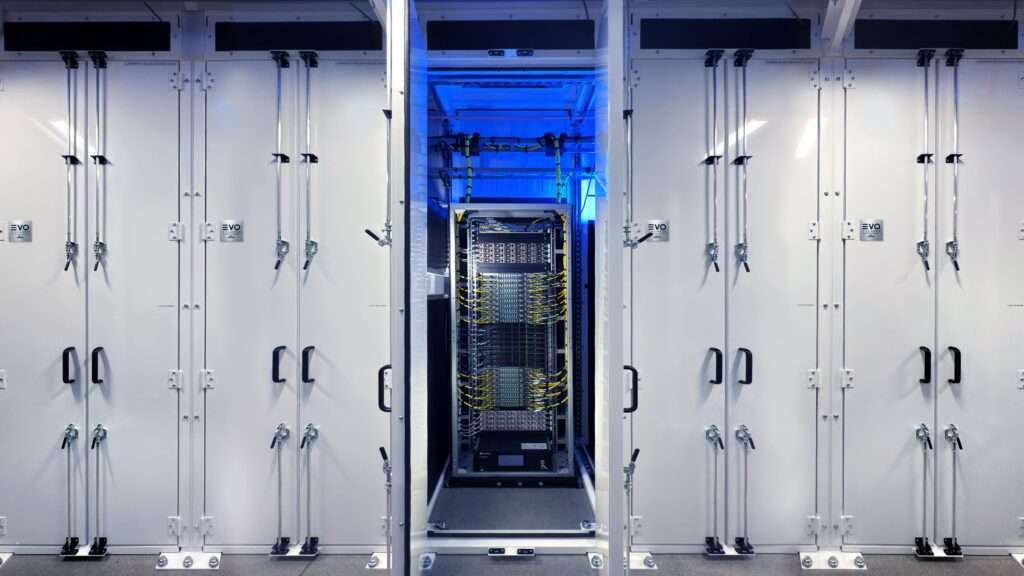
Dell Technologies has expanded Dell AI Factory with NVIDIA by introducing new PowerEdge servers based on NVIDIA Vera CPUs, a key component targeting the next phase of enterprise AI: agents. The company will add the PowerEdge R9822 and PowerEdge M9822 models to its global catalog in September, aiming to provide businesses with a validated pathway to deploy AI agent-based workloads, analytics, HPC, and general-purpose infrastructure within standard data centers or high-density environments.
This announcement comes at a time when AI is shifting from chatbots to systems capable of reasoning, planning, tool use, data querying, workflow execution, and multi-step coordination. This shift has direct implications for infrastructure. It’s no longer enough to just add GPUs for response generation. Agents require powerful CPUs, memory, networking, storage, prepared data, security, governance, and architectures capable of maintaining many processes simultaneously.
Vera Arrives in PowerEdge in Two Distinct Formats
Dell has introduced two complementary approaches. The PowerEdge R9822 is an air-cooled, rack-optimized 3U server designed for traditional data centers. Its use cases include AI agent sandboxes, analytics, general-purpose CPU infrastructure, and enterprise workloads that need sustained performance without necessarily requiring liquid cooling.
The PowerEdge M9822 takes a different route: 100% liquid direct cooling. It targets denser deployments, AI agent workloads, and high-performance HPC environments where rack efficiency and power consumption are critical. This difference reflects a market reality: not all companies can or want to redesign their data centers for liquid cooling, but increasingly demanding workloads are starting to require it.
NVIDIA’s Vera CPU is designed for the agent era. NVIDIA positions it as the component responsible for executing data pipelines, analytics, isolated tools, and code loads where each step depends on the previous one. In these workflows, CPU importance re-emerges, complementing GPU acceleration.
An agent does more than produce text. It can read documents, query databases, invoke APIs, run code, review results, correct them, trigger other tools, and deliver a final response. Each operation involves coordination, latency, memory, data input/output. GPUs accelerate models, but CPUs handle much of the surrounding workload.
| Product | Cooling | Main Focus | Availability |
|---|---|---|---|
| Dell PowerEdge R9822 | Air | AI agent, analytics, and CPU infrastructure in standard data centers | September 2026 |
| Dell PowerEdge M9822 | Liquid direct | High-density AI agent workloads and HPC | September 2026 |
| Dell Data Analytics Engine with Vera | N/A | Analytics for RAG, real-time decision making, and agents | Q1 2027 |
| Dell AI Factory with NVIDIA | Validated platform | Infrastructure, data, software, networking, and the ecosystem for enterprise AI | Expanding portfolio |
Enterprise AI Agents Are Reshaping Data Center Architecture
Dell summarizes the evolution with a clear statement: AI has shifted from content generation to performing work. This transition demands an infrastructure perspective as an AI factory, not just a collection of isolated servers. Companies moving from pilot projects to production need to validate models, connect data, manage security, control costs, deploy agents, and operate everything with enterprise-grade support.
Dell AI Factory with NVIDIA aims to support this journey. It includes AI servers and racks, deskside workstations for local agents, NVIDIA Spectrum-X Ethernet and Quantum-X800 InfiniBand networking, data platforms, storage, NVIDIA AI Enterprise software, Nemotron models, NemoClaw blueprints, OpenShell runtime, and physical AI technologies like NVIDIA Omniverse and Isaac.
Adding Vera enhances the general compute and control aspect. In recent years, AI’s focus on GPUs stemmed from their role as the bottleneck. But as agents integrate with enterprise data, tools, APIs, and runtime environments, the need for stronger, better-integrated CPUs reasserts itself within the accelerated stack.
Data querying capabilities are also a focus. Dell states it will add support for NVIDIA Vera CPUs to Dell Data Analytics Engine powered by Starburst, delivering up to three times higher query throughput for data workloads fueling AI agents, RAG, real-time decision-making, and modern analytics. This is crucial because many companies discover that their challenge isn’t just running models, but rapidly preparing and querying data.
AI agents heavily depend on information retrieval. A response about contracts, inventory, support tickets, incidents, code, or internal documentation must query reliable data sources in real time. If this layer is slow, the entire agent response becomes sluggish.
From Deskside to Rack: Dell and NVIDIA’s Complete Strategy
The announcement isn’t limited to data center servers. Dell highlights its deskside solutions for AI agents, supported by high-performance workstations and NVIDIA NemoClaw. The goal is enabling companies to build and run autonomous agents locally, with data that remains on the device.
This approach suits prototypes, secure development, validation of agents, or sensitive workloads that shouldn’t move to the cloud. From there, customers can scale to PowerEdge servers, Dell PowerRack racks, and denser platforms based on NVIDIA Vera Rubin, HGX Rubin NVL8, or RTX PRO Servers.
This continuity is precisely what Dell aims to sell: a pathway from experimentation to production. Many companies have explored AI through APIs or pilots but face challenges in moving those applications into governed environments with internal data, security, monitoring, controlled costs, and compliance. Dell seeks to streamline this with validated infrastructure packages.
The Dell AI Ecosystem Program completes this strategy by providing software vendors a way to validate their solutions on Dell AI Factory with NVIDIA. In a market saturated with AI tools, such validation can be valuable for enterprise clients seeking to avoid fragile integrations and mitigate technical risks.
CPUs Regain Importance in the Agent Era
Initial generative AI was often seen as a GPU race. Now, AI agents resemble more a system race. They require accelerators, yes, but also CPUs, networking, storage, data, and well-orchestrated software. Vera arrives in PowerEdge precisely to serve this new landscape.
NVIDIA’s CEO Jensen Huang has described AI agents as the company’s new operating system, with Vera as a CPU built for this era. While ambitious, this view highlights where the market is heading: agents won’t be confined to chat applications but embedded into business processes, data platforms, development environments, customer service systems, industrial operations, and decision workflows.
For Dell, integrating Vera into PowerEdge reinforces its role as an enterprise infrastructure integrator for AI. The company isn’t just competing to sell GPU servers but aims to deliver a complete architecture that enables deploying controlled, secure, enterprise-grade agents worldwide. This aligns with NVIDIA’s ongoing efforts to transform data centers into AI factories.
The key challenge remains: turning this platform promise into real deployments. Companies will need clarity on costs, workload compatibility, performance, data center integration, liquid cooling considerations, validated software, and lifecycle management. The September rollout will be just the beginning.
This development signifies a major shift: AI infrastructure is moving beyond just model training clusters towards an operational layer for autonomous workloads. Dell and NVIDIA intend PowerEdge with Vera to be a foundational element on which businesses build their next-generation AI factories.
Frequently Asked Questions
What did Dell announce at Computex 2026?
Dell announced the addition of PowerEdge servers with NVIDIA Vera CPUs to Dell AI Factory with NVIDIA, specifically models R9822 and M9822.
What’s the difference between the PowerEdge R9822 and M9822?
The R9822 is a 3U air-cooled server for standard data centers. The M9822 uses liquid direct cooling and targets denser AI agent and HPC workloads.
Why is Vera important for AI agents?
Because agents need to coordinate data, tools, code, analytics, and sequential workflows, tasks where CPUs play a crucial role alongside GPUs.
When will these servers be available?
Dell has announced global availability of the PowerEdge R9822 and M9822 for September 2026.
via: dell
