
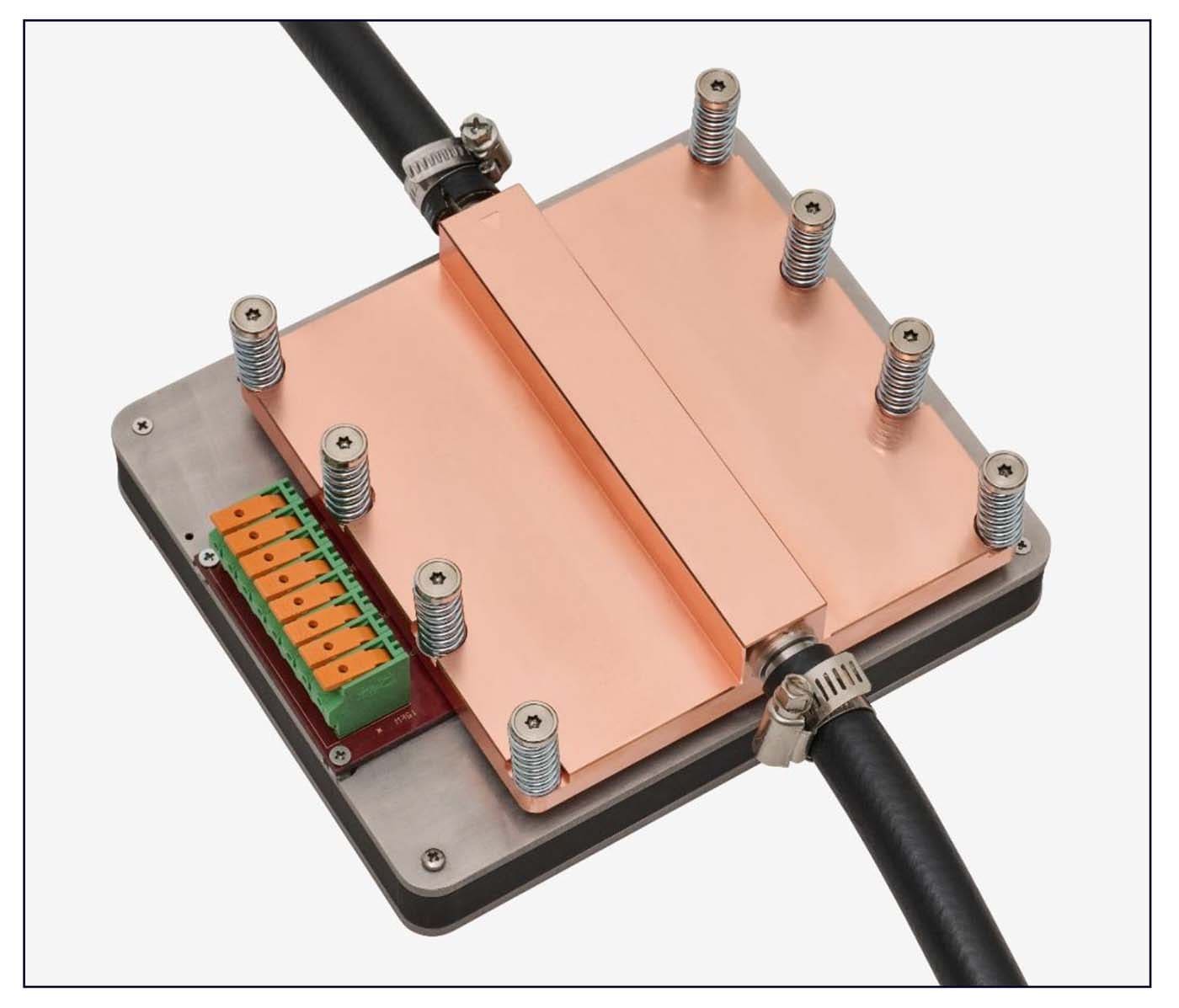
CoolIT Systems has announced a new coldplate capable of dissipating up to 15 kW of heat in a single chip package, a figure that signals the direction of future AI infrastructure: denser racks, more demanding accelerators, and data centers forced to redesign their cooling from the ground up.
The Canadian company, specialized in direct liquid cooling for high-performance servers, asserts that this breakthrough demonstrates that single-phase direct liquid cooling still has room for several more years of development. This is a significant message. The industry is increasingly considering that upcoming generations of AI hardware will push the market toward more complex bifacial solutions to extract heat from increasingly powerful chips. CoolIT offers a different thesis: monophase technology has not yet reached its limit.
The new coldplate nearly quadruples the capacity of the 4 kW design CoolIT announced in 2025 and exceeds by more than ten times the thermal needs of current AI GPUs, according to the company itself. The component uses a Split-Flow microchannel architecture and has been validated with a standard water-glycol mixture at 1.2 liters per minute per kW, with thermal performance compatible with warm water environments at 45 ºC.
The coldplate: a small piece for an enormous problem
A coldplate is a metal plate placed directly on the chip or chip package to remove heat via a liquid circuit. In traditional servers, much of the cooling relied on air, fans, and cold aisle containment. This model remains useful for many workloads but falls short when power concentrates in AI accelerators that consume over one kilowatt per unit and operate in increasingly compact systems.
The jump to 15 kW per package doesn’t mean all chips will consume that much tomorrow. Its significance lies in demonstrating technical margins. NVIDIA’s Blackwell platform has already established direct liquid cooling as a viable option for high-density AI infrastructure, and the upcoming Vera Rubin platform will continue to push in this direction. NVIDIA has explained that Vera Rubin NVL72 will use single-phase liquid cooling with warm water at 45 ºC—a temperature that allows the circuit to be cooled by ambient air under certain conditions and reduces reliance on traditional cooling systems.
The critical factor is density. Data centers must not only power more servers but also concentrate more energy into less space. Current AI racks have already gone beyond typical enterprise computing figures, and projections for platforms like Rubin Ultra suggest racks of hundreds of kilowatts. In this scenario, cooling becomes as critical as power supply or chip availability.
CoolIT’s proposal aims precisely to address this pressure. If a coldplate can handle thermal loads much higher than current levels, server manufacturers and data center operators gain margin to design future platforms without immediately resorting to more complex technologies.
Single-phase vs. bifacial cooling: an ongoing technical battle
Single-phase liquid cooling operates with a fluid that remains in liquid state throughout the cycle. It absorbs heat in the coldplate, transports it to a heat exchanger or CDU, and returns to repeat the process. This architecture is better known in the market, with less operational complexity and a growing deployment base in AI and supercomputing data centers.
In contrast, bifacial cooling uses a fluid that changes phase upon absorbing heat. This phase change enables capturing large amounts of thermal energy very efficiently but adds complexity in fluid management, system design, maintenance, and integration with existing facilities. Some providers see it as the natural path for extreme densities, though cost, maturity, and ease of large-scale adoption remain subjects of debate.
CoolIT seeks to strengthen the position of single-phase technology with a practical argument: it is already used to cool millions of AI accelerators and can continue growing without forcing data centers to completely redesign their operations. Kamal Mostafavi, CTO of CoolIT Systems, has argued that the new design shows this architecture can cool AI infrastructure “well into the future,” meaning throughout a significant part of the next hardware cycle.
This debate is not purely academic. For data center operators, switching cooling models impacts room design, technical team training, maintenance, water consumption, energy efficiency, and infrastructure reuse. The technology that gains momentum will not only be the most efficient in labs but also the one that balances performance, availability, cost, and operational simplicity.
AI is changing the physical design of data centers
CoolIT’s announcement aligns with a broader trend: artificial intelligence is forcing a reevaluation of data center architecture. For years, the focus was on GPUs, low-latency networks, HBM memory, and training software. Now, the conversation is expanding into piping, flow rates, heat exchangers, CDU design, water temperature, circuit pressure, and electrical capacity per rack.
Air cooling is not disappearing but its role is changing. In many designs, it will serve as a complementary part of the system—handling memory, power supplies, storage, or other components—while the main accelerators are directly cooled with liquid. This hybrid approach is already becoming common in many AI platforms.
CoolIT’s 15 kW coldplate alone doesn’t solve all the challenges faced by next-generation data centers. High-density racks require power, electrical distribution, redundancy, monitoring, maintenance, security, and tight integration between servers and infrastructure. However, it sends an important message to the market: the battle to cool AI is not over, and single-phase liquid cooling still has scope to grow beyond what many expected.
For major operators, this advance could mean more flexibility in planning AI deployments without rushing into more complex architectures. For server manufacturers, it opens the door to more powerful chip packages. And for European data centers, where energy efficiency and water use are under increasing scrutiny, it reinforces the idea that thermal design will be a strategic decision, not just a technical detail late in the project.
Frequently Asked Questions
What has CoolIT Systems introduced?
CoolIT has developed a coldplate capable of dissipating up to 15 kW of heat in a single chip package, aimed at future generations of AI hardware and high-performance computing.
What is single-phase liquid cooling?
It is a system where the coolant absorbs heat without changing phase. The fluid circulates through coldplates, extracting heat from the chip and transporting it to a heat exchange system.
Why is the 15 kW leap significant?
Because it demonstrates that single-phase liquid cooling still has the capacity to support much denser chips and racks than today, without necessarily moving to bifacial systems.
Does this mean all data centers will adopt liquid cooling?
Not all, but high-density AI workloads are accelerating adoption. Many data centers will coexist with air cooling, direct liquid cooling, and hybrid solutions depending on the server type and workload.
