
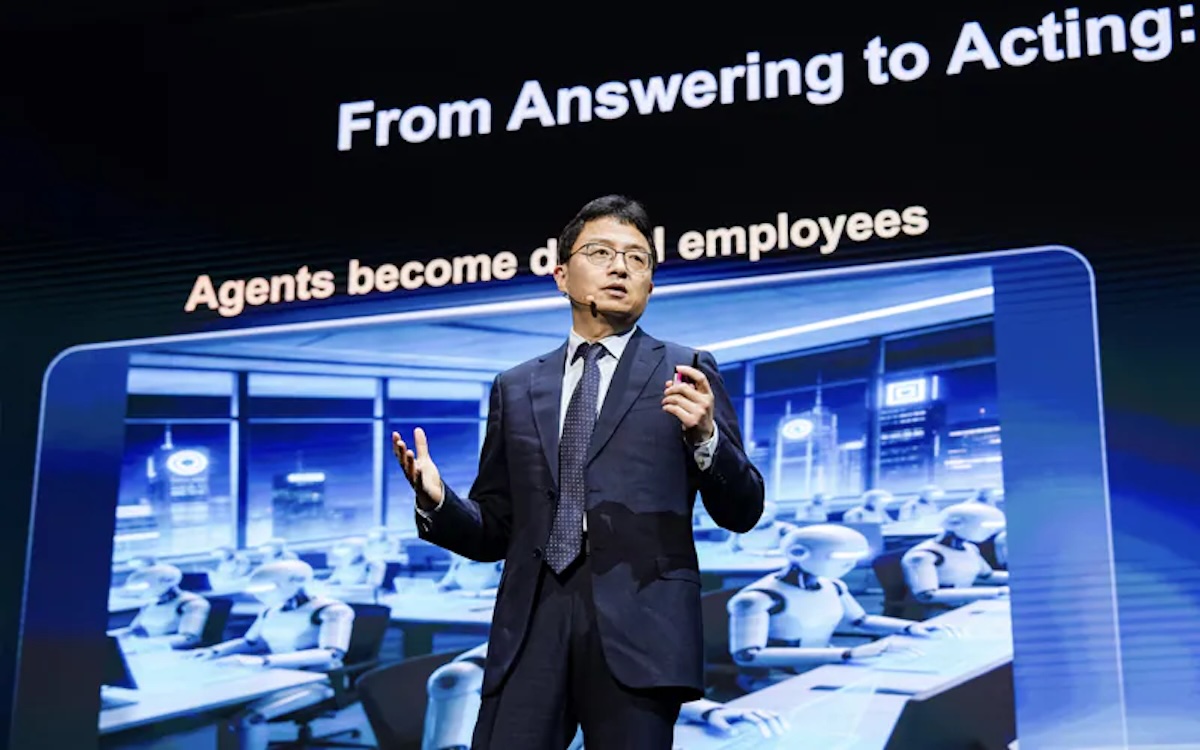
Huawei’s message is uncomfortable for Washington and beneficial for Europe: restrictions can slow down a rival for a period, but they can also accelerate its need to develop its own alternatives. Xu Zhijun, Huawei’s rotating president, publicly thanked the United States for exerting pressure on China in semiconductors, arguing that without these measures, the Chinese industry wouldn’t have advanced as strongly toward a more autonomous technological supply chain.
This statement should not be read as a complete victory for Beijing nor as an automatic defeat for U.S. policy. China still faces significant limitations in advanced lithography, cutting-edge manufacturing, performance per watt, and access to certain equipment. However, it reveals an increasingly visible paradox: when an economy is pushed against the wall in a strategic technology, it can respond by investing more, sourcing locally, accepting initially inferior performance, and creating a domestic market for its national champions.
From sanctions to involuntary industrial policy
Huawei was added to the U.S. Department of Commerce’s Entity List in 2019, a measure that imposed licensing requirements for exports, reexports, or transfers of certain products and technology to the company and its subsidiaries. Starting in 2022, Washington also tightened controls over advanced computing chips and related semiconductor equipment destined for China.
The goal was clear: limit China’s access to the most advanced chips and slow its progress in artificial intelligence, supercomputing, and critical technologies. Initially, the impact was real. Chinese companies had to redesign products, find substitutes, invest in domestic suppliers, and accept that they could no longer depend on Nvidia, TSMC, ASML, or the AI accelerator chain as before.
But this pressure has produced a side effect. China has turned restrictions into a matter of state policy. It has increased public and private investment, strengthened the role of domestic companies, and accepted that its local industry will develop along less perfect but self-reliant paths. Huawei is the most visible example: after years of sanctions, it has again made progress in chips, architecture, and AI accelerators, though still facing technical doubts and gaps compared to the most advanced manufacturing in Taiwan, South Korea, or the U.S.
Huawei recently introduced its “Tau Scaling Law” approach, which aims to improve system efficiency and data movement within chips, rather than relying solely on reducing transistor size. According to Reuters, the company hopes to reach densities comparable to 1.4-nanometer technologies by 2031, though analysts advise caution since China remains around 7-nanometer processes and faces serious barriers in advanced manufacturing tools.
| Milestone | What happened | Impact |
|---|---|---|
| 2019 | Huawei added to the U.S. Entity List | More restrictions on access to U.S. technology |
| 2022 | U.S. tightens controls on advanced chips for China | Increased pressure on AI, supercomputing, and semiconductors |
| 2023-2026 | China accelerates local investment in chips and AI | Greater demand for domestic suppliers |
| 2026 | Huawei defends new architectures to bypass manufacturing limits | Seeking alternatives to classical miniaturization |
| Next phase | Technology bloc competition | Less dependency but more global fragmentation |
The limit of blocking without building
Restriction policies can buy time, increase costs for a rival’s development, prevent access to the best chips, or delay specific products. But if they are not accompanied by a robust industrial strategy, they may end up encouraging what they aimed to prevent: the creation of an alternative ecosystem.
This is at the core of Xu Zhijun’s remarks. Huawei isn’t claiming that sanctions have been comfortable. Instead, they say that the pressure pushed them to do what they might have postponed if they still had easy access to foreign technology. When dependence ceases to be an option, local investment is no longer a desire but a necessity.
This phenomenon is not unique to China. Industrial history is full of restrictions, embargoes, or supply crises that pushed countries and companies to develop their own capabilities. The current speed of technological progress adds a new dimension. Artificial intelligence, advanced chips, data centers, cloud, and cybersecurity have become so sensitive that they cannot be fully left in foreign hands.
The U.S. tries to maintain its edge by controlling access: chips, design software, manufacturing equipment, intellectual property, and critical suppliers. China counters with scale, investment, planning, and a huge domestic market. The tension between these approaches is reshaping the global semiconductor supply chain.
For Nvidia, this dynamic also has costs. The company has maintained a dominant position in AI accelerators for years, but restrictions in China have reduced its flexibility and opened space for local alternatives. Jensen Huang has repeatedly warned that export controls could push China to develop its own technology, a point Huawei now uses as an industrial and political argument.
The European lesson: sovereignty without naivety
Europe should pay close attention to this case. Not to copy China’s model or turn technological sovereignty into autarky, but to understand a fundamental point: technological dependence can only be addressed by building real capacity. Regulations, declarations of priorities, or isolated projects are not enough. It requires a market, public procurement, infrastructure, talent, energy, data centers, factories, chip design, and customers willing to adopt European solutions—even if initially they are not always the most convenient.
The European Union already has the Chips Act, which aims to strengthen the European semiconductor ecosystem, reduce external dependencies, and double the continent’s global share to 20%. The European Commission itself recognizes that chips are central to the continent’s technological sovereignty.
However, objectives alone do not produce chips. Europe has been strong in research, specialized machinery, automotive manufacturing, industry, telecommunications, science, and critical niches in the supply chain. But it still depends heavily on Asia for advanced manufacturing and on the U.S. for many layers of software, cloud, and AI.
The European question is not whether to close its markets, but whether it is willing to create demand for its own technological capabilities. China demonstrates that a local industry grows with pressure, funding, and customers. The U.S. shows that controlling critical chain points grants geopolitical power. Meanwhile, Europe risks remaining on the easier side of the debate: demanding sovereignty without bearing its costs.
There is a difference between imposing restrictions on others and preparing to withstand restrictions ourselves. If tomorrow a geopolitical crisis limits Europe’s access to chips, cloud, AI models, GPUs, or critical software, the continent will need more than good policies. It will require capable suppliers, available infrastructure, and a less fragmented industrial policy.
Huawei’s case does not prove sanctions do not work. It illustrates that they work in complex ways. They can weaken in the short term and strengthen in the long. They can close one door and force the development of another. They can reduce dependence on a rival from whom they previously derived revenue. And they can accelerate a technological separation that will be difficult to reverse later.
For Europe, the takeaway is more practical than epic: technological sovereignty cannot be decreed, only built. It requires buying, financing, operating, testing, and maintaining for years. China learned this through pressure; Europe still has time to learn it strategically.
Frequently Asked Questions
What has Huawei said about U.S. restrictions?
Xu Zhijun, Huawei’s rotating president, argued that U.S. pressure helped accelerate China’s semiconductor industry growth.
Have U.S. sanctions failed?
Not necessarily. They limited China’s access to advanced technologies but also spurred Chinese investment in domestic alternatives.
Is China already competing at the same level as the U.S. in chips?
Not in all areas. China has made advances but still faces limitations in advanced manufacturing, efficiency, and access to critical equipment like leading lithography tools.
What should Europe learn from this case?
That technological sovereignty requires real industrial capacity, local suppliers, sustained investment, demand, and a comprehensive approach—not just regulation or strategic declarations.
