
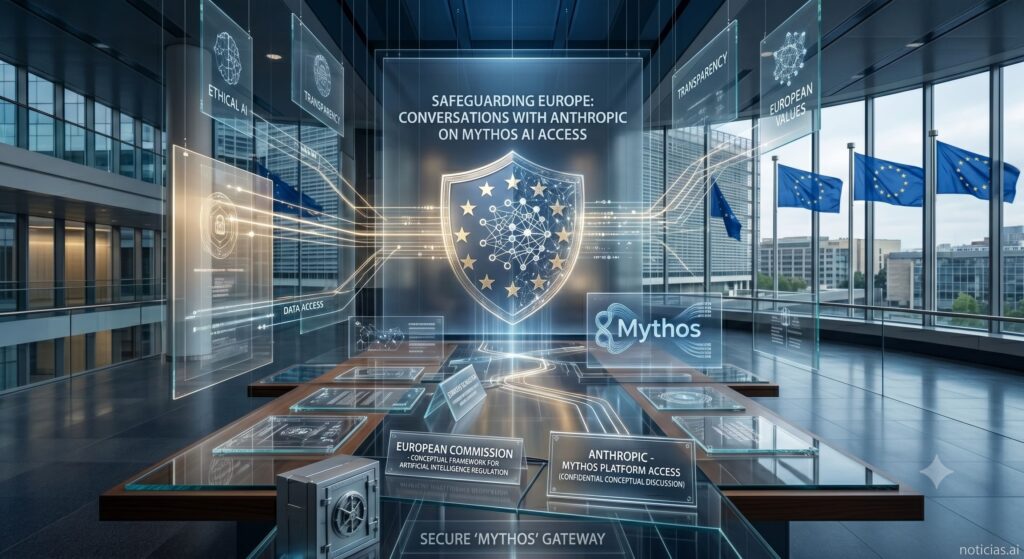
Claude Mythos has become one of the most sought-after and delicate tools in the new AI-driven cybersecurity landscape. The European Union is negotiating with Anthropic for potential access for ENISA, major tech companies are participating in Project Glasswing, and key security actors see the model as a device that could make the difference between patching early or remaining exposed for too long.
The interest is no coincidence. Mythos does not present itself as a conventional coding assistant or as another model for summarizing reports or reviewing code. Anthropic describes it as a system with particularly strong capabilities in offensive and defensive security tasks, capable of detecting complex vulnerabilities, reasoning about critical software, and assisting in preparing fixes. In practice, it has become a sort of “defensive weapon” that no one wants in the wrong hands but everyone wants nearby to protect their own systems.
The European Commission has held discussions with Anthropic to explore future access for European agencies to Claude Mythos. According to published information, the idea is that ENISA, the EU Agency for Cybersecurity, could join the circle of entities with controlled access to the model. This wouldn’t be a public release or a mass commercial availability but a restricted access for institutional defense purposes.
Mythos is already the standard everyone looks up to
The reason Mythos has generated such interest is the leap in capability it represents. Anthropic introduced Claude Mythos Preview within Project Glasswing, an initiative designed to help protect critical software before models with similar capacities become widespread. According to the company, the model has demonstrated the ability to identify and exploit zero-day vulnerabilities in large operating systems and web browsers during internal evaluations.
Noticias.ai has closely followed this development and highlighted that Anthropic has chosen not to release Mythos openly but to confine it within a defensive program with selected partners. Among the participants cited in various reports are AWS, Apple, Broadcom, Cisco, CrowdStrike, Google, JPMorgan Chase, the Linux Foundation, Microsoft, NVIDIA, and Palo Alto Networks. This list alone underscores the model’s importance: we are not dealing with an experimental tool for enthusiasts but a capability that interests those managing a significant portion of the world’s technological infrastructure.
The core message is uncomfortable. If Mythos can find flaws that have gone unnoticed for years, early access means users can fix their products sooner, reinforce their platforms, and buy time against future attackers. Those without access will have to rely on third-party reports, patches, or less advanced capabilities.
Therefore, the EU aims to be inside. Brussels isn’t just testing a trendy tool; it wants to understand what defensive advantages other actors are gaining and how that knowledge can be transferred to banks, administrations, critical operators, tech companies, and European service providers.
| Actor or Initiative | Role Regarding Mythos |
|---|---|
| Anthropic | Develops Claude Mythos Preview and controls access |
| Project Glasswing | Defense program for critical software security |
| ENISA | Potential European agency with access to Mythos |
| Major Tech Companies | Seeking to use it for discovering and fixing vulnerabilities |
| Banks & Critical Sectors | Aiming to reduce exposure to unknown flaws |
| European Regulators | Evaluating impact, access, and dual-use risks |
| Security Providers | Monitoring how to integrate advanced AI into real defense |
The model everyone wants but no one wants to release
Mythos’s dilemma is that its defensive value stems directly from its very capability, which also makes it dangerous. A system able to find deep vulnerabilities could also help craft exploits, chain failures, or automate attack phases if released without controls. That’s why Anthropic maintains restricted access.
In cybersecurity, this duality has always existed. The same techniques that enable auditing a system can be used to attack it. Now, the scale is different. An expert team takes time to review complex components, reproduce failures, understand their impact, and prepare tests. An advanced model can accelerate this process and apply it across large codebases or binaries.
This is the real shift. AI doesn’t eliminate the need for human researchers, but it can multiply their reach. It can review more surfaces, suggest exploitation routes, help prioritize findings, and reduce the time to patching. If this capability remains restricted to a select few, it creates an asymmetric advantage in software defense.
The emergence of competing models confirms the market is moving. OpenAI has launched verified access programs for cybersecurity-oriented models, and other providers are developing similar capabilities. But Mythos has positioned itself as a public benchmark—not necessarily because it has no rivals, but because right now, it’s the model that has garnered the most institutional and corporate attention from tech giants, banks, governments, and regulators.
In a sector accustomed to talking about EDR, SIEM, SOAR, pentesting, bug bounty, and vulnerability management, Mythos introduces a new category: frontier models capable of acting as augmented security researchers. This category could shift the relative advantage between attackers and defenders.
The new bottleneck: fixing before exploitation
The debate doesn’t end with discovering vulnerabilities. In fact, that might become the lesser concern. Noticias.ai highlighted a particularly relevant idea in analyzing Project Glasswing: if models like Mythos increase detection rates, the bottleneck moves to validating, communicating, and fixing vulnerabilities swiftly.
This is critical. A model may find thousands of potential flaws, but each must be validated: whether it’s exploitable, impacted versions, real impact, how to fix it without breaking compatibility, and how to deploy the patch in production. In critical software, this process can be slow and complex.
The risk is that AI produces more discovered vulnerabilities than the industry can absorb. Without proper processes, a powerful tool can end up creating an unmanageable backlog of issues. That’s why having Mythos “on hand” isn’t enough; organizations require engineering, governance, coordination with maintainers, response teams, and real patching capacity.
An important lesson for Europe is emerging here. Access to Mythos can help, but it doesn’t replace a comprehensive cybersecurity strategy. ENISA can evaluate capabilities, promote good practices, and share lessons learned—but European critical sectors will need faster remediation processes, more reliable software inventories, and improved update mechanisms.
Why everyone wants to be part of Project Glasswing
Project Glasswing has become more than just a technical program. It’s a strategic position. Being inside provides early access to a capability that can detect flaws before other models, researchers, or attackers do. Being outside means waiting for patches through the usual channels.
For big tech firms, this could be the difference between discovering a flaw in their own product and seeing it appear later in an active campaign. For banks and critical operators, it helps assess internal dependencies, libraries, legacy systems, or components that may not get the attention they deserve. For public agencies, it offers visibility into systemic risks within shared infrastructures.
The race isn’t only about having the best model; it’s about accessing the right model with the correct permissions before risks materialize. In cybersecurity, timing is key. Patching a week early can prevent a crisis. Detecting an attack chain before its public reveals can save millions of systems.
That’s why Mythos doesn’t seem to have a clear rival in terms of market perception today. There are competing initiatives, and more will likely emerge, but none have garnered the same level of institutional and corporate interest so quickly. The EU’s push to gain access confirms that Mythos has become a benchmark.
Europe can’t rely solely on external models
The potential inclusion of ENISA in this ecosystem is a positive step but raises a crucial question: can Europe afford to depend on U.S. models to protect its critical software? The reasonable answer is twofold. In the short term, Europe needs access to these tools to avoid being at a disadvantage. In the medium and long term, it must develop its own capabilities.
Cyber sovereignty won’t just be about national CERTs, standards like NIS2, or local providers. It will also require models, datasets, evaluation environments, laboratories, and teams capable of employing advanced defensive AI on European critical software. Regulations can demand resilience, but resilience is built with tools, talent, and infrastructure.
Claude Mythos has named a new reality. AI applied to cybersecurity is no longer just a copilot for writing reports or interpreting alerts. It can become a layer of search, validation, and vulnerability correction. Those who implement this layer early—and know how to use it well—will be better prepared.
The problem is that the same capability can also raise attackers’ levels. That’s why controlled access, defensive programs, and cooperation among businesses, governments, and software maintainers are crucial. The alternative is a chaotic race where the most powerful models get leaked, replicated, or used unchecked.
The EU has reached a logical conclusion: if all major players want Mythos to protect themselves, Europe cannot just stand on the sidelines. In AI-driven cybersecurity, access to these models is as important as turning their discoveries into real patches. Mythos isn’t just a tool; it’s a signal of where digital defense is heading.
Frequently Asked Questions
What is Claude Mythos Preview?
Claude Mythos Preview is an advanced model from Anthropic focused on cybersecurity tasks such as vulnerability detection, code analysis, controlled testing, and patch support.
Why does everyone want access to Mythos?
Because it can help find flaws before attackers do, prioritize risks, and speed up fixing vulnerabilities in critical software.
Why doesn’t Anthropic release it publicly?
Because its capabilities are dual-use; it can secure systems but also facilitate attacks if used without controls.
What role could ENISA play?
ENISA could gain controlled access to evaluate Mythos, facilitate knowledge sharing, and strengthen Europe’s AI-driven threat preparedness.
Sources:
- Noticias.ai, “Anthropic presents Mythos and warns: AI can already change cybersecurity”.
- Noticias.ai, “Project Glasswing shows the new cybersecurity bottleneck”.
- Noticias.ai, “Anthropic brings Mythos closer to Claude Code and opens a new era in cybersecurity”.
- Anthropic, “Project Glasswing: Securing critical software for the AI era”.
- Anthropic, “Claude Mythos Preview”.
- ENISA, European Union Agency for Cybersecurity.
