
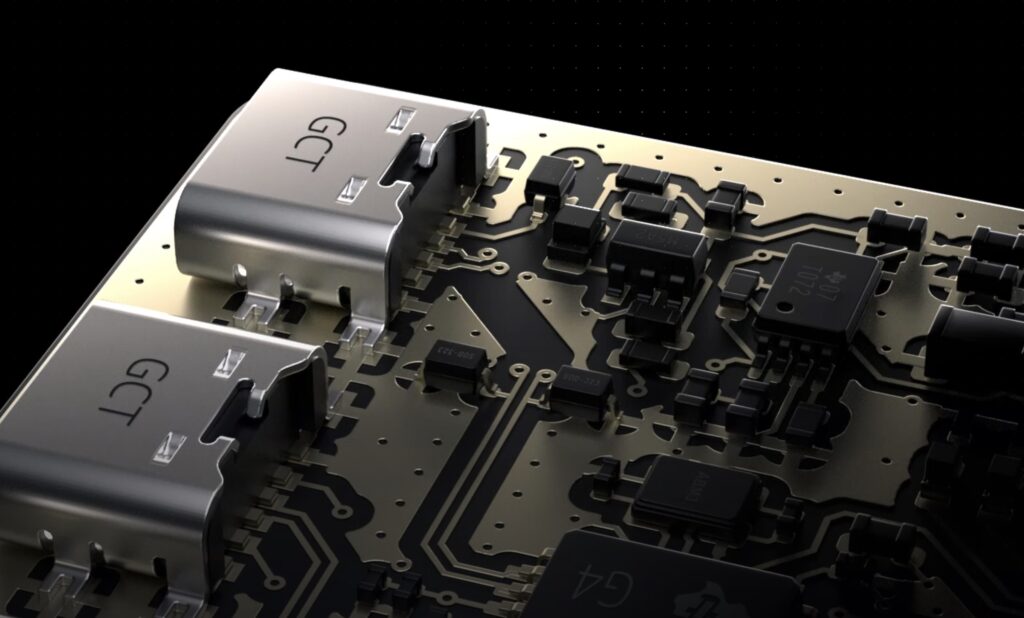
Itera has stepped out of the shadows with a bold promise to any hardware team: to test and modify real circuits in seconds rather than weeks. The deep tech startup, based in San Francisco, announced a $12 million seed round and a prototype of what it describes as the world’s first fluidic circuit board—a platform made from glass and liquid metal that allows reconfiguring connections without fabricating a new PCB with every change.
This isn’t about selling traditional commercial boards but offering an electronic prototyping infrastructure as a service. Customers upload their designs, Itera assembles real components on their reconfigurable substrates, and the circuits are tested at secure facilities in the United States. If modifications are needed, the company claims it can rewire internal connections in less than 60 seconds.
The hardware bottleneck remains physical
Software development has thrived on rapid cycles: write code, test, fix, and rerun. Hardware, however, often doesn’t move at that pace. A team designs a PCB, sends it to manufacturing, waits for production, receives the board, assembles components, tests, and if something fails, repeats much of the process. Itera states that this cycle can take between two and six weeks per iteration in many electronics projects.
That delay isn’t just inconvenient. For hardware startups, chip manufacturers, automotive, defense, or industrial electronics sectors, each iteration entails costs, delays, and risks. A poor decision early on can extend development, block validation, or deplete capital before reaching a final design.
Itera aims to address this issue directly. Their technology employs a glass and liquid metal architecture to form reconfigurable traces. As explained to Tom’s Hardware, the system uses electrowetting—a technique that uses electric fields to precisely control liquid metal alloys on a glass substrate. Instead of fixed copper traces like in conventional PCBs, the system can reposition the conductive material and change the physical wiring of the circuit.
The company claims this approach allows up to 1,000 times faster iterations than traditional methods, as engineers can test physical changes with real components without waiting for new fabrication. While this is an ambitious claim and currently based on the company’s own statements, it addresses a very real challenge in the electronics industry.
| Aspect | Traditional PCB Prototyping | Itera Platform |
|---|---|---|
| Design change | New fabrication of the board | Reconfiguration of liquid metal |
| Cycle time | 2 to 6 weeks, per Itera | Less than 60 seconds, per company |
| Type of testing | Final or near-final physical circuit | Real components on reconfigurable substrate |
| Business model | Prototyping services | Electronics as a Service |
| Location | Depends on supplier | Secure centers in the U.S. |
| Main promise | Conventional physical validation | Fast iteration with real electrical behavior |
Electronics as a Service: testing boards without fabricating each time
Itera’s business model is as significant as its technology. The startup doesn’t propose that companies buy machines to circulate liquid metal in their labs. Instead, they aim to operate the platform as Electronics as a Service. Designs are mounted and tested on their own facilities, with real components and remote access for engineers.
This approach makes sense for projects where a failed iteration is costly. Teams can quickly validate routing alternatives, check internal nodes, adjust signals, test design variations, and gather real electrical data without manufacturing a complete board each time. Itera also highlights the ability to measure any internal node, not just the test points exposed on a conventional PCB.
The company reports that its initial capacity is already reserved by a top-five global automotive manufacturer and defense sector companies, while hyperscalers and several chip makers are evaluating the platform. They haven’t disclosed names, so these references shouldn’t be taken as definitive validation. Still, they indicate that the proposal has garnered interest in sectors where reducing prototyping time can lead to significant economic benefits.
The $12 million funding round included Upfront Ventures, Costanoa Ventures, and Colle Capital. For a deep hardware startup, this funding enables the company to move beyond R&D, launch its first product, and begin demonstrating that the platform can operate beyond just a demo.
The promise is impressive, but technical data is missing
The story has a clearly futuristic element. Watching a circuit “reconfigure” with liquid metal sounds more like science fiction than industrial process. Yet, in hardware, promises must be measured with concrete parameters: number of layers, interconnection density, impedance, supported frequency, signal integrity, thermal limits, mechanical behavior, high-speed interface compatibility, reproducibility, and correlation with a final copper PCB on FR-4 or other substrates.
At this point, public details are scarce. Itera hasn’t published a complete technical datasheet with resolution limits, available layers, performance on high-speed signals, or thermal margins. PC Gamer, adopting a more skeptical view, reminds us that a liquid alloy on glass may not have the same electrical, mechanical, or thermal properties as a conventional copper circuit on fiberglass, raising reasonable doubts about capacitance, thermal transfer, and the technology’s initial reach.
This distinction is important. Itera is not yet positioned to replace a final, mass-production PCB. Its role, if it meets its promises, will be in early physical validation and exploration. It can help identify errors, compare options, and speed up decision-making before finalizing a PCB made through conventional methods.
It’s also crucial to differentiate between simple prototypes and complex designs. Small or low-complexity boards can often be prototyped quickly today—sometimes within 24 hours for urgent orders. The real value of Itera will likely come with designs where the cost of iteration, debugging, and rework is significantly higher than that of a simple PCB.
Why this could matter for chips, automotive, and defense
If the technology scales, its impact might be felt in areas where hardware is outpacing software’s development speed. In automotive, electronics grow in complexity due to electrification, assisted driving, sensors, infotainment, and centralized platforms. In defense, lengthy validation cycles and critical safety requirements make fast prototyping vital. In semiconductors, any tool that speeds up test boards, interface validation, or reference prototypes can save weeks.
Another trend supports this: AI is already accelerating design phases. Generative tools and technical assistants help create schematics, review constraints, suggest components, or detect errors. But physical validation remains a bottleneck. Itera aims to bring that velocity into the testing phase.
The concept is appealing because it aligns hardware prototyping closer to software iteration logic. But market adoption will depend on whether it truly reduces costs, prevents errors, yields reliable measurements, and integrates seamlessly into engineering workflows.
Itera has opened a promising door: transforming PCB prototyping into a reconfigurable, rapid service. The remaining questions are how far it can go, its limitations for complex designs, and how results compare to final production boards. If it demonstrates repeatability, accuracy, and practical value, it could significantly shorten the gap between an idea and its physical validation.
Frequently Asked Questions
What has Itera presented?
Itera has showcased a prototype of a fluidic circuit board made from glass and liquid metal, capable of reconfiguring connections in under a minute, according to the company.
Does Itera sell commercial PCBs?
No, not yet. Their initial offering is a prototyping platform as a service, where designs are tested with real components on reconfigurable substrates.
Can it replace a conventional PCB?
Currently, it should be viewed as a prototyping and validation tool—not a direct substitute for a final PCB intended for mass production.
Why is there talk of a 1,000-fold improvement?
Itera claims it can reduce iteration times from weeks to less than a minute, enabling much faster physical testing cycles.
