
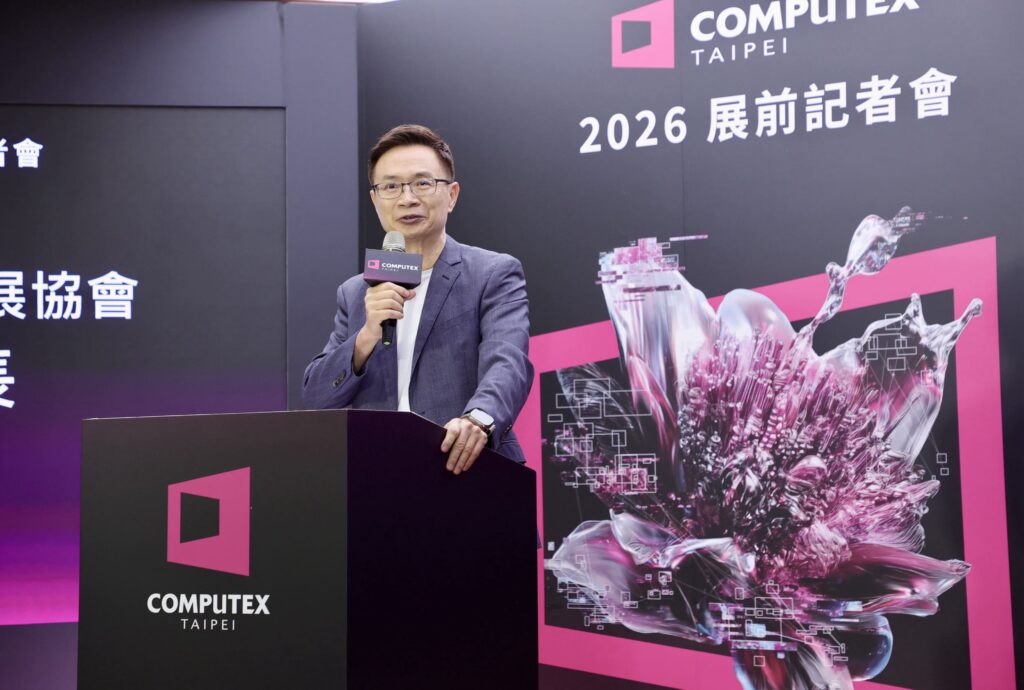
COMPUTEX 2026 wants to make it clear that artificial intelligence is no longer confined to data centers, language models, or personal computers. The Taipei tech fair will return this year to Taipei World Trade Center Hall 1 with a new zone dedicated to AI robots, a space aiming to showcase how AI is moving from software into the physical world: factories, logistics, healthcare, urban security, mobility, and connected services.
The chosen theme, “AI Together,” aptly summarizes the event’s ambition. Taiwan does not want to be limited to being a place where chips, motherboards, servers, and components are manufactured. COMPUTEX aims to position the country as a hub for complete AI solutions, capable of integrating hardware, software, industrial applications, edge AI, robotics, low-power displays, and smart city applications.
Robots, Edge AI, and Smart Cities
The main highlight of the World Trade Center Hall 1 will be the AI robotics area. According to organizers, this space will bring together companies specializing in sensors, motors, gear reducers, controllers, machine vision, integration systems, and comprehensive robotic solutions. The goal is to demonstrate real-world applications in industrial automation, transportation, logistics, and healthcare — not just lab prototypes or isolated demonstrations.
The theme choice is deliberate. Robotics is entering a new phase driven by Physical AI, where systems not only analyze information but also interpret their environment and perform actions. This evolution connects with Embodied AI, which aims to give robots and machines greater autonomy, perception, and adaptability to different workspaces.
The International Federation of Robotics estimates that the global market for industrial robot installations has reached $16.7 billion. Demand is no longer limited to automotive and traditional manufacturing. Growth is also seen in logistics, electronics, healthcare, inspection, agriculture, and specialized services, where automation begins to address productivity, safety, and skilled labor shortages.
In this context, Taiwan is naturally positioned to capitalize. Its industry combines semiconductors, motherboards, electronics, AI servers, sensors, precision components, and a network of manufacturers experienced in global production. The question for the island is no longer just who manufactures the chips, but who can turn them into complete, connected systems that are cooled, powered, protected, and maintainable.
Three Zones Showcasing Tangible AI
The World Trade Center area will feature over 180 exhibitors and will be divided into three main spaces: AI robots, electronic paper industry, and TechXperience. Each addresses a different aspect of technological transition.
The AI robots zone will feature companies like HIWIN, EVERBRITE, Turvo, Solomon, Texas Instruments, and Nuwa. Demos are expected of high-precision gear reducers, humanoid robot collaborations, and vision-guided automation systems. For industry, this area will be especially relevant as it brings AI into movement, physical manipulation, and decision-making in real-world environments.
The electronic paper zone will spotlight companies like E Ink, Sharp, and Netronix. The organizers aim to highlight applications of large-format color displays, low-power smart labels, and medical solutions that avoid blue light. While electronic paper may seem less flashy than robots, it fits a specific trend: more efficient information devices, visible in different environments, useful for retail, transportation, healthcare, and urban signage.
The third space, TechXperience, will focus on immersive experiences and end-user applications. COMPUTEX discusses cabin simulators with AI and high-performance platforms capable of showcasing real-time applications. Such zones serve a clear purpose: translating complex technological advancements into concrete scenes visitors can test.
| Featured Zone | Main Focus | Example Applications |
|---|---|---|
| AI Robots | Physical AI, automation, and robotics | Industry, logistics, healthcare, and transportation |
| Electronic Paper | Low-power displays and smart surfaces | Retail, medical, signage, mobility |
| TechXperience | Immersive experiences and end-user applications | Simulators, applied AI, interactive demos |
| COMPUTEX Forum | Industry trends | Robotics, automation, and Physical AI |
Additionally, there will be a robotics and edge AI pavilion driven by Intel, with 12 partners showcasing applications in robotics, smart manufacturing, and connected living. Intel emphasizes that edge AI systems not only perceive and analyze but can also act in real time—key in robots, autonomous vehicles, industrial inspection, and urban security—where sending all data to the cloud can introduce latency, costs, and privacy risks.
Taiwan Aims to Shift from Manufacturer to Solution Provider
James C. F. Huang, president of TAITRA, has highlighted Taiwan’s key position due to its hardware supply chain. His message is clear: the country aims to move from a global manufacturing hub for technology to a center for complete AI solutions. This aligns well with current industry trends.
For decades, COMPUTEX was mainly known for computers, components, motherboards, peripherals, and PC manufacturer announcements. Recently, the focus has shifted to AI, accelerated servers, chips, networks, storage, robotics, and industrial applications. The 2026 edition underscores this transformation: AI is no longer just software but an entire infrastructure.
The COMPUTEX forum will also include a session on robots, automation, and Physical AI with experts from NVIDIA, Qualcomm, ABB, and NXP. The lineup’s diversity underscores the scope of change: NVIDIA brings accelerated computing and simulation; Qualcomm adds intelligence to devices and edge; ABB focuses on industrial automation; and NXP supplies critical components for automotive, security, and embedded systems.
Urban security will also take center stage. IBASE Technology has introduced a vision based on image analytics, edge computing, digital twins, and 3D models to develop integrated surveillance and patrol systems combining ground vehicles and aerial review. This concept envisions cities where sensors, cameras, drones, vehicles, and analysis platforms work as a coordinated system.
E Ink, meanwhile, presents electronic paper as an evolution toward a “smart surface.” Its goal isn’t just displaying text but integrating information, color, and signage into everyday objects with low power consumption. In smart cities and sustainable contexts, this technology has substantial potential for labels, public transport, hospitals, retail, and connected buildings.
COMPUTEX 2026 arrives at a moment when Taiwan’s role in global AI markets has grown even more. The island is already essential in semiconductors, AI servers, advanced packaging, boards, cooling, and data center supply chains. Now, it seeks to expand this position with more comprehensive solutions—adding value and supporting end applications.
Robotics will be a key test of this ambition. While generative AI has dominated headlines, Physical AI could define the next phase: systems that perceive, decide, and act in factories, hospitals, warehouses, roads, and cities. COMPUTEX aims to showcase how Taipei will be among the first to see this transition unfold.
Frequently Asked Questions
When will COMPUTEX 2026 take place?
COMPUTEX 2026 will be held from June 2 to June 5 in Taipei, with venues in Nangang, Taipei World Trade Center, and Taipei International Convention Center.
What is the theme of COMPUTEX 2026?
The theme is “AI Together,” focusing on AI and computing, robotics and smart mobility, and next-generation technologies.
What is Physical AI?
It refers to applying artificial intelligence to systems that interact with the real world, such as robots, vehicles, industrial machines, sensors, and security platforms.
Why is Taiwan important for AI?
Because it hosts a crucial part of the global tech supply chain: semiconductors, AI servers, advanced packaging, electronics, components, industrial integration, and manufacturing.
Source: computextaipei.com.tw
