
Digital sovereignty has become one of the biggest buzzwords in technology, public administration, and business strategy. It appears in political speeches, commercial presentations, and procurement documents. But it is often confused with a too simplistic idea: believing that just hosting a service in Spain or within the European Union makes it sovereign.
That interpretation is convenient but incomplete. The physical location of data matters greatly. However, it doesn’t guarantee real control over the infrastructure, operations, software, keys, updates, networks, or service continuity on its own. In other words: being in Europe can be a necessary condition in certain cases, but it is not sufficient to speak of digital sovereignty in the strict sense.
The difference is significant. A company can hire a service deployed in a European data center and still depend on providers, platforms, licenses, virtualization layers, technical support, or corporate decisions made outside Europe. In such a scenario, data residence reduces some risks but does not eliminate technological dependence.
Location does not equal control
For years, much of the debate centered on where data is stored. The question was reasonable: if a Spanish company’s data, a hospital’s records, a university’s information, or a public administration’s data is hosted outside the European Economic Area, legal, regulatory, and operational problems could arise. The GDPR intensified this concern and prompted many organizations to pay closer attention to international data transfers.
But the debate has evolved. Today, the question can no longer be limited to “where is the service hosted.” It’s also necessary to ask who is operating it, under what jurisdiction the provider acts, what dependencies it has, who controls the keys, what happens if an authority of a foreign country issues an order, what leeway the client has to migrate, what technology underpin the platform, and what real capacity exists to maintain the service if commercial or geopolitical conditions change.
Digital sovereignty is not just about meeting a checklist of formal requirements. Complying with GDPR or the National Security Scheme is important, especially in public administrations and sensitive sectors, but regulatory compliance does not replace technological control. An organization can be formally aligned with a regulation and, at the same time, still depend on critical layers it does not control.
A common mistake is confusing localization with sovereignty. A service can run on European soil but rely on proprietary external software, management systems controlled by a third party, licenses that can change in price or terms, external networks, and support layers outside the client’s direct reach. In such cases, the map shows Europe, but the decision chain might be elsewhere.
The technological chain starts from the ground up
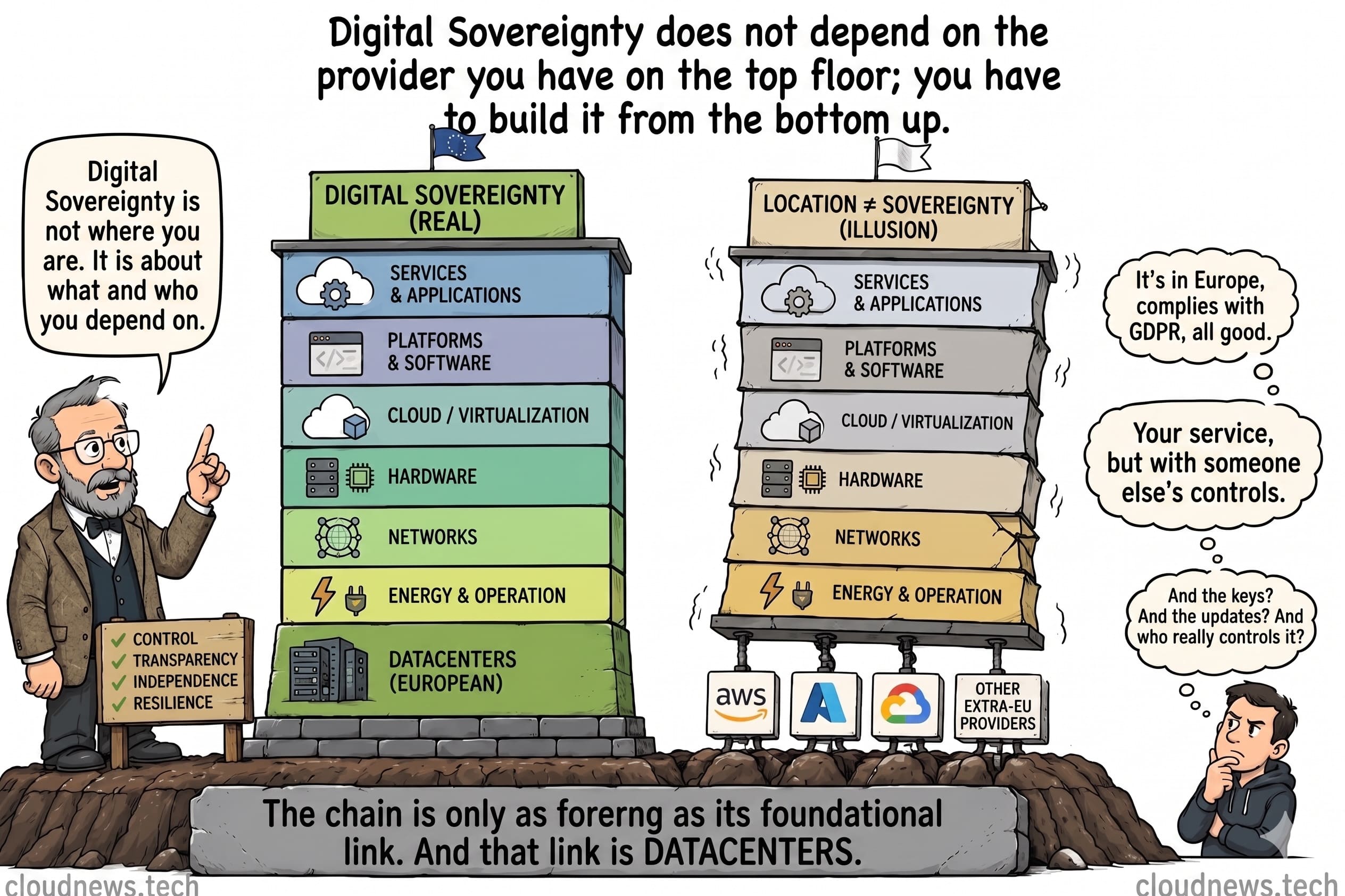
Digital sovereignty builds as a chain. The visible part includes services and applications: email, storage, CRM, ERP, analytics, artificial intelligence, collaboration platforms, or sector-specific applications. This is what the user sees and what often appears in contracts. But underneath, there are equally or even more important layers.
First come platforms and software. Next is virtualization or cloud infrastructure where workloads run. Below that is hardware. Then networks, connectivity, energy, physical operations, and at the base, data centers. If this foundation isn’t solid, European, auditable, and governable, everything built above inherits dependency.
That’s why data centers are not just simple buildings with servers. They are critical infrastructure for the digital economy. They underpin online banking, electronic administration, digital health, artificial intelligence, e-commerce, education, connected industry, and many everyday services that no longer function without technology.
When discussing sovereign cloud, the focus is often on the commercial layer of the service: region, availability, certifications, data processing agreements, or compliance. All of that matters. But if the physical infrastructure, operations, connectivity, technical decisions, and much of the supply chain depend on actors over which the client has no real control, sovereignty remains limited.
The chain is only as strong as its weakest link. And that link is in the data centers, energy sources, networks, hardware, and the ability to operate infrastructure with independent criteria. Without this base, sovereignty risks becoming merely a marketing label.
Europe needs operational sovereignty, not just regulatory
Europe has made significant progress in digital regulation. GDPR, NIS2 Directive, Data Act, AI Regulation, and national security frameworks have created a more demanding environment. These regulations can protect rights, raise standards, and foster confidence. But digital sovereignty is not achievable through regulation alone.
It requires industrial capacity, own infrastructure, strong European providers, competitive data centers, technical talent, resilient networks, available energy, and a less superficial approach to technology procurement. Sovereignty cannot rely solely on contractual clauses if there are no real alternatives beneath them.
For companies and public entities, this means changing how providers are evaluated. Asking whether data is stored in Europe is not enough. The entire chain must be reviewed: where workloads are hosted, who operates the data center, what jurisdiction applies, what technologies are used, what exit plans exist, how keys are managed, what dependencies exist on third parties, and what audit capabilities the client has.
It also means accepting that not all services require the same level of sovereignty. A marketing tool is different from a healthcare system, a tax platform, a digital identity infrastructure, or a critical load for an industrial company. Sovereignty should be scaled to the risk but cannot be reduced to just a location checkbox.
The key issue is control. Control over data, keys, operations, continuity, migration options, and critical decisions. Without that control, an organization might have the service nearby but hold the reins elsewhere.
Digital sovereignty begins with a contract but does not end there. It is demonstrated through architecture, daily operations, and the ability to withstand regulatory, commercial, or geopolitical changes without losing control. Europe does not only need more services hosted locally; it needs to build a foundational digital infrastructure capable of supporting its economy, administration, and businesses independently of decisions made abroad.
Frequent questions
What is digital sovereignty?
It is the ability of an organization, country, or region to control its data, infrastructure, technological services, operations, and critical dependencies.
Hosting data in Europe guarantees digital sovereignty?
No. Location matters, but so do who operates the service, what technology is used, who controls the keys, which jurisdiction affects the provider, and the client’s real ability to exit.
What role do data centers play in digital sovereignty?
Data centers are the physical backbone of the digital economy. Without local, secure, connected, and controllable infrastructure, sovereignty is limited.
Is complying with GDPR or ENS enough to be sovereign?
Not necessarily. Regulatory compliance is important but must be complemented by technological control, operational transparency, reasonable independence, and resilience.
Image and reference: LinkedIN
