
Anthropic has released Claude Opus 4.8, a new version of their most advanced model, directly targeting the area where much of today’s artificial intelligence competition is taking place: agents capable of working longer, using tools, reviewing code, operating terminals, and completing complex tasks with less human supervision.
The company presents Opus 4.8 as an improvement over Opus 4.7, not a complete overhaul. But the kind of advancements highlighted clearly indicate the market’s direction. The battle is no longer solely about conversational responses, general reasoning, or text generation. Increasingly, it matters whether a model can maintain context during a long session, detect its own errors, request clarifications when a task is ill-defined, and execute real workflows within development, financial analysis, research, or computing environments.
Greater focus on agentic programming and tool usage
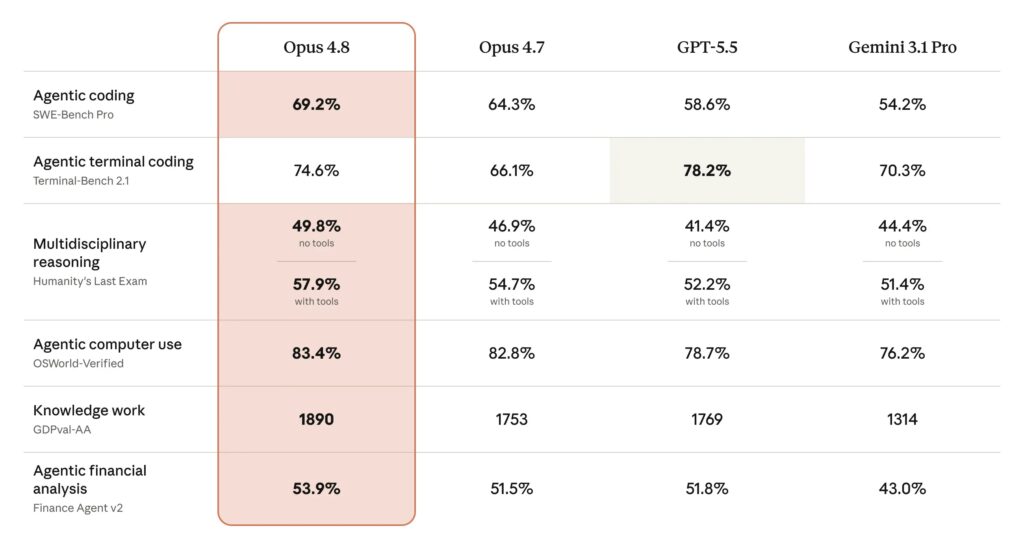
According to data published by Anthropic, Claude Opus 4.8 improves on Opus 4.7 in most benchmarks shown by the company. In SWE-Bench Pro, a test centered on agentic programming, the new model reaches 69.2%, compared to 64.3% for Opus 4.7. In OSWorld-Verified, geared toward computer-assisted tasks, it scores 83.4%, slightly above the 82.9% of the previous version.
It also outperforms in GDPval-AA, an evaluation of knowledge tasks, where Anthropic assigns it 1,890 points versus 1,753 for Opus 4.7. In Finance Agent v2, focused on financial analysis, it rises to 53.9%, surpassing the 51.5% of its predecessor.
The technical analysis is interesting because Anthropic isn’t just marketing a “smarter” model in abstraction. They are positioning Claude as a tool for environments where AI needs to interact with external tools, review information, execute tasks, and sustain longer chains of reasoning. This aligns with the real-world applications many companies are beginning to explore, including software development, technical support, automation, document analysis, and operations.
| Benchmark published by Anthropic | Opus 4.8 | Opus 4.7 | GPT-5.5 | Gemini 3.1 Pro |
|---|---|---|---|---|
| SWE-Bench Pro | 69.2% | 64.3% | 58.6% | 54.2% |
| Terminal-Bench 2.1 | 74.6% | 66.1% | 78.2% | 70.3% |
| Humanity’s Last Exam, no tools | 49.8% | 46.9% | 41.4% | 44.4% |
| Humanity’s Last Exam, with tools | 57.9% | 54.7% | 52.2% | 51.4% |
| OSWorld-Verified | 83.4% | 82.9% | 78.7% | 76.2% |
| GDPval-AA | 1,890 | 1,753 | 1,769 | 1,314 |
| Finance Agent v2 | 53.9% | 51.5% | 51.8% | 43.0% |
It’s worth clarifying that these results come from Anthropic and should be considered as data provided by the vendor. Additionally, benchmarks don’t always accurately predict real-world performance in enterprise repositories, legacy codebases, incomplete documentation, or restricted-permission environments. Nonetheless, the comparison clearly shows a trend: Opus 4.8 outperforms Opus 4.7 in nearly every highlighted area and directly competes with GPT-5.5 and Gemini 3.1 Pro on agentic tasks.
The only area where it doesn’t lead is Terminal-Bench 2.1, where GPT-5.5 scores 78.2%, above Opus 4.8’s 74.6%. For developers and technical teams, this nuance is important: Anthropic’s new model appears strong in agentic programming, computer usage, tool reasoning, and knowledge work, but not dominant in all categories.
Claude Code gains momentum with dynamic workflows
The update includes a significant new feature for Claude Code: dynamic workflows. Available as a research preview for Enterprise, Team, and Max plans, this function allows Claude to plan large-scale tasks and launch hundreds of sub-agents in parallel within the same session. The system then verifies the results before reporting back to the user.
This aligns with a clear trend in AI-assisted development. Early tools focused on completing individual lines, generating functions, or explaining snippets of code. The next phase targets broader tasks: migrations, refactoring, dependency analysis, large codebase review, API updates, and coordinated changes across multiple services.
Anthropic cites example projects such as repository-wide migrations spanning hundreds of thousands of lines of code, using existing test suites as references. Practically, this offers a new way to work: developers can now delegate long processes with planning, distributed execution, and verification, rather than just requesting immediate solutions.
For this to succeed in real environments, the challenge isn’t just generating correct code. It also involves knowing when not to modify certain parts, when to request additional context, how to manage dependencies between services, interpret test failures, and avoid difficult-to-review mass changes. That’s why Anthropic emphasizes improvements in the model’s “judgment” or “criteria.”
Honesty becomes a product feature
One of the most notable aspects of the announcement is Anthropic’s emphasis on honesty as a technical enhancement. The company states that Opus 4.8 is more prone to recognize uncertainties and less likely to claim progress when evidence doesn’t support it. In their evaluations, the model is approximately four times less likely than Opus 4.7 to overlook errors in code without comment.
While this may seem less dramatic than benchmark improvements, it has significant practical implications. In coding, a model that confidently presents an incorrect solution can lead to hours of debugging. In finance or legal analysis, unsupported claims can be dangerous. In operational contexts, overly confident agents may make changes with real-world consequences.
Enhancing honesty also addresses a critical need in enterprise AI: traceability and control. Companies want assistants that can explain their limits, express doubts, keep context, and flag issues — not just quick-response models. In agent workflows where models can use tools and make intermediate decisions, recognizing uncertainty becomes a vital safety measure.
Effort control and API improvements
Anthropic introduces effort control in claude.ai and Claude Cowork. Users can set how much internal effort the model dedicates to a task. Higher levels involve deeper thinking and more token consumption, while lower levels offer faster responses with fewer limits.
By default, Opus 4.8 uses a high effort setting, which Anthropic considers optimal for balancing quality and user experience. For demanding tasks or extended asynchronous workflows, higher levels like “extra” or “max” are recommended. This form of effort management is increasingly common among advanced models, recognizing that not all tasks require the same computing cost.
In the API message system, Anthropic adds another key enhancement: now system inputs can be included within the message array. This allows updating instructions mid-task without breaking cache or adding a user message. For long-running agents, this enables permission adjustments, token limit management, contextual updates, or security instructions without restarting the entire process.
Although a technical change, it has clear implications. Agents are no longer simple linear conversations. They need to adapt context, modify constraints, receive new signals, and keep instructions current without full restarts. This brings the API closer to supporting more complex orchestration scenarios.
Pricing and availability
Claude Opus 4.8 is now available at claude.ai, Claude Code, and through the Anthropic API under the identifier claude-opus-4-8. The standard price remains the same as Opus 4.7: $5 per million input tokens and $25 per million output tokens. The fast mode costs $10 per million input tokens and $50 per million output tokens, which Anthropic claims is now three times cheaper than previous models of this kind.
The company is also working on models with capabilities similar to Opus but at lower cost — an important avenue for companies looking to scale agents without enormous budgets. Additionally, Anthropic mentions a new class of models above Opus, linked to the Glasswing project and Claude Mythos Preview, currently in limited cybersecurity use. They note these models require additional safeguards before broader release.
While Opus 4.8 alone doesn’t reshape the AI market, it reaffirms a clear direction: the next phase is not just about models that respond well in chat but systems capable of sustained operation, tool coordination, recognizing limitations, and producing verifiable results. In that race, Anthropic aims for Claude to be less a conversational assistant and more a technical collaborator capable of functioning within real workflows.
Frequently Asked Questions
What is Claude Opus 4.8?
Claude Opus 4.8 is Anthropic’s latest version of the Opus model, focused on programming, advanced reasoning, tool use, and long agentic tasks.
What improvements does it have over Opus 4.7?
According to Anthropic, it shows better performance on multiple benchmarks related to programming, reasoning, computer usage, and financial analysis, and is more reliable at recognizing errors and uncertainties.
What are Claude Code’s dynamic workflows?
A preview feature allowing Claude to plan large tasks, run multiple sub-agents simultaneously, and verify results before producing an answer.
How much does Claude Opus 4.8 cost?
The regular price is $5 per million input tokens and $25 per million output tokens. The fast mode costs $10 per million input tokens and $50 per million output tokens.
