
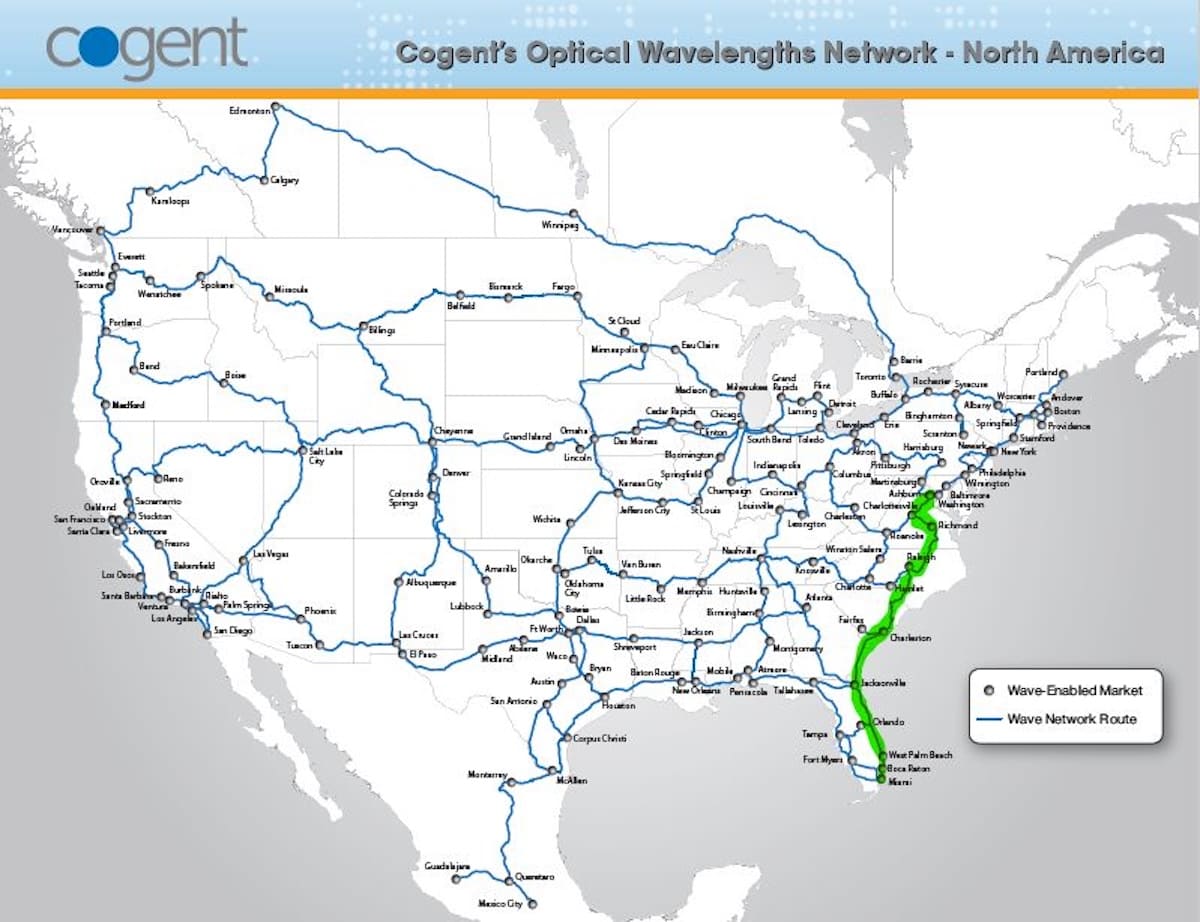
Cogent Communications is preparing a new high-capacity fiber route along the East Coast of the United States to connect Ashburn, Virginia, with Miami, Florida. The route aims at a very specific goal: providing high-capacity optical transport between one of the world’s largest data center hubs and several submarine cable landing points that connect North America with Europe, Latin America, and the Caribbean.
This development comes at a time when demand for connectivity is continually growing due to the expansion of artificial intelligence, cloud traffic, OTT services, carrier networks, and new neocloud platforms. Having capacity in a single campus or hub is no longer enough. Companies need diverse routes, low latency, more wavelength availability, and direct access to international exchange points.
From Ashburn to Miami: a corridor for moving global traffic
Ashburn has become one of the world’s data capitals. Its concentration of data centers, operators, hyperscalers, and content networks means much of the digital traffic in the United States passes through this Virginia region. Miami, on the other hand, is a major connection point toward Latin America and the Caribbean, as well as a transit hub for transatlantic routes and submarine systems landing in Florida.
Cogent’s new route seeks to connect these two worlds with a direct high-capacity fiber corridor. According to the commercial announcement about the deployment, the route would offer latency under 24 milliseconds, a capacity of 42.5 Tbps per system line, services of 10G, 100G, and 400G ready to deploy, and an installation timeline of 30 business days for certain services.
The value lies not just in linking two cities but also in connecting several cable landing stations, or CLS, along the Atlantic coast. Notable points include Telxius Virginia Beach, DC BLOX Myrtle Beach, JaxNAP in Jacksonville, Telxius Boca Raton, Equinix MI3, and OJUS in Hollywood, Florida. These points enable connections with submarine systems such as Dunant, MAREA, BRUSA, Firmina, Anjana, Nuvem, Monet, AMX1, PCCS, and TAM-1.
| Route Point | Role in Connectivity |
|---|---|
| Ashburn, Virginia | Major data center and cloud hub in the U.S. |
| Virginia Beach | Entry point for transatlantic cables like Dunant and MAREA |
| Myrtle Beach | New landing focus for cables to Europe and Latin America |
| Jacksonville | Key node for routes toward the Caribbean and Latin America |
| Boca Raton | Landing point for cables from Telxius and other operators |
| Miami / Hollywood | Traditional gateway to Latin America, Caribbean, and global networks |
The combined maximum design capacity of these ten submarine systems is around 2.64 Pbps, or 2,637 Tbps, according to the same commercial announcement. It’s important to note that design capacity does not necessarily equate to active, sold, or immediately available capacity. Still, it provides a sense of the corridor’s scale. This route is not intended for traditional business traffic but for transporting massive volumes between data centers, clouds, international networks, and submarine cables.
AI, cloud, and submarine cables are changing the value of terrestrial fiber
Artificial intelligence has highlighted an infrastructure component that seemed less visible for years: long-distance terrestrial routes. Training models, running inference, syncing data, feeding agents, moving video, replicating storage, or connecting cloud regions all require constant, predictable capacity. The bottleneck is no longer just in chips but also in how data moves between regions, data centers, and continents.
While submarine cables land at coastal points, their true value emerges when this capacity is transported to major inland hubs. A cable reaching Virginia Beach, Myrtle Beach, or Boca Raton needs backhaul to Ashburn, Atlanta, Dallas, Chicago, New York, or Miami. Without a solid terrestrial route, submarine capacity is limited by subsequent segments.
This is where Cogent’s strategy makes sense. The company already operates a global optical IP network and, since acquiring Sprint’s wireline business from T-Mobile in 2023, has additional long-distance assets in the U.S. that expanded its fiber footprint and strengthened services like wavelength, Ethernet, dark fiber, and large customer connectivity.
Cogent has also been positioning its optical network for high-capacity wavelength services. The company states it has nearly 1,100 locations equipped for waves supporting up to 400 Gbps per wavelength in markets such as Ashburn, Dallas, Silicon Valley, Miami, Portland, Los Angeles, Toronto, Vancouver, Querétaro, Monterrey, and Mexico City. The new Ashburn-Miami route aligns with this strategy: more routes, more capacity, and more delivery points for customers who want to avoid reliance on a single path.
| Service | Typical Use |
|---|---|
| 10G waves | Enterprises, regional operators, and dedicated traffic |
| 100G waves | Carriers, cloud, content, and large corporate networks |
| 400G waves | Hyperscalers, neoclouds, AI, massive backhaul, and submarine cables |
| Capacity (Tbps) | Aggregating traffic between hubs, CLS, and large data centers |
Demand isn’t only coming from traditional hyperscalers. Neocloud providers—specialized in AI infrastructure—also need high-performance routes to connect GPU clusters, storage zones, enterprise clients, and exchange points. Many of these players prefer dedicated, predictable optical routes over relying solely on general IP transit. They seek physical diversity and reliable performance.
A route with geopolitical and commercial significance
The Ashburn-Miami corridor also carries a strategic reading. The U.S. East Coast hosts several cable landing points for connections to Europe, Latin America, and the Caribbean. In an era of growing AI adoption, digital sovereignty, cloud dependence, and concerns over critical route security, pathway diversity becomes increasingly valuable.
For operators and large platforms, having alternative routes reduces exposure to physical cuts, congestion, equipment failures, or issues at exchange points. For finance, media, video streaming platforms, content networks, and cloud providers, latency and continuity are just as critical as cost per gigabit.
The significance of cables like Dunant and MAREA underscores the transatlantic relevance of this route. Google owns Dunant, which links Virginia Beach to the French Atlantic coast and was designed with a capacity of 250 Tbps, according to Google. MAREA, operated by Telxius and promoted by Microsoft and Facebook, connects Virginia to Sopelana in Spain—Telxius reports a capacity of 200 Tbps. Other systems such as Firmina, Anjana, or Nuvem further reinforce the connection between the US, Europe, and Latin America.
Cogent’s move isn’t isolated; other providers are also strengthening coastal routes, cable landing links, and backhaul to support submarine traffic. For instance, Arelion launched in 2023 a route between Reston and Florida to serve the east coast markets and traffic from cables heading to Latin America and the Caribbean. The competitive landscape reflects an understanding: being close to where international traffic lands is crucial.
Cogent’s innovation lies in combining reach, capacity, 400G services, and a clear focus on AI, hyperscalers, and neoclouds. In a market where every millisecond counts and AI workloads exponentially increase regional traffic, optical routes are no longer passive layers—they became a vital, competitive infrastructure.
The new Ashburn-Miami route reinforces an increasingly evident idea: the next phase of the internet isn’t just about bigger data centers. It also depends on fiber corridors that connect those centers to the submarine cables supporting global traffic. AI, cloud, and content reveal the fundamental truth: without fiber, there’s no cloud.
Frequently Asked Questions
What has Cogent Communications announced?
Cogent is developing a new strategic high-capacity fiber route along the U.S. East Coast to connect Ashburn, Virginia, with Miami, Florida, offering services for operators, hyperscalers, OTTs, and neoclouds.
Why is connecting Ashburn and Miami important?
Ashburn is one of the largest data center hubs globally, while Miami is a key point for connectivity to Latin America, the Caribbean, and international routes. Linking these markets reduces friction for cloud, AI, and submarine cable traffic.
What capacity will the route offer?
According to the deployment’s commercial announcement, the route will feature less than 24 ms latency, 42.5 Tbps per system line, services of 10G, 100G, and 400G, and installation timelines of 30 business days in certain cases.
Which submarine cables benefit from this corridor?
The route provides access to systems such as Dunant, MAREA, BRUSA, Firmina, Anjana, Nuvem, Monet, AMX1, PCCS, and TAM-1, connecting landing points in Virginia, South Carolina, Florida, and Miami.
via: LinkedIn
