

Cloud adoption in Spain is progressing with a paradox that well defines the current technological moment for many companies: the country still has room for improvement in basic cloud service adoption, but when organizations make the leap, they tend to use it for high-value processes. This is one of the main conclusions of the Cloud Nation 2026 Observatory, presented by Aire in collaboration with Atlas Tecnológico at an event held in Madrid.
The report paints a pragmatic picture of a Spanish company, less concerned with adopting technology as a trend and more focused on using it where it can improve real processes. According to data shared during the event, Spain reaches a 53% cloud usage rate compared to the EU average of 44% in certain analyzed metrics, especially excelling in cloud use for ERP, CRM, in-house computing, and development platforms.
Santi Magazù, CEO of Cloud and Cyber at Aire, and Zigor Gaubeca, the company’s CIO, were responsible for presenting the main ideas of the study. Both emphasized a recurring point throughout the event: cloud is no longer just a technological decision but a key component of competitiveness, security, and continuity for businesses.
The gap between large enterprises and SMEs remains open
The Cloud Nation 2026 Observatory shows that Spain has an unequal relationship with the cloud. Larger organizations and more digitized sectors are advancing faster, while SMEs and industry still face significant obstacles, including lack of technical knowledge, the complexity of migrating legacy applications, and fear of losing control over data.
Magazù warned that the real challenge for the country is to prevent SMEs and the industrial sector from falling behind. According to the report, the key is to offer more understandable solutions, technical support, and clear guarantees regarding security and data location.
Gaubeca highlighted the difficulty of migrating monolithic applications to cloud environments, a process that requires qualified profiles and practical knowledge. The shortage of specialized talent is therefore as significant a barrier as cost or technology. Many companies do not reject the cloud due to lack of interest, but because they don’t know how to proceed without taking unnecessary risks.
David Carrero Fernández-Baillo, co-founder of Stackscale (Aire), a company specialized in private cloud infrastructure, considers this evolution natural: “Spanish companies are no longer simply asking whether they should go to the cloud but what cloud they need, with what guarantees, and within what legal framework. Digital sovereignty isn’t about building walls but knowing where the data resides, who operates it, how it’s recovered, and what real options the client has if they need to switch providers.”
Sovereignty, regulation, and trust
Data sovereignty was one of the key topics of the day. The location of infrastructure, data protection, and the ability to maintain operational control have become strategic factors, especially in regulated sectors or those containing sensitive data.
The report indicates that security and data protection are now among the main reasons for deploying infrastructure at a national or European level. Performance, latency, business continuity, and the need to comply with increasingly stringent regulatory environments also weigh heavily.
During the roundtable, moderated by José Ángel Cuadrado Roca, legal and operational issues that influence any serious cloud strategy were discussed. José María Baños, founding partner of Letslaw, emphasized the importance of maintaining control over data and warned of the reputational impact that availability issues can have on a company. Sor Arteaga, managing partner at Easy Telecom Law Firm, focused on contractual reversibility and the importance of including clear exit clauses to prevent organizations from becoming trapped with a provider.
Following this same line, Carrero advocates that the journey to the cloud must be designed from the start with a joint technical and legal vision: “AI is accelerating decisions that previously were postponed, but speed should not be confused with improvisation. A good cloud strategy requires architecture, security, technical support, and legal advice from day one. If reversibility, data protection, or business continuity are left for the end, the project is born with debt.”
AI, edge computing, and the role of the tech partner
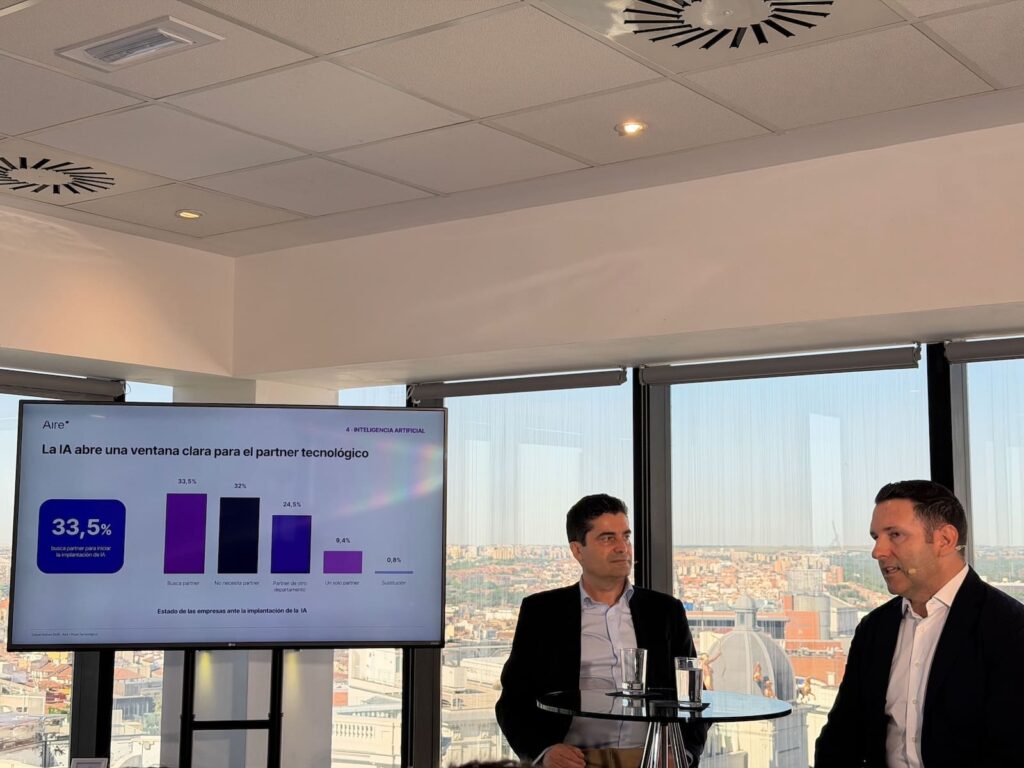
Artificial Intelligence appears as one of the main accelerators for cloud investment. Companies need more computing capacity, better data governance, and architectures capable of processing information near its source when latency, cost, or privacy demands it. That’s why the report places edge-to-cloud solutions among the priorities for industrial leaders.
Edge computing allows for processing and filtering data before sending it to the cloud, a strategy especially useful in manufacturing, predictive maintenance, logistics, energy, or environments where real-time decision-making can make a difference. But for AI to work effectively, infrastructure alone isn’t enough. Data must be organized, responsibilities assigned, access secured, and processes designed that can be measured and adjusted.
Miguel Hidalgo, system support manager at Konica Minolta, summarized this challenge with a simple analogy: if AI arrives at a disorganized company, it will ask for clear compute and data, but will encounter noise. Antonija Tadić, account director at WAM, urged strategic patience with a straightforward idea: when the client is in a hurry, more time must be invested in analyzing and designing the architecture before executing.
The tech partner gains weight in this context. For many SMEs and medium-sized companies, adopting cloud, AI, and edge computing simultaneously can be overwhelming. The choice of provider ceases to depend solely on price per resource and begins to include proximity, support, compliance, migration capability, sector knowledge, and contractual clarity.
Spain has a significant opportunity as a cloud hub for Southern Europe, but the report reminds us that growth will also depend on external factors beyond technology. Energy availability, distribution networks, and the capacity to make investments will be decisive. Teresa Mallada, senator of the Upper House, warned during the event about network node saturation and called for accelerated investments to prevent strategic projects from being blocked.
Cloud Nation 2026 concludes with a clear message: cloud in Spain is entering a more mature phase. It’s no longer enough to simply contract services. Companies must decide what data they can move, which must stay under control, how to comply with regulations, how to leverage AI, and how to exit a provider if necessary. Balancing technological ambition, sovereignty, and professional support will shape much of the digital competitiveness in the coming years.
Frequently Asked Questions
What is the Cloud Nation 2026 Observatory?
It is a report prepared by Aire in collaboration with Atlas Tecnológico that analyzes cloud adoption, data sovereignty, AI, and edge computing in Spain and Europe.
What is Spain’s main cloud paradox?
Spain still has growth potential in basic cloud service adoption, but excels in strategic use of the cloud for processes such as ERP, CRM, in-house computing, and development platforms.
Why is data sovereignty important?
Because it allows companies to know where their data is, under which legislation it’s managed, how it’s protected, and their capacity to migrate or recover services if they change providers.
