
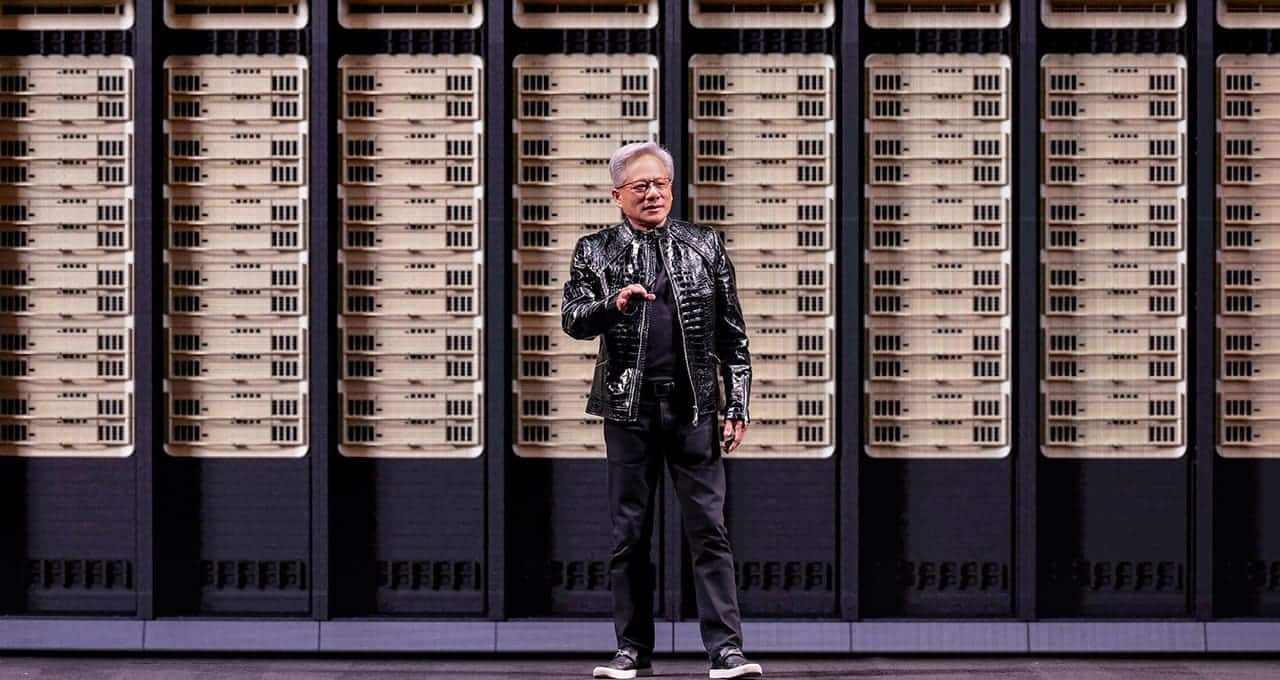
Jensen Huang has once again made Taiwan the symbolic stage of the new race for Artificial Intelligence. NVIDIA’s CEO gathered company employees at T17 and T18 in Beitou-Shilin Technology Park, Taipei, where the company’s future Taiwanese headquarters will be built, sending a highly strategic message: for NVIDIA, the island is one of the focal points of the AI revolution.
The meeting carried both a corporate and emotional tone. Huang addressed the staff, celebrated the progress of the headquarters project, and reinforced a point he has been emphasizing during his visits to the region for months: NVIDIA’s leadership cannot be understood without Taiwan’s role—its network of manufacturers, engineers, and semiconductor industry. According to Reuters, the executive stated that NVIDIA plans to spend approximately $150 billion annually in Taiwan—an amount that highlights the island’s importance in the company’s supply chain.
This is no small figure. In a time when the US, Europe, Japan, South Korea, and China are all striving to bolster their technological capabilities, Huang chooses to publicly highlight NVIDIA’s positive dependence on the Taiwanese ecosystem. His remarks covered more than just chips—they referenced an entire network: foundries, advanced packaging, system assembly, AI servers, networking, supercomputers, and technical talent.
Taiwan, much more than TSMC
When discussing semiconductors in Taiwan, TSMC is the first name that comes to mind. The company is the world’s leading manufacturer of advanced nodes and produces much of the chips powering AI data centers. But Huang’s message extends beyond a bilateral relationship between NVIDIA and its main manufacturing partner.
Taiwan has evolved into a comprehensive industrial platform for AI. Around TSMC, an ecosystem of design, testing, packaging, memory, boards, servers, and complete systems operates. Companies like Foxconn, Quanta, Wistron, Inventec, and Pegatron are all part of a chain capable of transforming GPU designs into racks ready for major data centers.
This ecosystem is difficult to replicate quickly. Generative AI and, more recently, agent systems have skyrocketed demand for accelerators, high-bandwidth memory, low-latency networks, and complete servers. Taiwan’s advantage isn’t only in manufacturing advanced chips but in coordinating a value chain that reduces lead times, enhances integration, and allows rapid scaling of production.
Huang’s mention of an annual $150 billion expenditure on the island should be understood in this context. It’s not just about real estate investments or local hiring, but about procurement volumes, industrial agreements, and operational spending that support NVIDIA’s AI business ecosystem.
A headquarters with strategic value
NVIDIA’s upcoming Taiwanese headquarters will be located in Beitou-Shilin Technology Park, on T17 and T18 plots. Taipei City Government and NVIDIA’s Taiwanese subsidiary signed an agreement in February for the project, with surface rights for 50 years and the option to extend for another 20. Taiwanese media report that the fee for these rights is around 12.2 billion New Taiwan dollars, roughly $390 million US dollars.
Construction of the campus, known as NVIDIA Constellation, is scheduled to begin this year, aiming for it to be operational by 2030. Local authorities describe the project as an investment capable of creating over 10,000 jobs and reinforcing Taipei’s position as a global tech hub.
For NVIDIA, this headquarters is more than just an administrative office. The company already has a strong presence on the island, but a large campus in Taipei signals a lasting commitment. Amid geopolitical pressures on semiconductors—where the US promotes domestic manufacturing and China seeks to reduce dependencies—NVIDIA makes it clear that Taiwan will remain a fundamental pillar of their strategy.
AI also depends on the supply chain
Huang’s message arrives at a time of significant global investment in AI infrastructure. Major hyperscalers are pouring tens of billions into data centers, networking, power, and chips. This investment frenzy has made NVIDIA one of the world’s most valuable companies but has also placed pressure on its entire supply chain.
NVIDIA’s risk isn’t only in selling enough GPUs. It also depends on capacity—foundries, packaging, memory, servers, cooling systems, and network equipment—being produced at the pace required by its customers. Many of these components are sourced from Taiwan.
Therefore, Huang’s words carry both industrial and political implications. Industrial, because AI relies on a highly complex physical infrastructure. Political, because the global digital economy depends on a territory situated in one of the most geopolitically sensitive regions of the world.
While NVIDIA has tried to diversify some manufacturing—through moves in the US and agreements in other countries—the density of the Taiwanese ecosystem remains hard to replace. The company may expand internationally, but its relationship with Taiwan continues to be central.
The event in Beitou-Shilin sent a clear message: NVIDIA aims to build not just a headquarters, but a symbol of its partnership with Taiwanese industry. In the era of AI, chips are crucial, but so are the places where they are designed, manufactured, assembled, and transformed into systems capable of supporting the next generation of digital services.
Frequently Asked Questions
What did Jensen Huang say about Taiwan?
NVIDIA’s CEO positioned Taiwan as one of the centers of the AI revolution and emphasized its role in the global semiconductor and AI system supply chain.
How much does NVIDIA plan to spend in Taiwan?
According to Reuters, Jensen Huang mentioned an estimated annual expenditure of about $150 billion in Taiwan, related to the local ecosystem supporting NVIDIA’s AI expansion.
Where will NVIDIA’s new headquarters in Taiwan be located?
The upcoming Taiwanese campus will be on T17 and T18 in Beitou-Shilin Technology Park, Taipei, with plans to be operational around 2030.
