
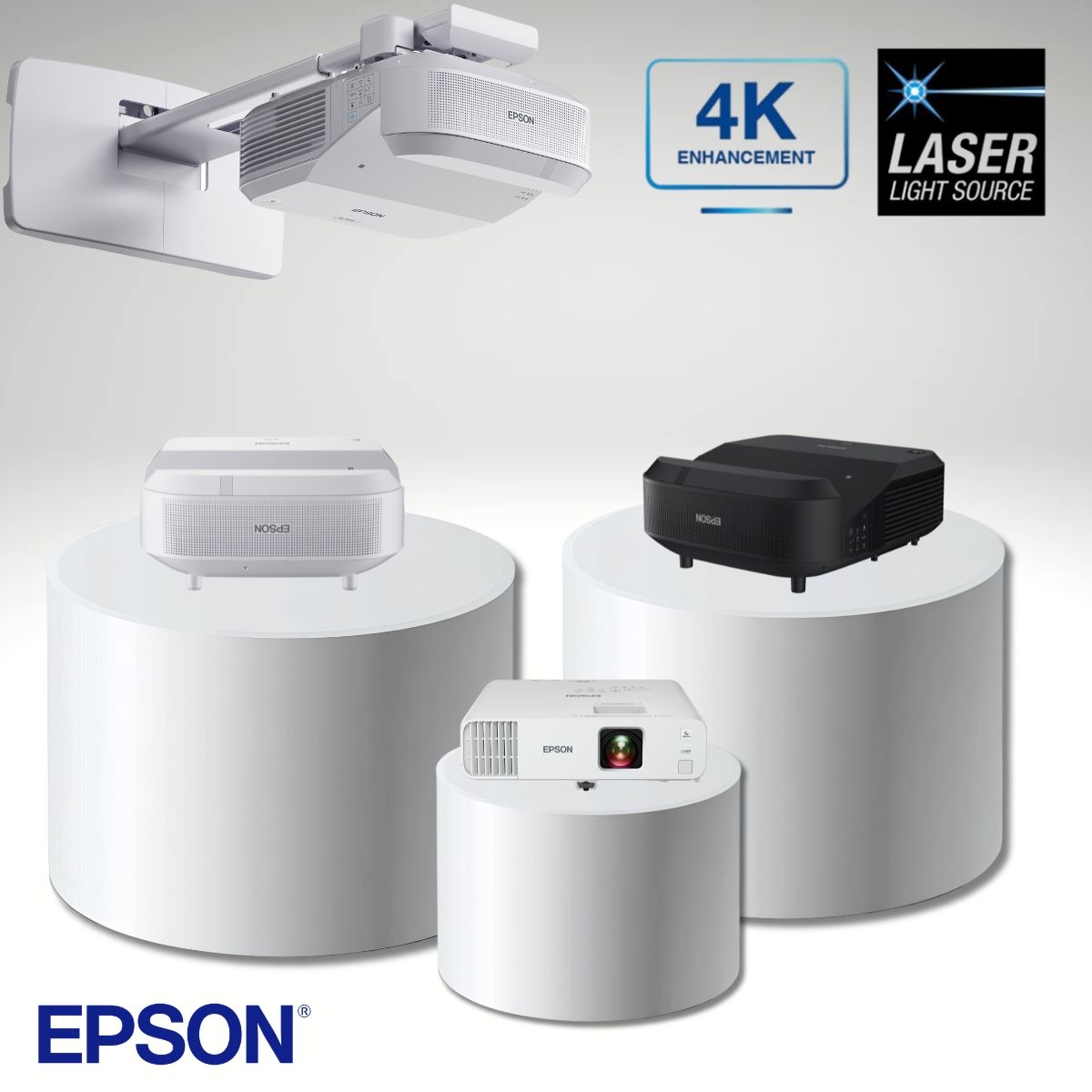
Epson has introduced a new family of PowerLite and BrightLink laser projectors aimed at strengthening its presence in classrooms, meeting rooms, collaborative spaces, and immersive environments. The company announced 10 new models with options for Full HD and 4K Enhancement, designed to cover everything from ultra-short throw installations to large-format portable units.
This launch responds to a clear trend: flat screens don’t always meet the imaging needs in educational, corporate, or creative spaces. When a large, flexible, and highly visible image for large groups is required, projection still makes sense. Epson now seeks to combine that size advantage with a more straightforward experience: wireless connectivity, collaboration tools, reduced maintenance, and faster setup for deployments involving many units.
Laser projectors for large images without complicated installation
The new lineup leverages Epson’s 3-chip 3LCD technology and includes standard throw, ultra-short throw, and portable format models. All the announced units weigh less than 20 pounds, approximately 9.1 kilograms, aiming to simplify both installation and subsequent management in educational centers, offices, and multipurpose spaces.
Epson emphasizes that image size remains critical. In classrooms, meeting rooms, or immersive exhibits, images of 100, 130, or even 180 inches can transform how users perceive content. The company compares its interactive BrightLink 870Ei and 780Ei models, capable of reaching up to 130 inches, with a 75-inch flat screen: Epson claims they provide a surface about three times larger.
In the ultra-short throw PowerLite 870E, 875E, and 780E models, the image can grow up to 180 inches. This feature is especially valuable for large classrooms, settings where multiple contents need to be displayed simultaneously, or installations where the projector must be placed very close to the wall to avoid shadows and visible cables.
| Series / Model | Type | Resolution / Enhancement | Brightness | Intended Use |
|---|---|---|---|---|
| BrightLink 870Ei / 780Ei | Ultra-short throw interactive | 4K Enhancement | Up to 5,000 lumens in 800E and 4,200 in 700E | Connected classrooms and interactive collaboration |
| PowerLite 870E / 875E / 780E | Ultra-short throw | 4K Enhancement | Up to 5,000 / 4,200 lumens depending on the series | Meetings, education, and immersive environments |
| PowerLite L370EG / L370E | Standard throw portable | 4K Enhancement | Up to 5,200 lumens | Large mobile projections |
| PowerLite L270F / L320FG | Standard throw portable | Full HD | Up to 5,200 lumens | Classrooms, meeting rooms, and presentations |
| PowerLite L320SF | Short throw portable | Full HD | Up to 5,200 lumens | Spaces with limited projection distance |
As is always the case with projectors, brightness figures should be understood within the usage conditions specified by the manufacturer. Epson reports color and white brightness measured under IDMS 15.4 and ISO 21118 standards, but actual results will depend on ambient lighting, projection surface, image size, and selected settings.
Connected classrooms, collaboration, and lower maintenance
The educational segment plays a central role in this announcement. The new BrightLink 870Ei and 780Ei models incorporate interactive functions, annotation tools, built-in audio, rechargeable interactive pens, and compatibility with Google Workspace and Microsoft 365. The BrightLink 870Ei features a touch module with finger support, while on the BrightLink 780Ei this function is available as an option.
Epson also introduces enhancements aimed at educational technology administrators. These include a mount for single-person installation, the Epson Setting Assistant app, NFC configuration for large deployments, and OTA updates on select models. The goal is to reduce the time IT teams spend installing, configuring, and maintaining projectors across many classrooms.
Maintenance is another key point. The solid-state laser light source promises up to 30,000 hours in extended mode and 20,000 hours in normal mode before brightness drops to approximately 50%, according to testing standards. This doesn’t mean the units won’t require any care over their lifespan—other components may need replacement sooner—but it significantly reduces the traditional burden of changing lamps regularly.
Connectivity has also been streamlined. The new Connection and Control Pad wall-mounted control box allows users to switch inputs, organize cables, and connect devices via USB-C, HDMI, and other options. It will be available in two configurations, one with HDBaseT and another without, depending on the projector model and installation type.
Portable projection for large-format experiences
The new PowerLite L-Series targets a more flexible profile: portable units with standard or short-throw capabilities capable of projecting very large images without the need for complex fixed installations. Epson mentions images approaching 500 inches in certain scenarios, with support for various aspect ratios, including ultrawide 16:6.
This option is suitable for educational centers that change rooms frequently, companies presenting in multiple spaces, temporary events, exhibitions, or light immersive experiences. Models include wireless connectivity, Miracast screen mirroring, Epson iProjection app support, and moderator functions to control displayed content.
They also feature two HDMI inputs, a built-in 16 W speaker with audio output, horizontal and vertical keystone correction, Quick Corner adjustment, and 1.6x optical zoom on appropriate models. While these may seem like minor details compared to brightness or resolution, they are crucial for daily use by installers and users. Fast setup and seamless source switching help avoid disruptions in classes or meetings.
Epson Classroom Connect complements this offering. The software enables wireless content sharing from PCs, Macs, Chromebooks, and iOS devices. It supports up to 50 connected devices and can display content from up to four sources simultaneously, with moderator controls allowing teachers to decide what is shown. Certain BrightLink models also permit on-screen annotation and local or cloud saving via OneDrive or Google Drive.
Phased availability in 2026
The new models will be released gradually. Epson anticipates PowerLite L270F, 780E, 870E, 875E, and BrightLink 780Ei to be available by summer 2026. PowerLite L370EG, L320FG, L320SF, and BrightLink 870Ei will arrive in fall 2026. The PowerLite L370E is expected at the end of 2026. All will be sold through authorized resellers.
This announcement also highlights the ongoing evolution of the professional visualization market. Flat screens have gained ground in many settings for their simplicity, brightness, and familiarity. However, projection retains a key advantage: scaling image size without proportionally increasing costs or physical footprint as much as large-format screens.
Epson aims to defend this position with projectors that are easier to connect, manage, and maintain. The focus is not just on higher lumens or larger images, but on reducing barriers that made some users perceive projection as a delicate technology reliant on specialists.
For schools, universities, businesses, and creative spaces, the new range offers an alternative to fixed large screens. Not every environment needs 180 or 500-inch images, but where size, flexibility, and collaboration matter, laser projection continues to have significant potential. Epson recognizes this and is actively strengthening that segment of the market.
Frequently Asked Questions
How many new projectors has Epson announced?
Epson has announced 10 new PowerLite and BrightLink models offering Full HD and 4K Enhancement options.
What’s the difference between BrightLink and PowerLite?
BrightLink is more oriented towards interactive classroom use, with annotation tools, pens, and tactile functions depending on the model. PowerLite covers non-interactive projection, ultra-short throw, and portable units.
What does 4K Enhancement mean on these projectors?
It’s an Epson technology that shifts pixels to surpass perceived Full HD resolution on screen, though it doesn’t necessarily mean a native 4K panel.
When will the new models be available?
Availability will be phased: some in summer 2026, others in fall, with the PowerLite L370E expected at the end of 2026.
via: news.epson
