
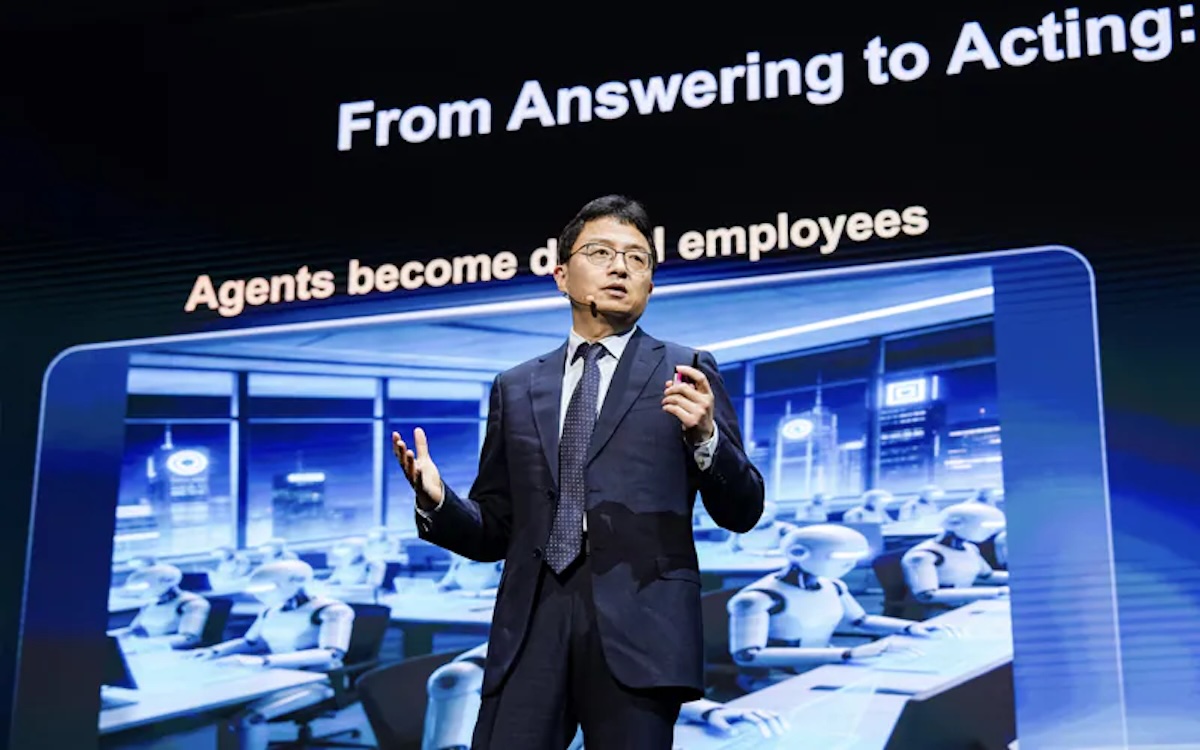
Huawei has unveiled in Paris a new data infrastructure solution for AI data centers, a proposal through which the Chinese company aims to strengthen its role in one of the least visible but most crucial layers of enterprise AI adoption: how data is stored, prepared, retrieved, protected, and reused to feed models and agents.
The announcement was made during the Huawei Innovative Data Infrastructure Forum 2026 held on May 21, where Yuan Yuan, Huawei’s Vice President and President of the company’s Data Storage Products line, emphasized that the next phase of enterprise AI will be data-driven. His clear message is: if companies want to deploy large-scale agents, models, and inference systems, simply adding more GPUs or accelerators is not enough. They also need a data architecture designed from the ground up for AI workloads.
Huawei’s proposal combines several components: data lake, AI data platform, contextual memory management, model engineering, resource orchestration, agent creation, and data resilience. It’s a full-stack approach aiming to cover everything from physical storage to the operation of enterprise agents.
Data as the Bottleneck in Enterprise AI
Over the past two years, much of the conversation around artificial intelligence has focused on models, accelerators, and data centers. However, actual enterprise adoption often encounters a more fundamental issue: data is not always ready to feed AI systems securely, quickly, and reliably.
A company may have years of information scattered across multiple locations, applications, document repositories, industrial systems, image repositories, logs, videos, vector databases, and cloud platforms. Transforming all that into actionable knowledge for agents and models requires more than raw storage. It involves importing multimodal data, classifying, visualizing, quality controlling, low-latency retrieval, and safeguarding against manipulation, ransomware, or misuse.
Huawei addresses this challenge with its data infrastructure solution for AI centers. According to the company, the architecture should be planned around several pillars: data lakes, AI platforms, computing power, models, agent frameworks, and resilience. This perspective is significant because it shifts focus from the model itself to the operational foundation that enables production deployment.
In the data lake component, Huawei highlights OceanStor Pacific Scale-Out Storage, with a declared density of 11 PB in 2U. The figure, presented by the company, tackles one of the major challenges in AI: storing enormous volumes of data without escalating physical space or total cost of ownership. It also includes DME Omni-Dataverse, a unified data space solution for importing multimodal data across sites and in real-time, while providing global visibility and recovery for large volumes of vectors.
Contextual Memory and KV Cache: The Inference Battle
One of the more technical elements of the announcement is Context Memory Storage (CMS), which Huawei presents as a solution for large-scale inference clusters. Its goal is to create a large, shared pool of KV cache at the petabyte scale, compatible with heterogeneous compute power.
The KV cache is a fundamental component in language model inference. It retains intermediate information generated during processing a conversation or task, so the model doesn’t need to recalculate everything repeatedly. In workflows involving agents, long documents, or persistent sessions, this memory can become a critical piece for reducing latency and costs.
Huawei claims that CMS can reduce the time to first token (TTFT) by up to 90%. It’s important to treat this figure as a manufacturer’s claim, pending validation based on actual configurations and loads. Nonetheless, the focus aligns with market trends: inference is no longer just about accelerators, but also how memory, context, cache, storage, and networking are managed.
The company also introduced a “3+1” data platform for enterprise inference scenarios. It integrates KV cache acceleration, a knowledge base with over 95% retrieval accuracy (according to Huawei), and an evolving memory bank. Additionally, the Unified Cache Manager allows coordination of this memory system and can improve inference accuracy by 30%, based on the company’s data.
| Huawei-Announced Layer | Main Function | Key Metric Reported |
|---|---|---|
| OceanStor Pacific | Scale-out storage for data lake | 11 PB in 2U |
| DME Omni-Dataverse | Unified data space and vector retrieval | Search over hundreds of billions of vectors |
| Context Memory Storage | Shared KV cache pool | Up to 90% reduction in TTFT |
| Platform 3+1 | Cache, knowledge, and memory for inference | Over 95% retrieval accuracy |
| Unified Cache Manager | Cache and memory management | Up to 30% increase in accuracy |
| ModelEngine Nexent | Agent creation via natural language | Up to 80% reduction in deployment time |
Models and Agents as Part of the Infrastructure
Huawei’s proposal isn’t limited to storage. It includes ModelEngine, a layer designed to facilitate model use, one-click deployment, and zero-code adaptation to new models. It also discusses fine-grained resource partitioning, with ratios of up to 1:10 in xPU partitioning, allowing a single resource to serve multiple purposes.
This aspect is crucial because many enterprises won’t operate just one model or task. They will have internal assistants, support agents, document analysis systems, vision models, semantic search engines, automation workflows, and business applications competing for resources. Poor management of this demand can turn AI infrastructure into an expensive and hard-to-govern mess.
The second component is ModelEngine Nexent, a platform for generating agents through natural language interaction. Huawei states it can reduce deployment time by 80%, and claims agents improve through automatic skill, prompt, and memory optimization. While these figures are manufacturer claims, they indicate a fundamental shift: agents are moving from experimental prototypes to operational components of enterprise environments.
This vision aligns with a broader trend. Agents are increasingly seen as “digital employees” capable of querying data, calling tools, executing processes, and maintaining context. But this also introduces risks. If an agent can access documents, business systems, or sensitive data, the infrastructure must log what it did, with what permissions, on which information, and under what controls.
Data Resilience Incorporated into AI Architecture
The final segment of the announcement focuses on resilience. Huawei warns of risks such as misuse of tools, data poisoning, manipulation, and ransomware. This is a vital mention because AI security isn’t limited to protecting models. It also involves safeguarding training data, document repositories, vectors, agent memories, cache flows, and the systems supporting inference.
An agent working with manipulated data can make poor decisions. A contaminated knowledge base might produce incorrect answers. Ransomware targeting a document repository can halt critical processes. An improperly governed sensitive memory pool can become a leak. Therefore, AI data infrastructure must be designed with protection at the source, not added as an afterthought.
Huawei’s announcement also has a competitive undertone. The company isn’t just offering storage hardware but a comprehensive architecture for enterprise AI centers. In a market where NVIDIA dominates much of the AI computing debate, and hyperscalers offer integrated AI platforms, Huawei aims to position itself through a focus on data, memory, storage, and agents.
Additionally, this proposal comes in a geopolitical context where China aims to reduce technological dependence and bolster its own enterprise AI platforms. With expertise in telecommunications, cloud, storage, and Ascend chips, Huawei is seeking to develop a more integrated alternative for industrial clients, government agencies, and large organizations.
The challenge will be demonstrating real-world performance, interoperability, cost-effectiveness, and maturity outside controlled environments. The figures presented are ambitious, but companies will need proof with their own data, workloads, and compliance requirements. In enterprise AI, technical marketing alone isn’t enough: architectures must operate reliably, securely, and maintainably.
Nonetheless, the core message is promising. The next phase of artificial intelligence won’t depend solely on larger models. It will depend on infrastructures capable of feeding those models with reliable data, efficient memory, fast search, governed agents, and protections against failures or attacks. Huawei has placed its bet: the heart of AI data centers starts with the data itself.
Frequently Asked Questions
What did Huawei present at the IDI Forum 2026?
Huawei unveiled a comprehensive full-stack data infrastructure solution for AI data centers, including storage, data lake, contextual memory, model management, agents, and resilience features.
What is Context Memory Storage?
It’s Huawei’s proposal to create a large, shared petabyte-scale KV cache pool for inference clusters, aimed at reducing latency and optimizing memory usage in AI workloads.
Why is KV cache important in generative AI?
Because it allows reuse of intermediate information during text generation or agent execution, minimizing repetitive calculations and improving response times in long sessions.
What security risks does Huawei aim to address?
Risks such as tool misuse, data poisoning, manipulation, and ransomware, all critical when agents and models rely on extensive data repositories.
