
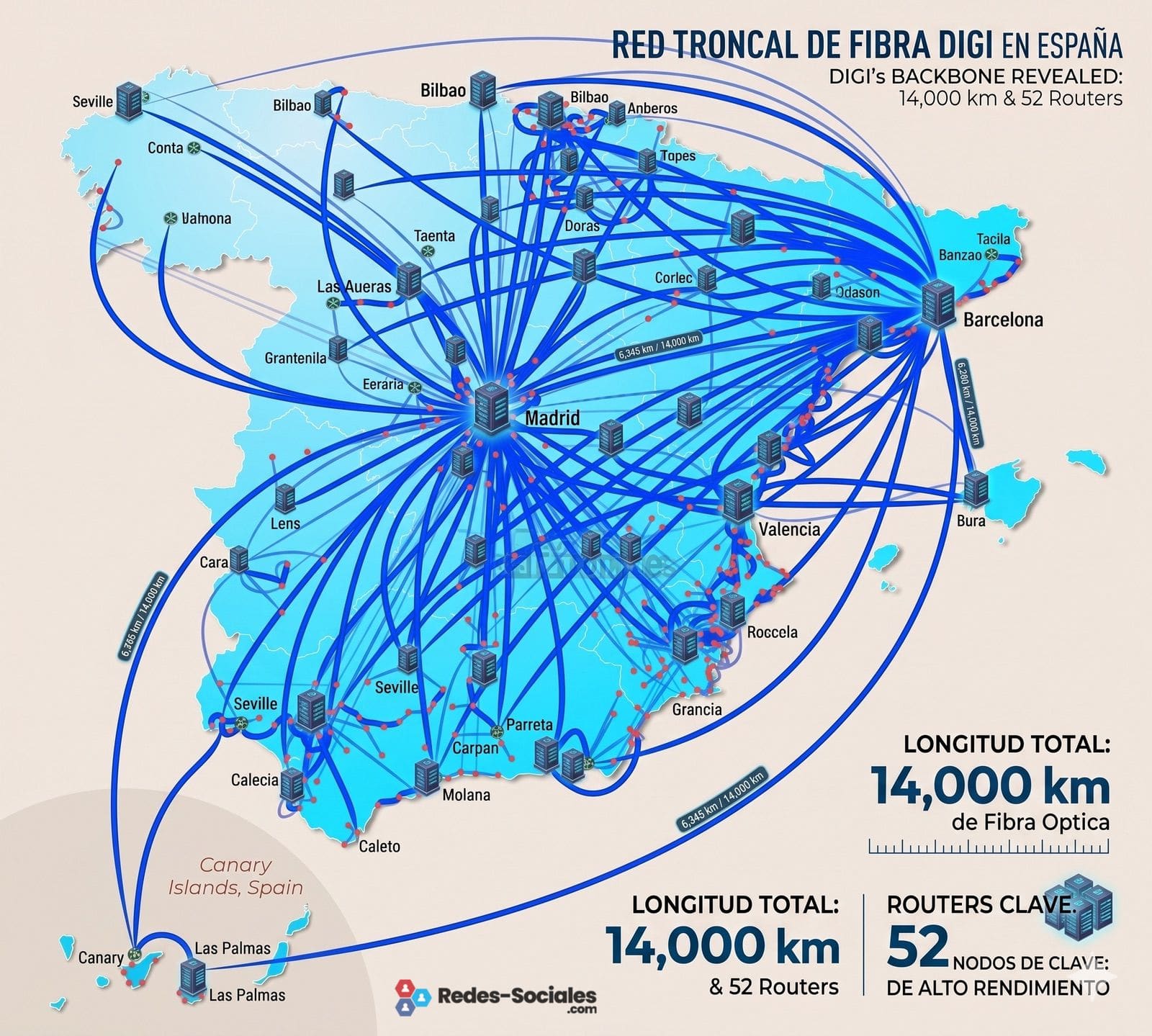
Digi has taken a somewhat unusual step for an operator that typically communicates more commercial figures than engineering details: it has publicly released its fiber backbone map in Spain for the first time. The image, included in its 2025 Annual Report, allows viewers to see how the core network supporting its fiber services is structured, including intercity connections and part of the infrastructure that underpins its growth in the Spanish market.
This move is of interest because it helps better understand what lies behind Digi’s expansion. The company doesn’t just compete on price; it is also building its own network and infrastructure agreements that enable it to offer fixed and mobile services with more technical control than a purely virtual operator. According to the report, its fixed network in Spain, made up of its FTTH XGS-PON and the SOTA network accessed via a consortium led by Macquarie Capital, passes through around 13.7 million homes. Additionally, Digi reports an intercity backbone of approximately 14,000 kilometers.
What the new Digi map shows
The map included in the report represents Digi’s fixed core network in Spain as of late 2025. It is not a commercial coverage map by municipality but a view of the infrastructure connecting nodes, cities, and points of presence. The blue lines depict fiber backbone links, and the icons spread across the territory appear to differentiate various types of network nodes.
Digi does not specify the exact meaning of each symbol in the document, so it’s best to avoid drawing absolute conclusions. Still, a visual count of the map allows identifying 52 green icons that, based on their appearance and distribution, seem consistent with core routers or main nodes. The red points could correspond to exchanges, fiber headends, locations with OLTs, or other technical access points. The company confirms the key figure: 14,000 kilometers of intercity backbone in Spain.
For the end user, the backbone is the invisible part of the internet—a network that transports traffic from cities, neighborhoods, and antennas to major exchange points and exit points to other networks. If the fiber reaching homes is the last leg, the backbone is the highway that enables all that traffic to flow.
| Key Data | Summary of Digi in Spain as of late 2025 |
|---|---|
| Intercity backbone network | 14,000 km |
| Homes passed by fixed and SOTA network | 13.7 million |
| Coverage over country’s households | 51.3% |
| Pensetration over homes passed | 15.8% |
| Visible core routers on the map | 52, based on visual count |
| Main fixed technology | FTTH XGS-PON |
| Additional wholesale access | NEBA over Telefónica’s network in specific areas |
Why a backbone network matters so much
Releasing the map changes how we interpret Digi’s growth. For years, the operator has expanded in Spain through aggressive pricing, mobile portability, and competitive fiber offers. But sustaining that growth requires more than just attractive tariffs: it demands transportation capacity, redundancy, interconnection agreements, and a network capable of handling increasing traffic volumes.
Having a broad backbone network allows an operator to reduce dependence on third parties, better control costs, and shape its expansion with more technical flexibility. It also helps connect fiber deployments, support converged services, and prepare for the evolution of its mobile network. In Spain, Digi is no longer just a reseller of capacity from others; its position has become more complex.
The annual report notes that Digi Spain began offering mobile services as an MNO in January 2025 through the National Roaming Agreement and RAN and spectrum sharing agreements with Telefónica. It also holds its own spectrum in several bands obtained under regulatory conditions tied to the creation of MasOrange. Practically, this marks Digi’s transition toward a more integrated operator.
Fiber also has strategic importance. Digi uses its own FTTH network, the SOTA network, and wholesale agreements like NEBA to expand into more areas. The SOTA network, sold to a consortium led by Macquarie Capital, continues to be used by Digi to provide services in certain regions. Additionally, in Andalucía, the company completed the deployment of a FTTH network reaching about 2.5 million homes as of October 2025.
From low-cost operator to infrastructure operator
The key is that Digi is beginning to appear less as an alternative operator supported by third-party infrastructure and more as a company with significant own infrastructure. While it doesn’t have the same scale as Telefónica, MasOrange, or Vodafone, its ability to compete increasingly depends less on price and more on its own architecture.
In 2025, Digi finished the year with 10.8 million RGUs in Spain, according to its annual report. Of these, 7.3 million were mobile services, and 2.6 million were broadband. The company also continued to lead in mobile portability in Spain for the fifth consecutive year. These figures explain why its backbone network is becoming a more visible piece of the market landscape.
| Area | Contribution to Digi’s growth |
|---|---|
| Own FTTH fiber | Control over fixed access and customer experience |
| SOTA Network | Additional coverage without owning the entire infrastructure |
| Telefónica’s NEBA | Service in areas where own coverage isn’t yet available |
| 14,000 km backbone | National transport for fixed traffic and growth support |
| Mobile agreement with Telefónica | Broad mobile coverage during Digi’s transition as an MNO |
| Own spectrum | Foundation for greater mobile independence in the medium term |
From a competitive standpoint in Spain, this data also signals strength. Following the Orange and MásMóvil merger, Spain’s telecom sector is more consolidated, yet Digi has established itself as the major challenger. Its backbone map demonstrates that this role isn’t purely marketing—it’s backed by physical investments in fiber, nodes, and financial agreements to scale coverage.
The challenge now will be maintaining balance. Telecoms are capital-intensive businesses: deploying fiber, maintaining networks, purchasing equipment, leasing capacity, paying for spectrum, and keeping prices low are complex endeavors. Digi has grown through an efficient strategy, but its continued expansion necessitates ongoing investments to avoid losing quality or operational margin.
This map publication doesn’t alone change the market, but it offers a rare snapshot of the infrastructure supporting one of Spain’s fastest-growing operators. To the average user, it might just be lines and dots, but to industry insiders, it’s a clear cue: Digi aims to compete from infrastructure, not just pricing.
Frequently Asked Questions
What exactly has Digi published?
Digi has included in its 2025 annual report a map of its fixed backbone network in Spain, along with data on homes passed, coverage, and fiber kilometers.
How many kilometers is Digi’s backbone network in Spain?
The company reports a backbone network of approximately 14,000 kilometers.
How many homes does Digi’s fixed network reach?
According to the annual report, its FTTH and SOTA networks collectively pass approximately 13.7 million homes in Spain.
Why is this map important for users?
Because it shows that behind Digi’s tariffs lies an extensive transport network. This infrastructure impacts capacity, growth, quality, and competition in the market.
