
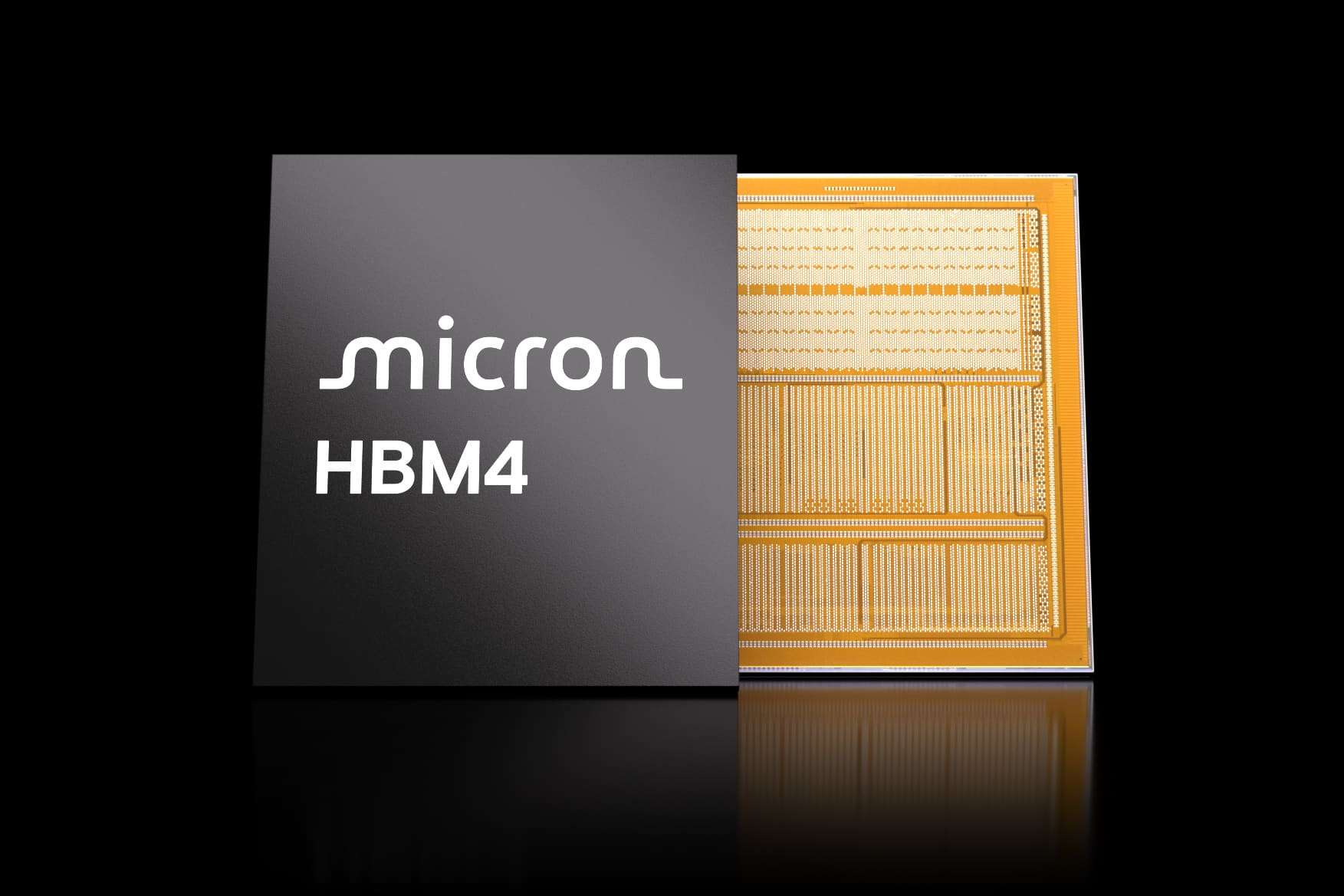
Micron has placed memory at the core of its artificial intelligence strategy. The company is preparing to transition to HBM4E in 2027, advancing in DRAM 1-gamma, accelerating its G9 NAND node, and beginning to speak more clearly about custom memory designs for AI platforms. The message is straightforward: in the next generation of data centers, memory will no longer be a secondary component around the GPU but a strategic piece affecting performance, cost, and availability.
Pressure is coming from multiple fronts. Larger language models require more bandwidth. Agentic inference consumes context, cache, and constant memory access. Rack-scale systems demand more capacity per server. And hyperscalers, accelerators manufacturers, and infrastructure providers want to secure supply before shortages worsen. Micron already warns that tight conditions in DRAM and NAND will persist beyond 2026.
HBM4E: the next memory battle for AI
The most notable point on the roadmap is HBM4E. Micron has already begun volume shipments of HBM4 36 GB 12H in Q1 2026, designed for NVIDIA Vera Rubin, and has also showcased a 48 GB 16-high version per stack, with 33% more capacity than the 12H version. The company claims that HBM4 surpasses 2.8 TB/s bandwidth per stack and offers better energy efficiency compared to HBM3E.
The evolution towards HBM4E targets 2027. According to TrendForce, Micron forecasts its first HBM4E product to become a JEDEC-standard, with ramp-up expected in 2027. The company will transition from using 1-beta DRAM in HBM4 to 1-gamma DRAM in the HBM4E era, with both standard and custom logic dies manufactured by TSMC.
| Product | Status / Timeline | Relevance for AI |
|---|---|---|
| HBM4 36 GB 12H | Mass production in 2026 | Designed for NVIDIA Vera Rubin, with over 2.8 TB/s per stack |
| HBM4 48 GB 16H | Samples sent to clients | More capacity per HBM cube for next-gen accelerators |
| Standard HBM4E | Ramp-up expected in 2027 | Performance and efficiency evolution for new platforms |
| Customized HBM4E | In development with TSMC logic dies, per TrendForce | Greater adaptation to specific clients and accelerators |
Customization is a key factor that could transform the business. Until now, HBM was primarily understood as an advanced memory product accompanying a GPU or accelerator. With HBM4E, the logic is beginning to shift toward designs more tailored to individual clients. AI chip manufacturers, companies with proprietary ASICs, and major cloud providers don’t just want more memory—they want memory that better fits their architecture, interconnection, power consumption, and economic model.
This could improve margins for Micron but also increases complexity. Customizing logic dies, coordinating advanced packaging, and designing alongside clients involves more engineering, greater dependence on partners like TSMC, and tighter validation cycles. Memory is thus approaching a collaboration model already dominant in large AI chips.
1-gamma and G9 NAND: the industrial backbone of the cycle
Micron’s roadmap isn’t solely dependent on HBM. The company is supporting its growth with two key nodes: 1-gamma DRAM and G9 NAND. During its fiscal Q2 2026 earnings call, Micron stated that 1-gamma is on track to become its largest-volume node in history and should constitute the majority of its DRAM bit mix by mid-2026. It also indicated that G9 NAND continues to aim for a majority share of NAND bits in the same period.
| Technology | Role in the roadmap |
|---|---|
| 1-gamma DRAM | Foundation for DRAM growth and future HBM4E |
| G9 NAND | Key node for data center SSDs and AI storage |
| EUV in 1-delta | Increased adoption of advanced lithography to improve cleanroom efficiency and scaling |
| QLC NAND | Greater emphasis on capacity and large-scale storage |
High-bandwidth memory attracts attention, but NAND is also beginning to play a growing role in AI. Micron links data center NAND demand to use cases like vector databases, KV cache offloading, and the increased role of SSDs in capacity storage tiers. Its portfolio highlights PCIe Gen6 SSDs based on G9 NAND and high-capacity 122 TB drives, making it clear: AI not only needs training and token generation but also large-scale data storage, search, and movement.
This explains why Micron is reorganizing investments and capacity. The company has increased CapEx, accelerates projects in Idaho, New York, Japan, Singapore, and India, and expects its new advanced packaging plant in Singapore to significantly contribute to HBM supply in 2027. It has also struck strategic deals with customers to secure multi-year visibility, including its first five-year agreement.
Memory becoming a strategic asset
The fundamental shift is that memory is no longer just a cyclical market. While it still experiences cycles, prices, and overcapacity risks, AI is introducing more structural demand. Each new generation of accelerators requires more HBM; each AI server needs more DRAM; each agentic inference flow consumes more context; and modern data architectures put additional pressure on high-performance, large-capacity SSDs.
| Demand drivers | Type of memory affected |
|---|---|
| Training large models | HBM, server DRAM |
| Agentic inference | HBM, LPDDR, DDR5, fast storage |
| KV cache and vector databases | Data center SSDs, high-capacity NAND |
| Rejuvenated traditional servers | Enterprise DRAM and SSDs |
| PC and workstation AI | LPDDR, DDR5, SSDs |
| Automotive and robotics | DRAM, LPDDR, industrial NAND |
For customers, the implication is clear: securing memory is becoming as critical as securing GPUs. Reserving accelerators alone is no longer enough. Major buyers want multi-year agreements, capacity visibility, and early collaboration with manufacturers. Micron recognizes this and aims to shift from component supplier to strategic architecture partner for AI platforms.
This also impacts the broader market. If more manufacturing capacity is dedicated to HBM, advanced DRAM, and data center products, other segments risk shortages or price increases. PCs, smartphones, automotive, industrial, and consumer storage sectors indirectly compete for cleanroom space, wafers, packaging, and investment priorities.
An opportunity with execution risks
Micron faces a clear opportunity. Demand for HBM and AI memory is growing faster than the industry’s ability to supply, and the company wants to capture more value with advanced nodes, custom products, and strategic agreements. However, execution will be demanding.
HBM isn’t traditional DRAM. It requires stacking, advanced packaging, close integration with accelerators, and tight coordination with clients. If yields don’t meet expectations, if packaging becomes a bottleneck, or if clients alter designs, the impact could be significant. Moreover, the market is not idle: SK hynix leads much of the HBM conversation, Samsung wants to regain ground, and major customers are diversifying supply to avoid dependence on a single supplier.
The difference is that Micron approaches this phase with a broader narrative. It’s not just about HBM. The company discusses HBM, DRAM, LPDDR, SSDs, NAND, packaging, strategic partnerships, and manufacturing capacity—aspects that could be an advantage if AI continues to fragment across training, inference, agents, edge devices, robotics, and hardware.
The next phase of AI won’t depend solely on who has the fastest GPU. It will depend on who can feed those GPUs with data, sustain scalable inference, reduce token power consumption, and ensure supply for years to come. In this race, memory is no longer in the background. Micron wants to be at the forefront.
Frequently Asked Questions
What is HBM4E?
HMB4E will be the evolution of HBM4, designed to offer higher performance, efficiency, and customization options for future AI platforms.
When does Micron expect to launch HBM4E?
Micron anticipates starting HBM4E ramp-up in 2027, with initial standard versions and customized options for clients.
Why does HBM customization matter?
Because AI accelerators increasingly depend on tight integration between compute, memory, and packaging. Custom designs can boost performance, reduce power, and better align with specific architectures.
Will memory shortages persist beyond 2026?
Micron expects tight supply-and-demand conditions in DRAM and NAND to continue past 2026, driven by AI, servers, and industrial capacity constraints.
