
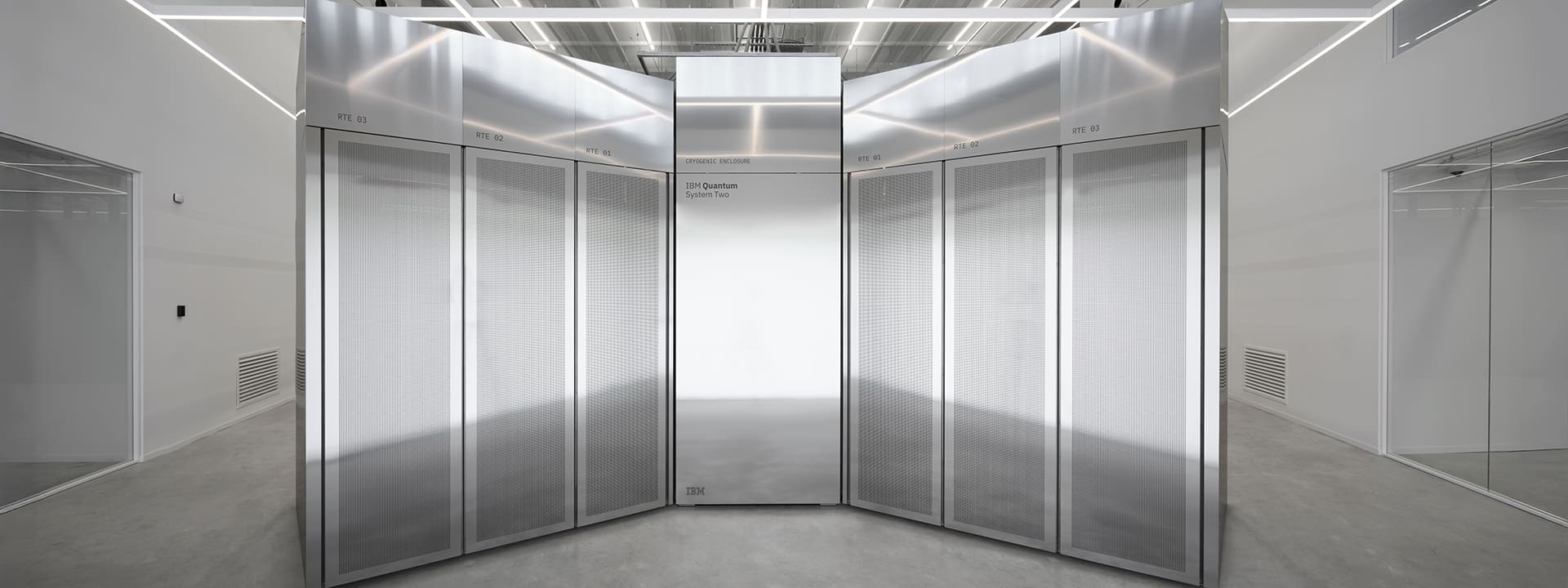
IBM and the U.S. Department of Commerce have signed a letter of intent to create the first American foundry specifically designed for quantum chips. The initiative will be supported by a proposed $1 billion funding under the CHIPS and Science Act program and will lead to the formation of Anderon, a new independent company driven by IBM to manufacture quantum wafers on U.S. soil.
This announcement marks a significant shift in Washington’s industrial policy. Until now, much of the debate around technological sovereignty centered on advanced semiconductors for artificial intelligence, memory, advanced packaging, or logical manufacturing. Quantum computing now enters this conversation more strongly: it’s not enough to research algorithms or build prototypes; the United States also aims to control the capacity to manufacture physical components that could support future fault-tolerant quantum computers.
According to IBM, Anderon will be headquartered in Albany, New York, and will operate as a 300-millimeter wafer fab. In addition to the proposed $1 billion from the Department of Commerce, IBM will contribute another $1 billion in cash, intellectual property, assets, and specialized personnel. The operation is still subject to negotiation and the signing of definitive documents, so it’s best to consider this a proposed agreement, not a finalized aid package.
A quantum foundry is not a conventional chip factory
The term “foundry” is typically associated with companies like TSMC, Samsung, or GlobalFoundries, which produce traditional chips for third parties. In this case, the concept is different. Anderon will focus on quantum wafers, starting with superconducting qubit technologies and supporting electronics, although IBM plans to expand its capacity over time toward other quantum modalities.
This distinction matters because quantum computing doesn’t scale simply by adding more transistors. Its systems depend on highly sensitive qubits, specific materials, cryogenic control, interconnections, superconducting wiring, advanced packaging, wafer testing, and processes capable of reliably reproducing results. The industrial challenge isn’t just creating a qubit in a laboratory but manufacturing many with sufficient quality and reproducing the process consistently.
IBM states that Anderon will provide advanced quantum wafer technologies, including superconducting wiring, through-silicon vias, bumps, process design kits, inline testing, and characterization. In industry terms: the company aims to turn part of the quantum research into a more repeatable, scalable, and accessible manufacturing chain for other ecosystem players.
| Project Element | Announced Data |
|---|---|
| New Company | Anderon |
| Drivers | IBM and U.S. Department of Commerce |
| Public Funding Proposal | $1 billion |
| IBM’s Contribution | $1 billion in cash, plus IP, assets, and personnel |
| Location | Albany, New York |
| Type of Facility | Quantum wafer foundry, 300mm |
| Primary Technology Focus | Wafers for superconducting qubits and supporting electronics |
| Status | Letter of intent, pending final documentation |
The strategy: a portfolio of companies, not a single bet
The agreement with IBM is part of a broader package. The Department of Commerce announced nine letters of intent offering a total of $2.013 billion in federal incentives to accelerate U.S. leadership in quantum computing. The package includes two quantum foundries—IBM and GlobalFoundries—and seven companies focusing on different quantum computing approaches.
GlobalFoundries would receive $375 million to establish a secure domestic quantum foundry targeting multiple architectures, including superconductors, trapped ions, photonic, topological, and silicon spin. Other companies in the group are Atom Computing, Diraq, D-Wave, Infleqtion, PsiQuantum, Quantinuum, and Rigetti, with planned aid to resolve technical bottlenecks in device reproducibility, optical complexity, error rates, cryogenic integration, ultrafast readout electronics, photon losses, and interconnections.
This structure reflects a pragmatic approach: Washington isn’t betting everything on a single quantum technology. Quantum computing remains an open field, with superconducting, photonic, neutral atom, ion-trap, and silicon spin approaches competing to demonstrate real scalability. The portfolio strategy reduces the risk of being stuck with one architecture if another emerges as the leader.
| Company | Planned Incentive | Main Area |
|---|---|---|
| IBM | $1 billion | Superconducting wafer foundry |
| GlobalFoundries | $375 million | Multimodal quantum foundry |
| Atom Computing | $100 million | Neutral atoms |
| Diraq | Up to $38 million | Silicon spin |
| D-Wave | $100 million | Superconductors, annealing, gate-model |
| Infleqtion | $100 million | Neutral atoms |
| PsiQuantum | $100 million | Photonic |
| Quantinuum | $100 million | Trapped ions |
| Rigetti | Up to $100 million | Superconductors |
Why it matters for technological leadership
Quantum computing is still far from mainstream adoption. There are significant advances, but also enormous challenges: error correction, qubit stability, scaling, integration, energy costs, cryogenics, software, and practical applications with demonstrated advantages. Therefore, the announcement should not be interpreted as the resolution of large-scale commercial quantum computers.
Its significance lies elsewhere. The U.S. aims to prevent the next strategic computing layer from depending on external supply chains. The experience with advanced semiconductors and AI has provided a clear lesson: those who control manufacturing hold a decisive part of technological power. In quantum, this manufacturing isn’t yet industrialized at scale, making this a critical moment to stake positions.
IBM approaches this phase with a prominent position. The company claims to have deployed over 90 quantum systems and maintains an ecosystem of clients and partners that includes more than 325 Fortune 500 companies, startups, universities, and government agencies. It also aims to deliver a large-scale, fault-tolerant quantum computer for commercial customers by 2029.
The creation of Anderon could have a significant impact if it truly expands manufacturing capacity for multiple suppliers. A specialized quantum foundry could accelerate hardware iterations, improve reproducibility, lower entry barriers for startups, and help turn prototypes into more manufacturable systems. In an industry where many advances die when moving from lab to scalable manufacturing, this layer could be decisive.
There are also national security implications. The Department of Commerce notes that quantum computing could impact defense, advanced materials, biopharmaceutical discovery, financial modeling, and energy systems. Cryptography is another dimension: although quantum algorithms capable of breaking widely used encryption are not yet available, governments are already preparing the transition to post-quantum algorithms.
This announcement reaffirms that the U.S. industrial policy no longer limits itself to manufacturing classical chips. The next frontier combines AI, semiconductors, photonics, cryogenics, materials, and quantum technologies. Anderon alone doesn’t guarantee U.S. leadership, but it clearly signals that the race has entered a more physical, industrial phase less dependent on isolated laboratories.
For Europe, this move also has strategic implications. If the U.S. accelerates a network of quantum foundries supported publicly and with state equity participation, the EU will need to decide whether its quantum strategy remains at the level of excellent research or if it seeks to build comparable industrial capacity. In strategic technologies, publishing papers is no longer enough when others begin producing wafers.
Frequently Asked Questions
What have IBM and the U.S. Department of Commerce announced?
They have signed a letter of intent to create Anderon, an independent company of IBM that will operate as the first U.S.-based foundry specializing in quantum wafers.
How much funding will the project receive?
The Department of Commerce proposes up to $1 billion in CHIPS incentives, while IBM plans to contribute $1 billion in cash, plus intellectual property, assets, and personnel.
Where will the quantum foundry be located?
Anderon will be headquartered in Albany, New York, and will operate a 300mm quantum wafer fabrication facility.
Why is a quantum foundry important?
Because it helps transition from laboratory prototypes to more repeatable, scalable manufacturing of quantum components, a necessary step toward building larger, more reliable quantum systems.
Sources:
- IBM, “IBM and U.S. Department of Commerce Announce America’s First Purpose-Built Quantum Foundry”.
- NIST / U.S. Department of Commerce, “Department of Commerce Announces Letters of Intent With 9 Companies for $2 Billion to Accelerate U.S. Leadership in Quantum Computing”.
- The Quantum Insider, “IBM and U.S. Department of Commerce Announce Proposed $1 Billion CHIPS Award to Fund Purpose-Built Quantum Foundry”.
- HPCwire, “IBM and U.S. Department of Commerce Announce Purpose-Built Quantum Foundry, Supported by Proposed $1B CHIPS Award”.
