
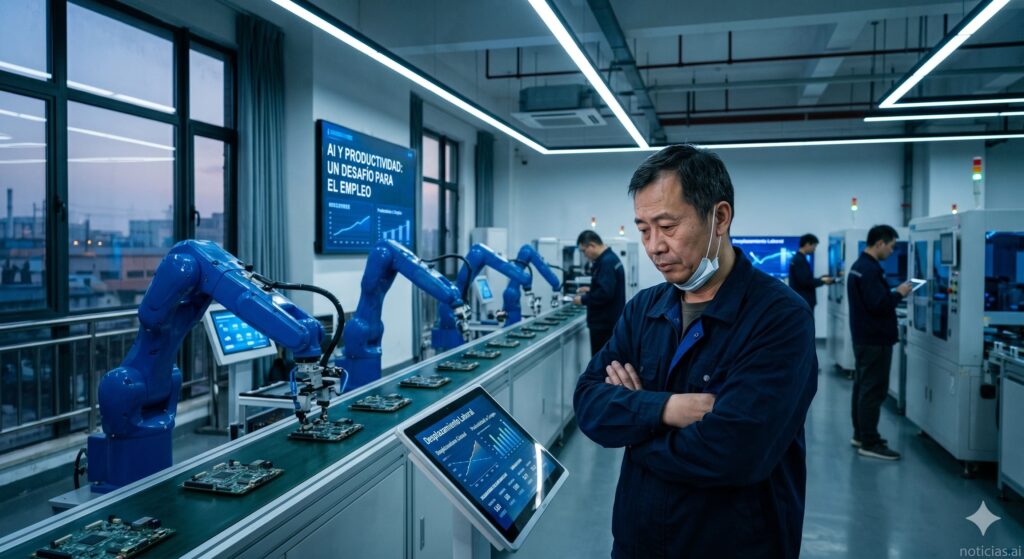
China has initiated a conversation that extends far beyond labor law. The recent decision by Chinese courts to consider dismissals of workers replaced by artificial intelligence (AI) systems as unjustified does not constitute a blanket ban on automation-driven layoffs, but it sends a clear market signal: AI cannot automatically serve as an excuse to shift all the costs of technological transitions onto employees.
The most cited case involves a worker in Hangzhou dismissed after his company argued that an AI system could handle a significant portion of his tasks. Chinese courts declared the dismissal illegal and awarded over 260,000 yuan in compensation. The underlying message isn’t that companies cannot adopt AI, but that they must better justify organizational changes and take on more social responsibility when automation impacts employment.
From a technological perspective, this is an uncomfortable realization. If a company incorporates AI, automates processes, and increases productivity, it has two main ways to capture that value: reduce labor costs or produce more with the same workforce. If legal, social, or political reasons limit the first approach, the second becomes more likely. In a country with China’s industrial capacity, this can have global consequences.
AI as a productivity multiplier, not just an efficiency enhancer
Discussions about artificial intelligence tend to focus on offices, programmers, customer service, or content creation. But in China, the deeper impact may lie in the combination of AI and physical industries: factories, logistics, quality control, inventory, design, procurement, predictive maintenance, and demand planning.
AI does not produce cars, batteries, solar panels, or electronic components on its own. However, it can better coordinate the supply chain that manufactures them. It can reduce errors, optimize shifts, anticipate breakdowns, detect defects, accelerate prototyping, improve routing, and better match supply with demand. When these improvements are applied across thousands of companies simultaneously, the result is not just internal efficiency; it could be an increase in the country’s overall productive capacity.
The dilemma is straightforward to explain but difficult to manage. A company that previously produced 100 units with 100 workers might use AI to produce the same 100 units with just 70 employees. But if the political or legal environment makes workforce reductions difficult, it may attempt to produce 140, 180, or 200 units with the same 100 workers. Productivity rises, employment remains stable, but the market must absorb the excess.
| AI Adoption Scenario | What the company does | Microeconomic effect | Macroeconomic risk |
|---|---|---|---|
| Automation with layoffs | Maintains production but reduces workforce | Improves margins and lowers costs | Unemployment, decreased consumption, social tension |
| Automation without layoffs | Maintains workforce and increases output | Increases volume and lowers unit costs | Overcapacity and price pressure |
| AI to boost exports | Uses productivity gains to gain market share abroad | Enhanced international competitiveness | Trade conflicts and tariffs |
| Internal efficiency via AI | Reduces waste and downtime | Improves profitability without increasing volume | Less external impact if overall production doesn’t grow |
| AI combined with industrial policy | Coordinates automation, employment, and scale | Strengthens strategic sectors | Increased global dependence on China |
The difference between efficiency and overproduction depends on demand. If the market grows, the additional productivity can be absorbed. If it doesn’t grow enough, inventories build up, price wars emerge, and aggressive exports ensue. This is already happening in sectors where China has accumulated industrial capacity far beyond domestic demand.
Chinese overcapacity may acquire a new algorithmic layer
Europe already views Chinese industrial overcapacity with concern. The European Parliament has analyzed how excess capacity in various sectors can distort competition, pressure European manufacturers, and increase reliance on critical imports. The discussion encompasses electric vehicles, steel, chemicals, industrial components, batteries, solar panels, and other sectors where China combines scale, public support, mature supply chains, and prices hard to match.
AI can act as an additional layer over this industrial machinery. It does not replace subsidies, energy, logistics, or raw material availability, but it can enable the entire system to operate more precisely. For a factory, a small improvement in forecasting, defect detection, energy use, inventory management, or machine uptime can translate into substantial savings at scale.
The challenge for Europe and the US is not that China automates. All advanced economies will automate. The key difference is that China can combine automation with industrial discipline, lower costs, protected employment, and export pressure. If this mix works, global competition will be decided not just by who has better AI models but by who can turn them into cheaper, more consistent physical production.
For a technology-minded audience, this is the most relevant part: AI will not be just software. It will be an industrial coordination technology. Its impact will be seen not only in chatbots, scheduling agents, or office assistants but in factories that produce more with fewer errors, warehouses that rotate inventory more efficiently, manufacturers that shorten lead times, and supply chains that respond faster than their competitors.
The hidden costs: energy, water, and raw materials
The hypothesis of producing more with the same workforce leads to another concern: resources. If AI increases the capacity to manufacture physical goods, the pressure does not only fall on the labor market. It shifts to electricity, water, minerals, transportation, data centers, and waste.
The International Energy Agency estimates that data center electricity consumption could rise from 485 TWh in 2025 to around 950 TWh in 2030. AI-focused data centers will grow even faster within that total. This direct demand adds to indirect consumption triggered by a more automated, data-intensive, and productive industry.
AI can also help reduce energy use, optimize electrical grids, improve industrial efficiency, and prevent waste. Not everything leads to higher consumption. But if the main incentive is to produce more to compensate for labor cost constraints, the overall balance may become more complicated.
| Resource | How AI May Impact It | Risks if production increases |
|---|---|---|
| Electricity | Data centers, inference, industrial automation | More strain on grids and generation capacity |
| Water | Cooling and industrial processes | Greater stress in water-scarce regions |
| Critical minerals | Hardware, batteries, sensors, electronics | Increased dependence on global supply chains |
| Transport | Faster exports and deliveries | Greater congestion and emissions |
| Waste | Rapid product and equipment turnover | More pressure on recycling and environmental management |
The paradox is that AI can be a tool to make industry more sustainable and, at the same time, fuel a volume-based race if used to produce cheaper and faster. Much will depend on the incentives in place.
Job protection as a geopolitical advantage
The Chinese courts’ decision can be seen as a form of labor protection but also as part of a broader strategy. China needs to adopt AI at scale without triggering social crisis due to technological unemployment. Its young population has already faced significant labor tensions, and haphazard automation could worsen these issues.
The emerging approach is different: allow companies to incorporate AI, but prevent every productivity gain from immediately translating into layoffs. This can help maintain internal stability while pushing companies to compete through volume, quality, and exports.
For Western tech companies, the lesson is clear. AI will not develop in a vacuum. Each country will integrate it based on its productive structure, labor market, and industrial policy. In the US, it may accelerate cost reductions and office automation. In Europe, regulation, labor negotiations, and sectoral protections may shape its deployment. In China, it can be a tool to produce more without upsetting social balance.
The risk is a three-speed AI: an American AI focused on software and corporate productivity, a more regulated and cautious European AI, and a Chinese AI embedded in manufacturing, logistics, and exports. If that scenario materializes, the economic impact will be asymmetric.
China has not outright banned AI-driven layoffs, but the judicial signals are already shifting incentives. When the second largest economy in the world nudges in that direction, the rest of the planet takes notice. The question is not only whether AI will displace jobs but also whether efforts to protect employment might drive the system to produce more than the market and planet can sustain.
Frequently Asked Questions
Has China banned layoffs due to AI?
Not entirely. What is known are judicial decisions that limit using AI as an automatic justification for dismissals without sufficient legal cause.
Why can this affect global industry?
Because if companies keep labor and increase productivity with AI, they can produce more, lower prices, and boost exports, pressuring competitors worldwide.
Does AI always lead to overproduction?
No. It can improve efficiency without increasing volume. The risk arises when firms leverage that efficiency to gain market share by producing more in markets that are not growing as fast.
What should European companies watch out for?
The combination of AI, China’s industrial scale, low costs, government support, and export pressure. Addressing this challenge requires more than regulation; it also involves investment, automation, competitive energy, and industrial strategy.
