
Amazon started by selling books online, but that image no longer helps to understand the company. Today, the company led by Andy Jassy operates as a store, marketplace, cloud provider, ad network, audiovisual platform, logistics operator, device manufacturer, healthcare provider, satellite company, and an increasing player in artificial intelligence. Each new layer strengthens the others, and that’s the real competitive challenge.
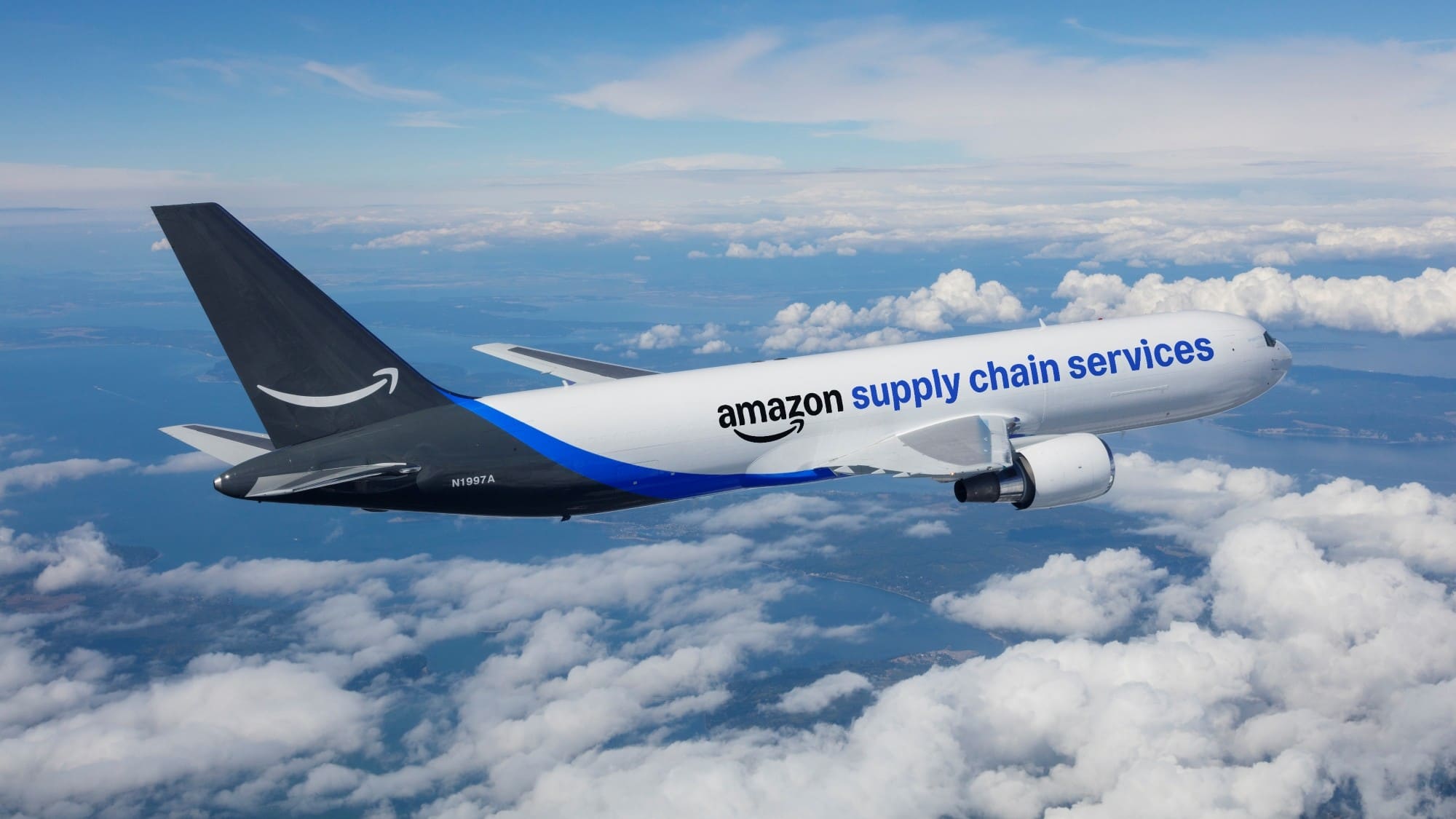
The launch of Amazon Supply Chain Services (ASCS), opening its logistics network to any business, is not an isolated move. It is another piece of a strategy Amazon has been refining for years: building infrastructure to solve its own problems, turning it into a product, and then selling it to the market. It did it with AWS in cloud computing. It did it with Fulfillment by Amazon (FBA) in e-commerce. Now, it aims to do it with transportation, warehousing, customs, inventory, and last-mile delivery.
In 2025, Amazon reached $716.924 billion in net sales, a 12% increase from the previous year. Only AWS generated $128.725 billion, the advertising business reached $68.635 billion, and third-party seller services added up to $172.162 billion. Online stores contributed $269.287 billion, while Prime and other subscriptions totaled $49.619 billion. The financial picture makes it clear that Amazon no longer depends on a single activity; it gains power because it controls many simultaneously.
The Amazon Machine: Sectors and Rivals
Amazon competes with very different companies because its businesses are no longer easily separable. Its marketplace attracts customers. Prime improves retention. FBA ties sellers to its logistics network. Amazon Ads turns purchasing intent into advertising. AWS funds infrastructure, AI, and third-party services. Now, ASCS is trying to open the full logistics chain to companies that don’t even sell on Amazon.
| Sector | What Amazon does | Main competitors |
|---|---|---|
| E-commerce and Marketplace | Sells its own products and allows third parties to sell on Amazon Marketplace. | Walmart, eBay, Shopify, Mercado Libre, Alibaba, Temu, Shein, Target, Carrefour, El Corte Inglés. |
| Seller services | Charges commissions, fulfillment, storage, shipping, and related services to external sellers. | Shopify, eBay, Walmart Marketplace, Mirakl, WooCommerce, BigCommerce. |
| Logistics and last mile | Manages fulfillment, transportation, parcel delivery, storage, and now ASCS for third parties. | UPS, FedEx, DHL, USPS, Maersk, DSV, Kuehne+Nagel, GXO, XPO, C.H. Robinson. |
| Cloud and infrastructure | AWS offers computing, storage, databases, AI, custom chips, and managed services. | Microsoft Azure, Google Cloud, Oracle Cloud, IBM Cloud, OVHcloud, Hetzner, DigitalOcean, CoreWeave. |
| Artificial intelligence | Bedrock, Trainium, Inferentia, infrastructure for training and inference, with agreements with Anthropic. | Microsoft/OpenAI, Google, Meta, NVIDIA, Oracle, IBM, CoreWeave, xAI. |
| Digital advertising and retail media | Amazon Ads sells sponsored ads, display, video, and purchase-based advertising. | Google, Meta, Walmart Connect, TikTok, Instacart, Criteo, The Trade Desk. |
| Streaming and entertainment | Prime Video, MGM, live sports, music, audiobooks, and Twitch. | Netflix, Disney+, YouTube, Apple TV+, Max, DAZN, Spotify, Warner Bros. Discovery. |
| Devices and smart home | Echo, Alexa, Fire TV, Kindle, Ring, Blink, and eero. | Apple, Google Nest, Samsung, Roku, Sonos, Xiaomi, Philips Hue. |
| Food and brick-and-mortar retail | Whole Foods, Amazon Fresh, physical stores, and online food sales. | Walmart, Costco, Kroger, Target, Carrefour, Tesco, Aldi, Lidl. |
| Health and pharmacy | Amazon Pharmacy, One Medical, and digital health services. | CVS Health, Walgreens, UnitedHealth/Optum, Teladoc, Hims & Hers, traditional pharmacies. |
| Satellite internet | Amazon Project Kuiper, now Amazon Leo, aims to offer broadband via a constellation of LEO satellites. | Starlink, OneWeb/Eutelsat, Telesat, telecom operators. |
| Payments and financial services | Branded credit cards, Amazon Pay, financing, and seller services. | PayPal, Stripe, Adyen, Klarna, Apple Pay, Google Pay, banks, and fintech firms. |
The table explains why Amazon is difficult to analyze with traditional competitive tools. UPS can compete with Amazon in parcel delivery. Google can compete in advertising. Microsoft competes with AWS in cloud services. Netflix, with Prime Video. But none of these companies fully replicates the combination of store, purchase data, logistics, cloud, advertising, devices, subscriptions, and direct consumer relationships.
This is Amazon’s real power: it may not always dominate each market separately, but it connects markets that were previously isolated. When a seller uses Amazon Marketplace, they may pay commissions, storage fees, fulfillment costs, advertising, data tools, and logistics services. When a consumer subscribes to Prime, they get shipments, video, music, promotions, storage, and perks that make shopping outside less likely. When a brand seeks visibility, Amazon doesn’t just sell advertising—it provides access precisely at the point where a purchase decision is made.
The AWS precedent and the new logistical leap
AWS exemplifies this pattern best. Amazon built technological infrastructure to support its growth and later opened it to the market. In 2025, AWS generated $128.725 billion in revenue and $45.606 billion in operating profit, more than half of Amazon’s total operating profit. In Q4 2025, Synergy Research ranked AWS as the leading global cloud provider, with a 28% market share, ahead of Microsoft and Google.
The new logistics strategy follows a similar logic. ASCS offers third parties an end-to-end portfolio of freight, distribution, fulfillment, and parcel services. Amazon claims its network includes maritime, air, land, and rail transportation, customs clearance, unified inventory, AI-driven forecasting, multi-channel delivery, and a centralized platform for service contracting. Initial clients include Procter & Gamble, 3M, Lands’ End, and American Eagle Outfitters.
The challenge for UPS, FedEx, and DHL is not only that Amazon now delivers parcels. That was already happening. The threat is that Amazon sells a full supply chain. If a company can move raw materials, store inventory, distribute finished products, prepare orders, sell across channels, and deliver directly to customers within a single network, logistics providers shift from being merely transporters to becoming the operational backbone of commerce.
This move increases dependency risks. A brand might start by selling online through Amazon and then use FBA to speed delivery, run advertising campaigns to maintain visibility, and now rely on ASCS to move inventory outside Amazon. Each step seems rational, but collectively, they place a growing portion of the business within Amazon’s private infrastructure.
Advertising, data, and AI: the invisible layer
Amazon’s advertising business is one of the least visible to consumers but one of the most strategic for the company. In 2025, it generated $68.635 billion—more than many tech giants. Amazon Ads’ strength lies not just in showing ads but in doing so at the moment when users search, compare, or purchase. Google knows search intent. Meta understands interests and relationships. Amazon knows commercial intent and final conversion.
This advantage is reinforced through its marketplace and logistics. The more sellers depend on Amazon for sales, the more data Amazon collects on demand, pricing, inventory turnover, and margins. The more brands purchase ads for visibility, the stronger that circle becomes. And the more inventory, fulfillment, and distribution processes automate, the harder it is to separate commerce from the infrastructure supporting it.
AI adds another layer. AWS sells AI services to companies, Bedrock integrates models from various providers, Amazon develops its own chips like Trainium and Inferentia. The company has made AI infrastructure a major investment area. In 2025, Jassy announced that Amazon plans to spend around $200 billion in capex for 2026, focusing on AI, chips, robotics, and satellites.
The core question isn’t just whether Amazon will compete in AI. It already does. The real question is what happens when AI is trained, deployed, sold, and run on Amazon’s cloud infrastructure, integrated into logistics, improved through advertising, automated customer service, enhanced in its marketplace, and optimized across the supply chain. In that scenario, AI is not just another product—it’s the cement binding all these layers together.
Slow regulators versus a company driven by accumulation
The antitrust debate around Amazon is not just rhetorical speculation. In September 2023, the FTC and 17 state attorneys general sued the company, alleging it unlawfully maintained monopoly power in the “online big-box” and seller marketplace markets. The FTC accused Amazon of using interconnected tactics to hinder rivals, harm sellers, and keep prices high. Amazon denies these allegations, claiming its practices benefit consumers and small businesses.
In Europe, the European Commission accepted legally binding commitments from Amazon in 2022 to address concerns about the use of non-public seller data, access to the Buy Box, and Prime conditions. In 2023, Amazon was also designated as a gatekeeper under the Digital Markets Act, alongside Alphabet, Apple, ByteDance, Meta, and Microsoft.
The challenge is that regulation tends to target specific sectors as Amazon expands through accumulation. One investigation might focus on its marketplace. Another on seller data. Another on advertising. Yet another on logistics. Meanwhile, Amazon integrates all these components into a single system. This speed disparity is crucial: regulators investigate in compartments, but the company builds an integrated network.
It’s important to clarify: Amazon doesn’t have an absolute monopoly across all sectors in which it operates. It competes with Microsoft and Google in cloud. Google and Meta remain giants in advertising. Netflix, YouTube, and Disney hold strong positions in streaming. UPS, FedEx, and DHL maintain extensive networks in logistics. Walmart and Costco are formidable rivals in food retail. But Amazon’s uniqueness lies elsewhere: its ability to leverage one sector’s strength to reinforce another.
This is the key difference between competing and dominating. Competing means offering better services within a market. Dominating involves creating an architecture where customers, sellers, advertisers, developers, brands, and suppliers are funneled through your systems—even if they believe they’re making independent decisions. Amazon doesn’t always need to push out competitors; it suffices to slow down, increase costs, or reduce visibility for those operating outside its network.
The hidden cost of convenience
For consumers, Amazon often symbolizes speed, price, and ease. For many businesses, it offers a way to increase sales, outsource operations, and reduce complexity. This explains much of its success. It’s undeniable that Amazon has improved delivery expectations, product availability, and efficiency across many markets.
However, convenience comes at a cost when concentrated in a single platform. If a company depends on Amazon to sell, advertise, store, deliver, and analyze its demand, its options for negotiation and agility shrink. If a consumer centralizes shopping, video, music, books, smart home, pharmacy, and subscriptions within Amazon, their digital life becomes increasingly confined within its environment. And if a developer or tech company runs services on AWS while also selling to Amazon-driven clients, dependency deepens further.
This is the debate that regulators cannot afford to treat as isolated cases. Amazon is no longer just a large company; it is a critical economic infrastructure. Private infrastructures with such a role pose a delicate challenge: when they operate well, everyone wants to use them; when widely adopted, they become difficult to replace; and when that happens, power shifts from the market to those who control the infrastructure.
That’s why ASCS matters. Not just because it threatens UPS or FedEx, or because it reminds us of AWS’s origins. It signals Amazon’s next step: transforming an internal function into an open platform, attracting clients efficiently, and gradually increasing dependency over time. The key question for the tech industry isn’t just what markets Amazon operates in. It’s how many markets can remain open when one company participates in almost every link in the chain.
FAQs
Which sectors does Amazon compete in today?
Amazon competes in e-commerce, marketplace, logistics, cloud computing, AI, digital advertising, streaming, devices, healthcare, food retail, payments, and satellite internet, among others.
Is Amazon a monopoly?
The FTC alleges that Amazon unlawfully maintains monopoly power in certain e-commerce and marketplace markets. Amazon denies these claims. Elsewhere, the company doesn’t hold an absolute monopoly but maintains a highly influential platform position.
Why are ASCS concerns so significant for UPS, FedEx, and DHL?
Because Amazon no longer only delivers packages. With ASCS, it offers transportation, storage, fulfillment, inventory, and distribution services to third parties—threatening several layers of traditional logistics business.
What is the biggest risk for companies relying on Amazon?
Mainly, dependency: conducting sales, advertising, storage, delivery, and data analysis within Amazon can limit options and bargaining power.
Source: Financial News
