
The race for memory is shifting from the lab to concrete. Samsung Electronics and SK Hynix, the two major South Korean memory chip manufacturers, have accelerated their plans to build new factories in response to a shortage that threatens to extend due to the demand for AI infrastructure. It’s no longer just about producing more HBM or more DRAM for servers; the plants that will enable manufacturing that memory in the coming years need to be completed sooner.
The pressure is easy to understand. AI data centers consume enormous amounts of high-performance memory, from HBM for GPUs to high-capacity DRAM and enterprise SSDs. TrendForce forecasts that contractual prices for conventional DRAM will rise between 58% and 63% quarter-over-quarter in the second quarter of 2026, while NAND Flash could increase between 70% and 75%. The consultancy attributes this increase to capacity reallocation toward AI servers, HBM, and enterprise SSDs, at the expense of lower-margin products.
A race to build first
Samsung is speeding up its Pyeongtaek campus, one of the world’s largest semiconductor complexes. Industry sources report that the company is aiming to drastically shorten the timeline for P5 Fab 1, whose construction resumed at full scale in November and was initially expected to be completed in the second half of 2028. If this schedule compression succeeds, the line could be operational as early as 2027.
The pressure also affects P5 Fab 2, which is scheduled to begin construction in July. The idea is for both phases to proceed in parallel—something unusual given the complexity of a semiconductor fab. These facilities require deep foundations, metal structures, cleanrooms, gas systems, ultrapure water, power, cooling, vibration control, and extremely tight coordination between civil engineering and industrial equipment.
SK Hynix is not far behind. The company is accelerating the development of its Yongin cluster, a key part of its strategy to consolidate leadership in advanced memory. It approved an additional investment of 21.6 trillion won (about $15 billion) to complete the first fab in the complex, which will feature two main structures and six cleanrooms. The first cleanroom has been brought forward from May 2027 to February 2027, according to the company and South Korean economic media.
| Project | Company | Expected Status |
|---|---|---|
| P5 Fab 1, Pyeongtaek | Samsung Electronics | Accelerated construction; possible completion in 2027 per industry sources |
| P5 Fab 2, Pyeongtaek | Samsung Electronics | Construction scheduled to start in July, progressing alongside P5 Fab 1 |
| Yongin Fab 1 | SK Hynix | Two structures and six cleanrooms; first cleanroom moved up to February 2027 |
| Yongin Fab 2 | SK Hynix | Preliminary planning underway, according to sources cited by industry |
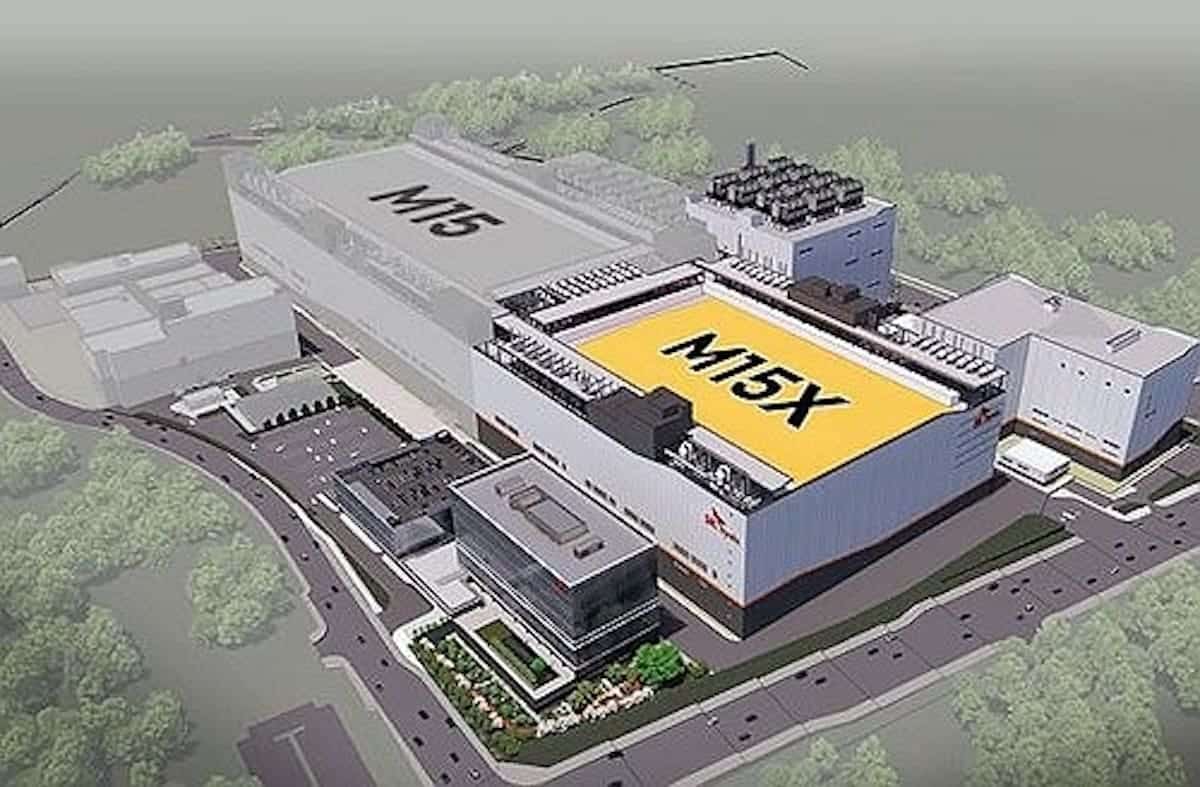
| M15X, Cheongju | SK Hynix | Focused on strengthening capacity for HBM and advanced memory |
The key difference compared to past cycles is that this time the bottleneck cannot be resolved quickly. Building a fab is not the same as turning on a production line overnight. After construction, equipment installation, qualification, ramp-up, manufacturing performance, and supply agreements follow. Even if Samsung and SK Hynix proceed at full speed, the market could remain tight through 2026 and 2027.
Materials, contractors, and bottlenecks
The pace of construction is creating a less visible competition: that for materials and specialized suppliers. In a fab, every week counts, and certain structural components can determine the entire schedule. Industry sources point to tensions in products such as precast concrete beams and metal structures, supplied by vendors juggling multiple projects simultaneously.
One notable name mentioned in this context is Sencore Tech, a manufacturer specializing in steel structures and construction solutions that can shorten certain processes. Industry sources suggest Samsung is using Sencore Tech’s PC beams in a complex building between P5 Fab 1 and P5 Fab 2, while SK Hynix reportedly has priority supply agreements with the same vendor. If these reports are confirmed, the race for fabs involves not only memory manufacturers but also their construction supply chains.
This detail is important because the semiconductor industry is often analyzed from the chip perspective—lithography tools, contracts with NVIDIA, or chip designs. But before a line produces HBM or DRAM, someone must build the facility, install the cleanrooms, and secure thousands of industrial elements. Shortages could appear in wafers, lithography equipment, advanced packaging, gases, energy, or simply construction materials that meet the specifications for a chip factory.
The urgency is also reflected in financial results. Samsung reported strong growth in its semiconductor business in Q1 2026, with the DS division supported by AI memory demand and price increases amid limited supply. The company noted that its memory business surpassed its quarterly sales record, driven by high-value products linked to AI.
SK Hynix is experiencing a similar moment. The company has benefited from its position in HBM, especially due to AI accelerators’ demand. The Yongin investment aims to secure future capacity in a market where major clients seek multi-year commitments and reliable supply, not just short-term price reductions.
Why AI has changed the memory cycle
Memory has always been a cyclical market. For decades, manufacturers alternated between periods of shortages and high prices, and phases of excess capacity and depressed margins. AI is altering this dynamic because demand comes not only from PCs, mobile devices, or traditional servers but from a new infrastructure that consumes more memory per system and requires more complex products.
HBM is the clearest example. Every high-end AI GPU needs high-bandwidth memory stacks, manufactured with advanced processes and complex packaging. As NVIDIA, AMD, and other providers increase their accelerators’ power, pressure on HBM3E, HBM4, and future generations intensifies. But the impact extends to other categories: AI servers require high-capacity DRAM, fast storage, enterprise SSDs, and NAND tailored for data centers.
| Memory Segment | What’s happening |
|---|---|
| HBM | Demand driven by GPUs and AI accelerators; limited by manufacturing and packaging capacity |
| Server DRAM | Increased demand for training, inference, databases, and enterprise AI workloads |
| Enterprise NAND | Capacity reallocated toward SSDs for data centers and high-performance storage |
| Consumer memory | More pressure on prices as capacity shifts to higher-margin products |
| DDR4 and older generations | Limited supply due to reduced production and migration to more profitable nodes |
For clients, this means higher prices and greater uncertainty. hyperscalers may secure supply through long-term contracts, but module manufacturers, integrators, PC brands, distributors, and end consumers have less room to maneuver. Signals of tension—inventory issues, spot price spikes, and financing delays for chip purchases—have increased in recent months.
For Samsung and SK Hynix, the incentive is clear. Each additional month of capacity can translate into significant revenue if demand remains above supply. The question is: who will reach the market first and with what technology? SK Hynix has secured a very strong position in HBM. Samsung is trying to close the gap and leverage its scale. The expansion of Pyeongtaek and the push in Yongin are part of that ongoing battle.
The risk lies in overreacting. If all manufacturers accelerate simultaneously and demand normalizes later, the industry could revert to a scenario of excess capacity. But currently, the market appears more concerned about the opposite—that supply will not arrive in time to sustain AI growth, data centers, and large-scale inference.
This race will also have implications for Europe and other regions. Memory is a core component for servers, cloud infrastructure, AI, computers, mobile devices, automotive, and industrial electronics. If prices continue climbing, the cost of building AI data centers will rise as well. Concentration of capacity among higher-margin clients could delay or raise costs for other sectors.
The rivalry between Samsung and SK Hynix underscores how physical infrastructure remains critical in the digital economy. AI may seem like software, models, and data, but it depends on factories that take years to build, materials that can be in short supply, and supply chains where a construction delay can impact billions in future sales.
Frequently Asked Questions
Why are Samsung and SK Hynix accelerating their factories?
Because demand for memory related to AI, data centers, and servers is outpacing available capacity. Accelerating a fab can provide competitive advantage in supply and profitability.
Which factories are at the center of the race?
Samsung is speeding up its Pyeongtaek campus, especially P5 Fab 1 and P5 Fab 2. SK Hynix is advancing its Yongin cluster, where the first cleanroom is now scheduled for February 2027.
Why are DRAM and NAND prices rising so much?
Capacity is being reallocated toward higher-margin AI-related products like HBM, server DRAM, and enterprise SSDs. TrendForce predicts increases of 58-63% in conventional DRAM and 70-75% in NAND Flash in Q2 2026.
When will the new capacity be felt in the market?
Even with accelerated construction, a semiconductor fab requires installation, testing, and ramp-up time. Therefore, shortages may persist through 2026 and into 2027 despite ongoing investments.
