
Dell Technologies has expanded its enterprise AI strategy with a very concrete proposal: running AI agents close to the data, on local workstations and endpoints, before moving them to the data center. The company has introduced Dell Deskside Agentic AI, a new component within Dell AI Factory with NVIDIA, designed for companies that want to transition from proof-of-concept AI agents to production environments with better control over costs, latency, and data sovereignty.
The announcement was made at Dell Technologies World 2026 held in Las Vegas, supporting an increasingly common idea in businesses: not everything has to run in cloud APIs. AI agents capable of autonomous multi-step tasks can generate high token consumption at scale. Although per-token prices decrease, accumulated usage can make cost forecasting challenging, especially for internal workflows that operate continuously.
On-Premises AI Agents: Less Dependence on Cloud
Dell presents Deskside Agentic AI as an alternative for workgroups that need to test, deploy, and scale agents without sending all data to the public cloud. The solution combines high-performance Dell workstations, NVIDIA hardware, and a software layer designed to create and govern agents in local environments.
The company claims that some organizations can reach break-even with public cloud API costs in just three months and cut expenses by up to 87% over two years—based on their calculations. These figures should be understood as commercial estimates, not universal guarantees; actual results depend on inference volume, model type, energy costs, administrative expenses, and the actual lifespan of the infrastructure.
This approach makes sense in sectors where AI is approaching sensitive data: finance, government, industry, healthcare, and defense, where sharing information externally may be restricted due to data residency, regulatory compliance, traceability, or intellectual property concerns. In such cases, bringing some inference workloads to advanced workstations or private data centers can be more attractive than relying solely on a cloud architecture.
Dell summarizes this vision with a quote from Jeff Clarke, the company’s COO: “The most efficient token is the one produced closest to the data.” Beyond the marketing message, this reflects a genuine debate in enterprise AI: which workloads should go to the cloud, which can stay local, and when it’s worth combining both models.
From Workstation to Data Center
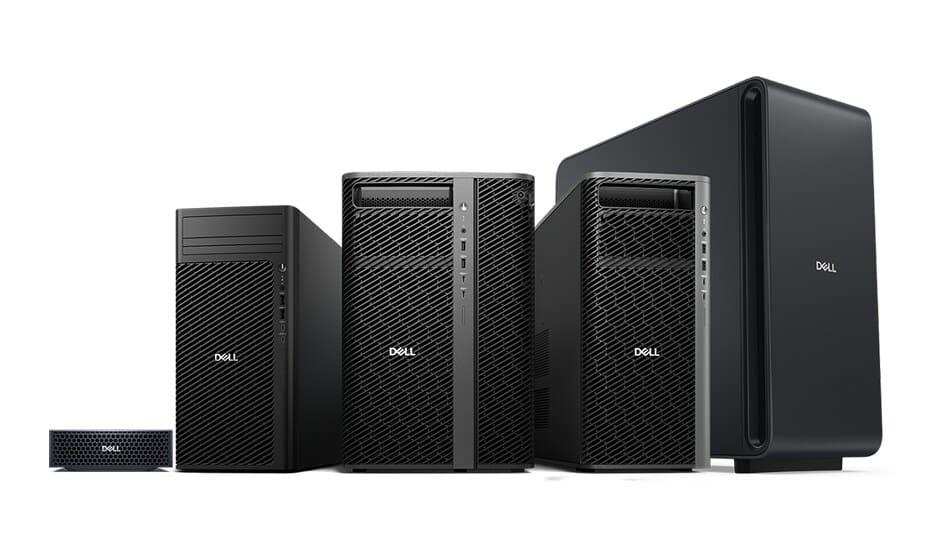
The new offering supports various deployment sizes. Dell Pro Max with GB10 targets individual prototyping and models ranging from 30 billion to 200 billion parameters. Dell Pro Precision 9 is aimed at enterprise workstations equipped with Intel Xeon 600 processors and up to five NVIDIA RTX PRO Blackwell Workstation Edition GPUs, supporting models from 30 billion to 500 billion parameters. At the top end, Dell Pro Max with GB300 is based on NVIDIA GB300 Grace Blackwell Ultra Desktop Superchip, for inference with models from 120 billion to 1 trillion parameters.
| Platform | Intended Use | Cited Model Range by Dell |
|---|---|---|
| Dell Pro Max with GB10 | Personal prototyping and small teams | 30B to 200B parameters |
| Dell Pro Precision 9 | Enterprise workstations with GPU | 30B to 500B parameters |
| Dell Pro Max with GB300 | Advanced local inference | 120B to 1T parameters |
The goal isn’t to replace the data center but to create a continuum between technical desktops, departmental equipment, and corporate infrastructure. A company can start with local agents for coding, document analysis, internal support, or research, then move more mature workflows to Dell PowerEdge XE servers within its own infrastructure.
This approach aligns with the evolution of agent-centric AI. In the initial phase of generative AI, many companies experimented with chatbots and assistants connected to external APIs. The next stage demands greater integration with internal processes, document repositories, business systems, and security policies. Hardware regains importance—not out of nostalgia for on-premises setups but because some costs and risks emerge when use shifts from experimental to operational.
OpenShell, NemoClaw, and AI-Q 2.0
One of the central elements of the announcement is NVIDIA OpenShell support across Dell AI Factory with NVIDIA. According to Dell, OpenShell provides a secure, isolated environment for building, deploying, and governing agents, with real-time privacy and security controls. Compatibility extends from workstations to PowerEdge XE servers, running on Canonical Ubuntu and Red Hat AI.
The proposal also includes NVIDIA NemoClaw, described as an open-source reference stack for managing always-on AI agents on local hardware. It leverages OpenClaw, the agent framework used for persistent, autonomous, multi-step workflows, and integrates open NVIDIA Nemotron models for reasoning and programming.
Additionally, Dell announced support for NVIDIA AI-Q 2.0, focused on multi-agent workflows for research, decision support, and complex tasks. The Dell-NVIDIA AI-Q 2.0 Reference Architecture, based on Dell AI Data Platform, targets demanding on-premise deployments, especially in regulated sectors such as financial services, government, and manufacturing.
Availability is immediate for the announced elements: Dell Deskside Agentic AI, NVIDIA OpenShell for Dell AI Factory with NVIDIA, NVIDIA AI-Q 2.0, and the Dell-NVIDIA AI-Q 2.0 reference architecture are now available.
For Dell, the message is clear: agent-centric AI cannot rely solely on large remote clusters or external APIs. For many companies, a hybrid approach is the way forward—local inference on advanced workstations, enterprise servers for scaling, and cloud when economical or technical considerations favor it. IT departments’ questions will shift from “which model” to “where to run it,” “under what controls,” and “what are the medium-term operational costs.”
Frequently Asked Questions
What is Dell Deskside Agentic AI?
It’s a Dell solution within Dell AI Factory with NVIDIA for running agent-based AI workflows on local devices and workstations, with the option to scale later to the data center.
Why does Dell emphasize running AI agents close to the data?
Because agents can consume many tokens and handle sensitive information. Running locally can help reduce latency, improve data control, and make costs more predictable, depending on workload type.
Does this proposal replace public cloud?
No. Dell advocates a hybrid model. Some workloads can run on private workstations or servers, while others make sense in the cloud.
What is NVIDIA’s role in the announcement?
NVIDIA provides hardware, models, and software like OpenShell, NemoClaw, and AI-Q 2.0, which Dell integrates into its AI Factory to create, deploy, and govern agents from desktop to data center.
