
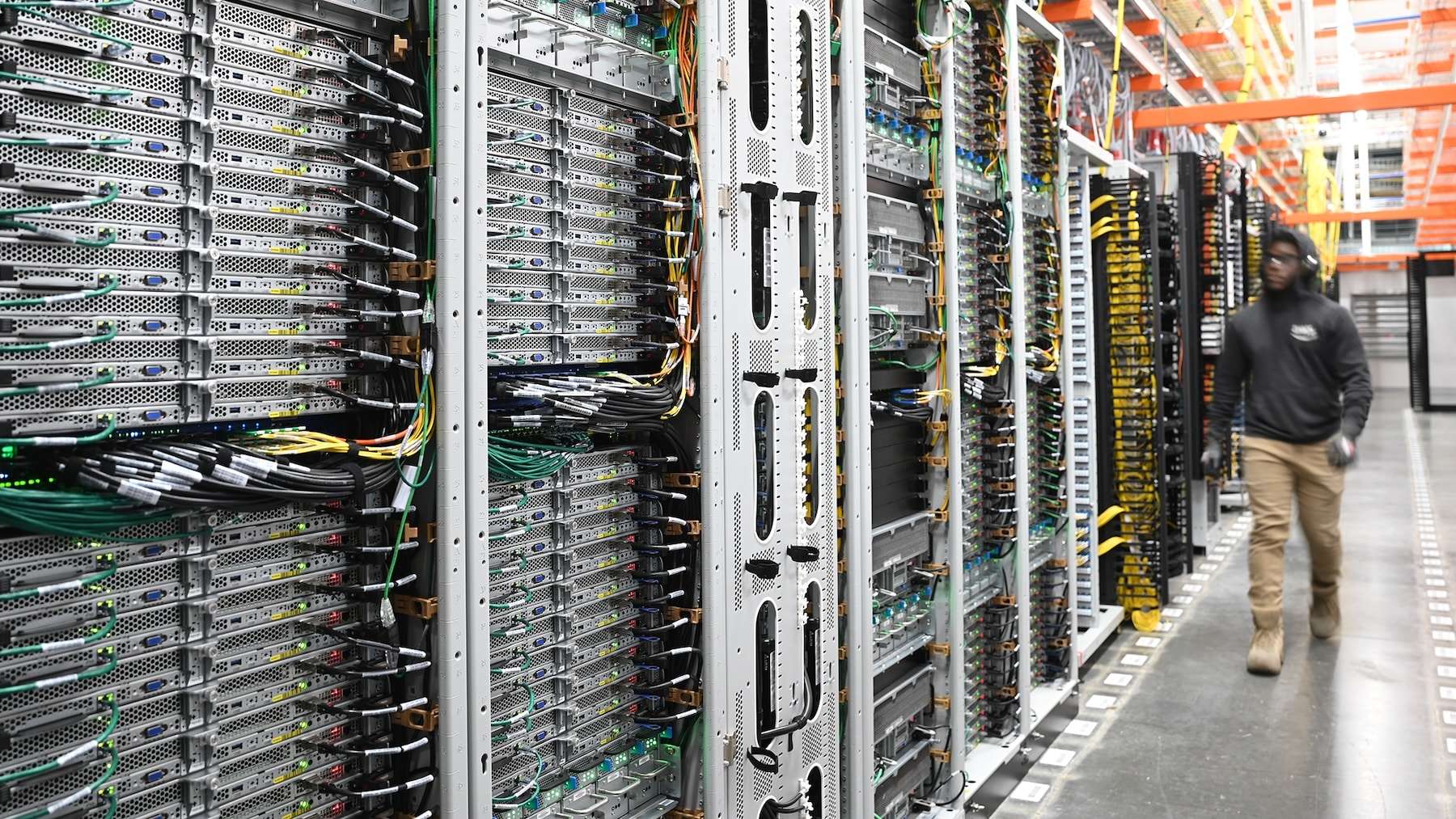
By the end of 2025, Amazon Web Services operated a total of 5,280,516 square meters of data centers and offices, according to the figures published by Amazon in its 10-K annual report. This figure is equivalent to 56.8 million square feet and illustrates how Amazon’s cloud has become a massive physical infrastructure, even though it is often perceived as an abstract service.
It’s important to interpret this data carefully. Amazon does not break down the exact portions occupied by data center technical rooms, support zones, offices, commercial spaces, or other facilities related to the AWS segment. It also excludes the overall corporate headquarters. Still, this volume provides a useful reference for measuring the growth of the cloud business and the pressure that Artificial Intelligence is placing on land, energy, cooling, and capital investments.
Conversion to Square Meters
In Amazon’s 10-K, the company reports that AWS leased 28.37 million square feet and owned 28.47 million square feet. Converted to metric units, this amounts to approximately 2,635,659 m² leased and 2,644,857 m² owned. Together, AWS surpasses 5.28 million square meters, about 528 hectares.
| Amazon AWS 2025 Concept | Square Feet | Approximate Square Meters |
|---|---|---|
| Leased Area | 28.37 million | 2,635,659 m² |
| Owned Area | 28.47 million | 2,644,857 m² |
| Total AWS | 56.84 million | 5,280,516 m² |
The conversion uses the standard factor of 1 square foot = 0.09290304 square meters. The result helps European readers better grasp the scale: the total AWS footprint is roughly 740 times the size of a soccer field measuring 7,140 m². While this comparison isn’t meant to be exact from an urban planning perspective, it helps convey the order of magnitude.
Annual growth rates are also significant. According to Data Center Dynamics, which reports figures from the 10-K, AWS’s combined area increased by 16% compared to 2024. The previous year saw a 28% increase over 2023, following a 14% rise from 2022. In 2021, the increase was even greater, with a 44% jump over the 18.1 million square feet recorded in 2020.
An Increasingly Physical Cloud
This data comes at a time when AWS is resuming its expansion. In Q1 2026, Amazon announced that AWS revenues grew 28% year-over-year to $37.6 billion, with an operating profit of $14.2 billion. Andy Jassy, Amazon’s CEO, stated during the earnings call that AWS is now operating at an annualized revenue rate of $150 billion.
This growth directly translates into infrastructure. Customers don’t buy “square meters” of AWS but instead capacity in computing, storage, networking, databases, model training, inference, and managed services. Behind each API are buildings, electrical equipment, cooling systems, fiber optics, servers, accelerators, and land capable of supporting increasingly dense installations.
Amazon confirms that its global infrastructure spans 123 availability zones across 39 geographic regions, with plans announced for seven additional zones and two new regions in Saudi Arabia and Chile. The company also operates a global network with hundreds of CloudFront points of presence and regional caches, as well as Local Zones, Wavelength Zones, and other options designed to reduce latency or bring services closer to specific markets.
The expansion in area doesn’t necessarily mean all growth is new server rooms. A data center facility includes much more than just the racks: electrical rooms, generators, batteries, technical corridors, cooling equipment, security zones, logistical spaces, and operational offices. Therefore, it’s important to avoid a simplistic interpretation of this data. The 5.28 million square meters do not equate to 5.28 million square meters of racks.
Artificial Intelligence is Changing the Investment Scale
Artificial Intelligence has elevating cloud infrastructure requirements to a whole new level. Training and deploying advanced models demand large clusters of accelerators, high-bandwidth memory, low-latency networks, massive storage, and enormous energy consumption. For hyperscalers, the challenge is no longer just opening more regions but ensuring electrical capacity, chips, cooling, and construction capabilities in the right markets.
Amazon has tied much of its recent investments to this demand. In its Q1 2026 results, the company noted that free cash flow decline was mainly due to a $59.3 billion increase in property and equipment purchases, a rise primarily attributed to investments in Artificial Intelligence technology.
The relationship with Anthropic reinforces this perspective. The AI startup committed to spending over $100 billion on Amazon’s cloud technologies over ten years, while Amazon plans to invest up to an additional $25 billion in the company if certain commercial milestones are met. The deal includes access for Anthropic to capacity based on Trainium chips and underscores how AI is becoming a key driver for cloud infrastructure contracts.
For Europe, this AWS data also has regulatory and energy implications. Major cloud providers are competing for land, renewable energy, permits, grid access, and local acceptance. As AI demand grows, markets with good connectivity and electrical availability face increasing pressure. Madrid, Frankfurt, Dublin, Paris, London, Milan, and Nordic poles will continue to be points of tension and opportunity, shaped by evolving energy policies, taxation, and digital sovereignty requirements.
AWS is not alone in this race. Microsoft, Google, Oracle, and other providers are also increasing investments in data centers, proprietary chips, and AI lab partnerships. However, Amazon’s reported surface area allows for a tangible understanding of the physical scale behind a trend often discussed only in revenue, contracts, or computational capacity.
The outcome is a larger, more expensive cloud, increasingly dependent on critical infrastructure. The promise of flexibility and pay-as-you-go remains, but the backbone supporting it is now composed of real estate, energy, and hardware assets on a scale resembling large heavy industries.
Frequently Asked Questions
How much area did AWS operate in 2025?
AWS operated 56.84 million square feet, equivalent to about 5,280,516 square meters.
How many square meters did AWS own versus leased?
According to Amazon’s 10-K, AWS had approximately 2,644,857 m² owned and 2,635,659 m² leased.
Is all that surface area server rooms?
No. Amazon does not specify what part corresponds to data hall space. The figure includes data centers, offices, and other AWS-related spaces but excludes general corporate facilities.
Why is AWS’s surface area growing so much?
The growth reflects the expansion of the cloud business, AI demand, increased compute and storage needs, and the expansion of regions, availability zones, and network infrastructure.
