
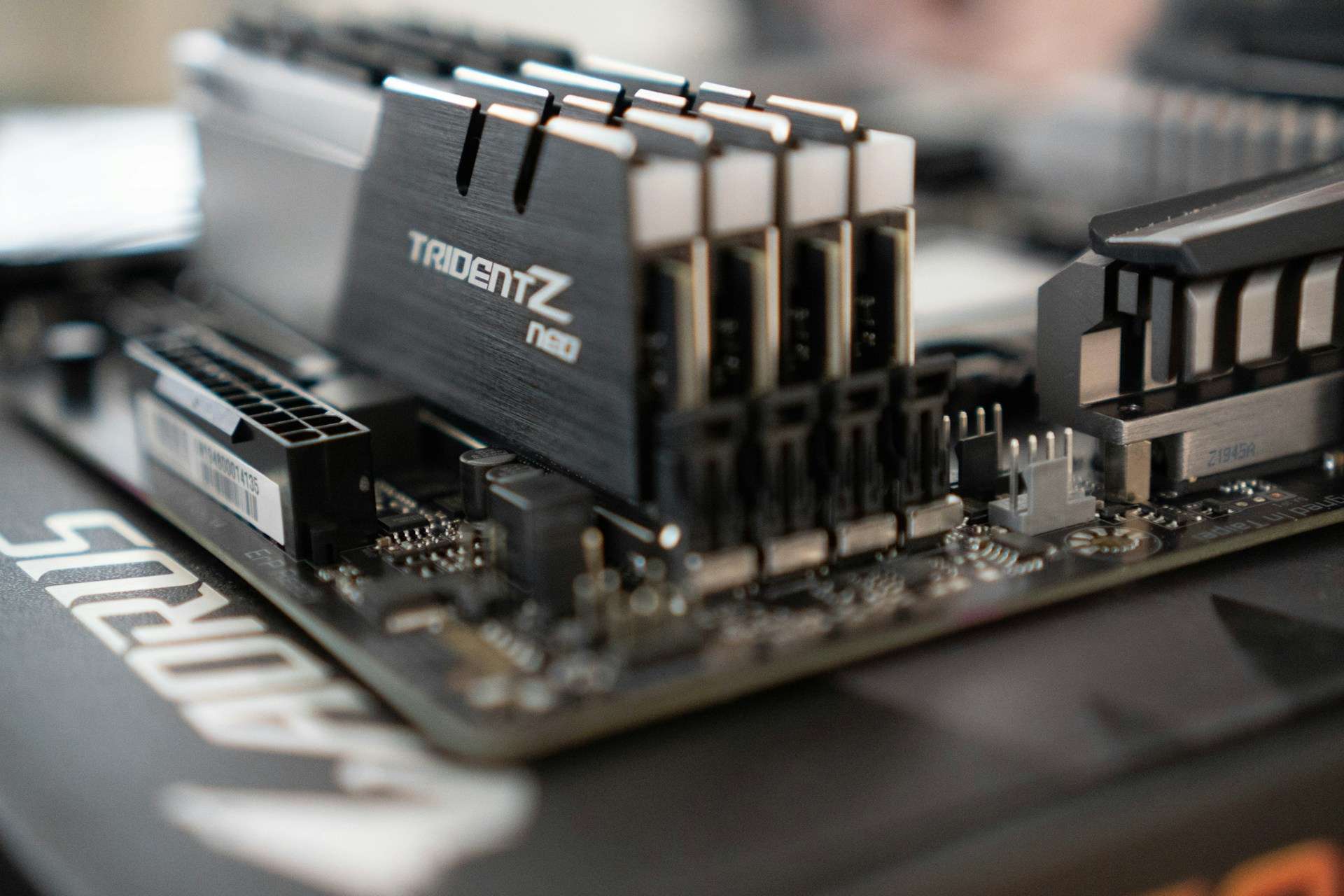
China is accelerating its DRAM memory offensive amid ongoing global supply tensions. ChangXin Memory Technologies (CXMT), the leading Chinese DRAM manufacturer, has begun introducing its DDR5 advances to the market through local module manufacturers, targeting both consumer and server markets. While China is not yet on par with Samsung, SK hynix, or Micron, this confirms that the gap is narrowing in a segment that was previously dominated by the three giants.
The key lies in DDR5. CXMT officially launched its DDR5 portfolio in November 2025, featuring chips up to 8,000 Mbps and densities of 16 Gb and 24 Gb, along with modules such as UDIMM, SODIMM, CUDIMM, CSODIMM, RDIMM, MRDIMM, and TFF MRDIMM designed for PCs, workstations, and servers. The company positions these products as part of its entry into higher-performance scenarios, including data centers and professional equipment.
This news is particularly significant given the current shortage and rising cost of memory. The demand for AI infrastructure is absorbing HBM, server DDR5, enterprise NAND, and manufacturing capacity that was previously more evenly distributed among data centers, PCs, mobile devices, and consumer electronics. For example, Micron has warned that memory shortages could extend beyond 2026, driven by AI data center demand and resource reallocation toward higher-margin products.
CXMT brings Chinese DDR5 to the real market
CXMT’s progress is already filtering into the Chinese supply chain. South China Morning Post reports that Chinese module manufacturers are accelerating the release of consumer and enterprise products based on domestic DDR5 chips as CXMT’s advances reach the market. The publication notes that the 24 Gb density leaves CXMT roughly one generation behind the most advanced 32 Gb DDR5 chips from Samsung, SK hynix, and Micron, but it still represents a significant leap for China’s DRAM industry.
This nuance is crucial. China has not yet achieved technological leadership in DRAM. Major South Korean and U.S. manufacturers maintain advantages in density, efficiency, global customer validation, HBM, and production ecosystem. However, CXMT is no longer competing solely in low-profile memory markets. Its roadmap for DDR5, LPDDR5X, and future high-speed products is beginning to cover segments where China previously relied almost entirely on foreign suppliers.
Pressure also comes from module makers like Jiahe Jinwei, owner of brands such as Asgard and Gloway. Recently, 64 GB DDR5 RDIMM modules at 5,600 MT/s for servers have appeared under Chinese brands, signaling that China aims not only to produce DRAM chips but to establish a complete chain of modules for local AI, data centers, and enterprise clients.
In consumer markets, this strategy could directly impact RAM prices. If Chinese DDR5 modules achieve volume, compatibility, and availability outside the domestic market, they could become a cheaper alternative in certain segments. Nonetheless, significant barriers remain: validation with motherboards, long-term stability, memory profile support, brand reputation, warranty, and geopolitical restrictions.
Global shortages create an opportunity for China
China’s opportunity isn’t solely based on technical advances. It also stems from market tensions. Samsung, SK hynix, and Micron are prioritizing AI-related products, especially HBM and high-value server DRAM. While this makes economic sense, it leaves gaps in conventional memory, consumer modules, and certain enterprise formats.
When prices rise and lead times lengthen, buyers seek alternatives. This could benefit CXMT within China and, over time, in markets where cost outweighs brand reputation. The question is how far their products can go if trade tensions persist.
Reuters reported at the end of 2025 that CXMT planned an IPO in Shanghai to raise about $4.22 billion, aiming to upgrade facilities, fund R&D in advanced DRAM, and expand its product lineup, including HBM for AI processors. At that time, its global DRAM market share was around 4% in Q2 2025, far behind the leaders but with room to grow.
| Manufacturer | Approximate Position |
|---|---|
| Samsung | Global leader in DRAM and NAND, strong in advanced memory |
| SK hynix | Very strong in HBM and AI DRAM |
| Micron | Major global supplier, with increasing focus on HBM and data centers |
| CXMT | Leading Chinese DRAM manufacturer, accelerating DDR5, LPDDR5X, and plans for HBM |
| YMTC | Chinese leader in NAND, under significant pressure from sanctions and technological substitution |
YMTC represents another facet of China’s memory strategy. While CXMT concentrates on DRAM, YMTC aims to strengthen its NAND independence despite U.S. sanctions. Reports from Tom’s Hardware suggest the company is developing lines with domestic tools and seeks to increase its NAND market share, though full localization remains challenging due to dependence on critical equipment like lithography tools.
Chinese DDR5 does not mean complete independence
CXMT’s progress should not be mistaken for full self-sufficiency. Manufacturing modern DRAM requires lithography equipment, deposition, etching, metrology, materials, gases, EDA software, packaging, and extensive process expertise. U.S. and allied restrictions continue to limit China’s access to certain advanced technologies.
Political pressures remain. Reuters reported in April that Micron is lobbying the U.S. Congress to tighten restrictions on the sale of chip manufacturing tools to Chinese competitors like CXMT, YMTC, and SMIC. The proposed MATCH Act aims to block avenues that still permit some Chinese companies to grow despite existing controls.
This means CXMT’s path could be rapid but non-linear. The company needs to ramp up production, enhance performance, cut costs, validate products with demanding clients, and navigate a complex geopolitical environment. Despite DDR5-8000 sounding competitive on paper, actual module performance depends on latencies, stability, compatibility, binning, firmware, motherboards, and memory controllers.
It’s also important to distinguish between chip speed and mass-market availability. Demonstrating DDR5 capable of 8,000 Mbps doesn’t guarantee that all modules in the channel will operate at that speed, nor that they will immediately replace equivalent products from Samsung, SK hynix, or Micron. The memory industry relies on volume, trust, and consistency.
Nevertheless, the direction is clear. China aims to transition from a memory buyer to a full supplier, from DRAM and NAND chips to modules for PCs, servers, and AI workloads. The global shortage offers an unexpected window of opportunity: if major players cannot satisfy all demand, Chinese manufacturers can first capture the domestic market, then expand into price-sensitive regions.
The question is no longer whether China can produce competitive DDR5—that process has already begun. The real question: will it do so at sufficient scale, quality, and continuity to shift the global memory balance? Samsung, SK hynix, and Micron still lead, especially in HBM and higher densities, but CXMT has moved beyond a secondary role in the conversation.
Frequently Asked Questions
What has CXMT announced in DDR5?
CXMT unveiled a family of DDR5 products with speeds up to 8,000 Mbps and densities of 16 Gb and 24 Gb, along with various module formats for PCs, workstations, and servers.
Is China now on par with Samsung, SK hynix, and Micron?
Not yet. CXMT is roughly a generation behind in DDR5 density compared to the most advanced 32 Gb chips but is narrowing the gap and increasing its supply chain presence.
Why does AI favor Chinese memory manufacturers?
Because the demand for HBM and data center memory is straining global supply. If large manufacturers prioritize higher-margin products, opportunities open up for Chinese alternatives in standard DDR5 and consumer or enterprise modules.
Could cheaper Chinese DDR5 modules reach Europe?
It’s possible in certain segments, but their success will depend on availability, validation, trade restrictions, distribution channels, and trust from PC and motherboard manufacturers.
