
The semiconductor industry is once again blending technology, geopolitics, and industrial pressure around one key name: Intel. Following reports about a preliminary agreement to manufacture some Apple chips, a new and more delicate rumor is circulating: Tesla may be facing pressures from the Trump Administration to move part of its future AI chip production from TSMC to Intel.
The information comes from unofficial sources shared on Weibo and reported by specialized media, so it should be treated with caution. Tesla, Intel, and TSMC have not publicly confirmed any such change. Still, the rumor fits into an increasingly visible trend in the United States: the government has shifted from encouraging local chip manufacturing to intervening much more directly in the industrial fate of strategic companies.
The context helps explain why such information causes so much noise. In August 2025, the Trump Administration converted billions of dollars in public aid into a nearly 10% stake in Intel. The deal made the U.S. government one of the leading shareholders of the manufacturer, with a position that has greatly appreciated following the company’s stock rally and reports of new foundry clients. Since then, Intel is no longer just a private company trying to revive its contract manufacturing business; it is also a political move by Washington.
Tesla Had Already Divided Its Chips Manufacturing Between Samsung and TSMC
Until now, Tesla’s AI chip strategy seemed supported by diversification among major foundries. Elon Musk confirmed that Samsung would manufacture the AI6 chip at its new plant in Taylor, Texas, under a supply agreement valued at $16.5 billion, with an outlook through 2033. Reuters reported in March 2026 that Musk expected to complete the tape-out of AI6 by December, with subsequent production based on Samsung’s 2 nm technology.
Meanwhile, various reports indicated that Tesla would also use TSMC for more advanced or specialized variants. In April, Musk stated that the AI6.5 would further improve performance by utilizing TSMC’s 2 nm process in Arizona. This component was particularly important because TSMC remains the leading foundry for advanced nodes, with a track record of execution unmatched by Samsung or Intel in cutting-edge generations.
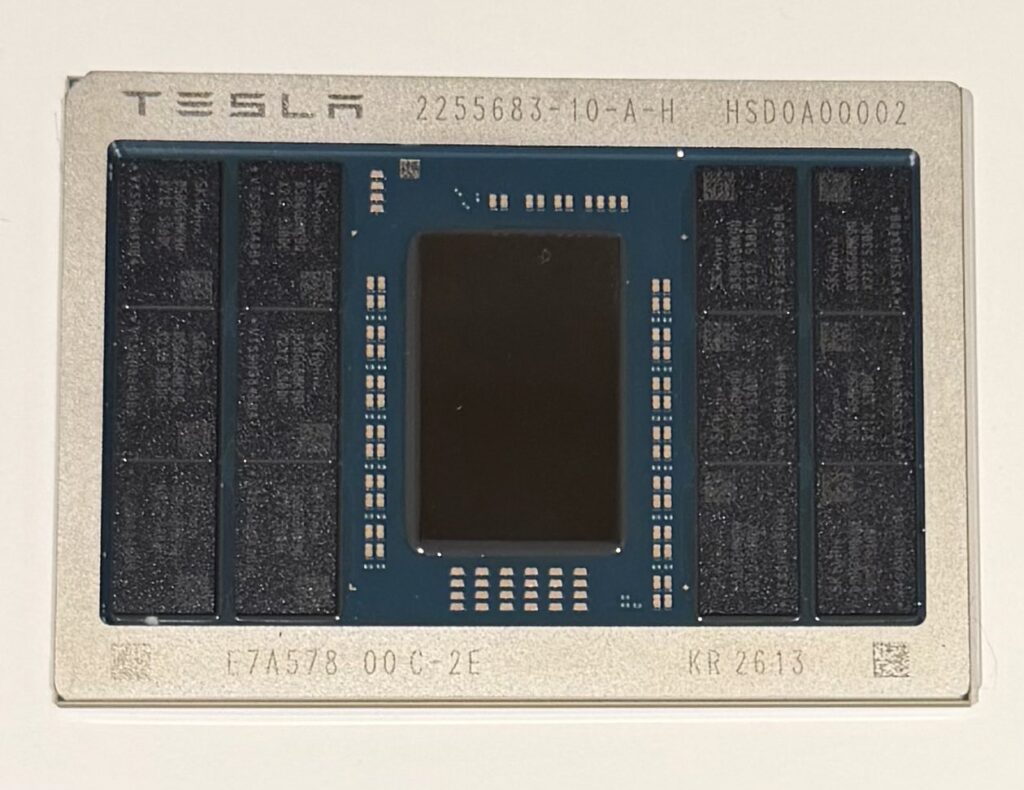
The alleged shift toward Intel would particularly impact that most sensitive area: advanced manufacturing on U.S. soil. According to the rumor, political pressure aims to have Tesla shift from initially working with TSMC to using Intel instead. There is even some confusion in the published versions: some mention AI6 while others reference AI6.5. This lack of precision reinforces the need to treat the information as unconfirmed.
| Chip | Known or Reported Status | Associated Foundry So Far | Strategic Interpretation |
|---|---|---|---|
| AI5 | Design completed according to Musk; production pending scaling | Samsung and TSMC, per industry sources | Tesla’s first major step toward next-generation proprietary chips |
| AI6 | Musk expects tape-out by December 2026 | Samsung 2 nm in Taylor, Texas | Major contract to strengthen Samsung’s foundry presence in the US |
| AI6.5 | Higher-performance variant mentioned by Musk | TSMC 2 nm in Arizona | Access to the most mature foundry for advanced nodes |
| Suspected shift | Not confirmed | Possible partial replacement of TSMC with Intel | Political reinforcement of Intel Foundry and domestic manufacturing |
Intel Needs Customers; Washington Needs a Win
Intel Foundry’s prospects depend heavily on proving it can produce for demanding external clients, not just its own products. Securing orders from Apple, Tesla, or companies linked to Elon Musk would be a top-tier industrial and political validation.
The preliminary deal with Apple, reported by The Wall Street Journal and echoed by Reuters, was already seen as a turning point. The information suggested Intel could manufacture some chips for Apple after over a year of discussions, with backing from the U.S. government. For Apple, diversifying part of its supply chain beyond TSMC makes sense; for Intel, it would be a credential that’s hard to beat.
Tesla would be another even more symbolic piece. Its AI chips are not secondary components; they support autonomous driving, the Optimus robot, potential data center applications, and Musk’s vertical strategy. For Intel to enter this space would mean much more than gaining volume—it’s a statement that the US industry can restore advanced manufacturing for some of the country’s most ambitious AI platforms.
The technical challenge is significant. Intel still needs to prove its advanced nodes can compete in performance, efficiency, density, yields, and capacity against TSMC in such demanding projects. Tesla cannot afford to turn a critical autonomous or robotic chip into a political experiment. If the switch occurs, it must be backed by very solid manufacturing guarantees.
The Risk of Politicizing the Supply Chain
The push to produce chips domestically in the US has a clear logic. Taiwan hosts a critical part of global advanced manufacturing, and tensions with China convert that dependency into a strategic risk. The US government seeks more domestic capacity, more industrial jobs, and reduced vulnerability in key technologies.
However, there is a delicate line between encouraging and forcing. If Washington uses its influence over Intel to push orders their way, uncomfortable questions arise: Are foundries competing on equal footing? Is excellence in technical capability being rewarded or political alignment? Can a publicly traded company with state involvement become an industrial instrument without market distortion?
The Intel case is particularly sensitive because the government not only regulates and incentivizes but also owns shares. This creates a new incentive: that Intel’s commercial success isn’t just a technological victory but also a benefit for taxpayers and a political tool. The rise in Intel’s stock after the Apple news has already been portrayed by some outlets as a paper gain for the US government.
In the semiconductor industry, this mixture can have profound consequences. Foundry decisions are driven not only by patriotism but also by design, nodes, libraries, IP, packaging, performance per watt, wafer cost, yield, capacity, lead times, and confidentiality. Changing providers can delay products, force redesigns, and disrupt entire roadmaps.
TSMC Remains Difficult to Replace
The main reason to doubt a rapid shift by Tesla from TSMC to Intel is simple: TSMC remains the most reliable supplier for advanced nodes. Its advantage isn’t just in EUV machines or scale but includes years of experience, design ecosystem, customer relationships, packaging, operational discipline, and manufacturing capacity.
Samsung is trying to regain ground, and the contract with Tesla was a significant win for its Texas plant. Intel also wants to re-enter advanced foundry competition. But TSMC maintains a position that doesn’t change from quarter to quarter. Therefore, if Tesla moves production, it should be a gradual transition, a second source, or a specific variant—not an immediate replacement of an entire critical line.
It’s also worth noting that Tesla has reasons to diversify. Its ambition to deploy own chips for cars, robots, and AI systems may require massive volumes. Relying on a single manufacturer would be risky, especially given TSMC’s capacity constraints driven by Apple, NVIDIA, AMD, Qualcomm, and other high-value clients. From that perspective, Intel could become appealing if it offers U.S.-based capacity, incentives, priority access, and a political commitment.
The key question is whether that can offset the technical risks. In advanced chips, a foundry is chosen not only for proximity or government support but because it can produce millions of chips with the desired performance, cost, and quality on schedule.
The rumor about Tesla and Intel should thus be viewed as another signal of the new industrial moment. The US no longer just wants to finance factories; it wants those factories to produce. Intel is no longer competing solely against ASML, TSMC, Samsung, or chip designers technologically, but within a national strategy to rebuild domestic capacity.
If Tesla ends up commissioning part of AI6 or AI6.5 to Intel, it would be a major development. If not, the mere fact that such speculation exists shows how much chip manufacturing has ceased being purely a technical decision. In the new semiconductor war, every advanced wafer is also a political statement.
Frequently Asked Questions
Is it confirmed that Tesla will move AI6.5 from TSMC to Intel?
No. The information comes from rumors circulating on social media and specialized outlets. Tesla, Intel, and TSMC have not officially confirmed any such move.
What is known about Tesla’s AI6 chips?
Elon Musk indicated Tesla might complete the AI6 tape-out in December 2026. Reuters reported that Samsung would manufacture these chips at its Taylor, Texas plant under a deal valued at $16.5 billion.
Why is Intel so important to the Trump Administration?
In 2025, the US government acquired an approximately 10% stake in Intel as part of a strategy to strengthen domestic semiconductor manufacturing and reduce dependence on foreign supplies.
Can Intel easily replace TSMC in advanced chips?
Not easily. TSMC holds a strong lead in advanced nodes, industrial performance, ecosystem, and capacity. Intel needs to demonstrate yields, lead times, and competitiveness with very demanding external clients.
