
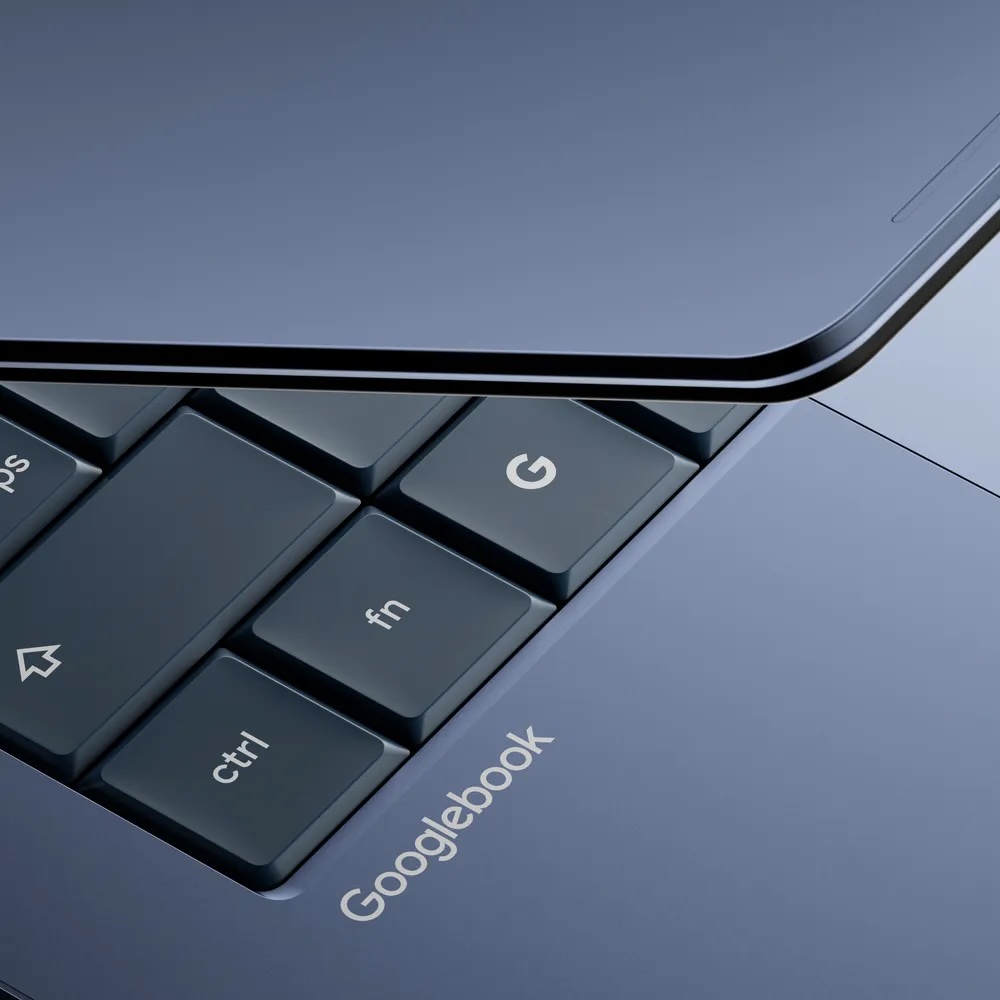
Google is preparing one of its most ambitious bets for the PC market since the launch of the Chromebook. The company has introduced Googlebook, a new category of laptops built around Gemini Intelligence, with a base that combines parts of Android and ChromeOS, close integration with Android phones, and an experience where Artificial Intelligence ceases to be just another app to become part of the system.
The innovation has garnered attention due to a detail that goes beyond the name. Intel and Qualcomm have publicly confirmed their collaboration with Google on this new family of devices, while Google has also indicated that there will be devices with MediaTek chips. This opens a highly significant technical possibility: Googlebook would not be limited to ARM, as many expected due to its close ties with Android, but could also feature x86 processors if Intel’s involvement results in conventional PC hardware.
The approach significantly shifts the interpretation of the announcement. If Googlebook were only a premium Android laptop, it would compete in a space closer to tablets, high-end Chromebooks, and lightweight devices. If it also supports x86, Google aims to build a much broader platform capable of entering the realm of AI PCs, premium ultrabooks, and productivity laptops, where today Windows and macOS dominate.
A system designed for Gemini to be everywhere
Google describes Googlebook as a laptop designed from scratch for Gemini Intelligence. The company speaks not only of adding an assistant to the desktop but of rethinking the interaction with the device around contextual suggestions, automation of tasks, and a smoother relationship between laptop, mobile, and applications.
The most striking feature is Magic Pointer. The cursor, a component that has hardly changed in decades, becomes an entry point to Gemini. According to examples shown by Google, users will be able to point to a date in an email to create a meeting or select two images, such as a living room and a sofa, to visualize how they would look together. The idea is for AI to understand the context of what appears on screen and suggest useful actions precisely where the user is working.
Also introduced is Create your Widget, a feature to create personalized widgets via natural language instructions. Gemini will be able to consult the internet or connect to Google apps like Gmail and Calendar to build dashboards with useful information: travel plans, reservations, tasks, reminders, or events. The desktop ceases to be just a place for icons and starts functioning as a dynamically generated AI space.
Integration with Android is another key aspect. Googlebook will allow access to phone applications from the laptop, browse mobile files through the system explorer, and insert content without manual transfers. Google wants users to stay “in flow” even when switching devices—a promise similar to the long-standing ecosystem connection Apple has built between iPhone and Mac, but applied to Android.
Intel, Qualcomm, and MediaTek: three paths for one platform
The involvement of Qualcomm and MediaTek fits with Android’s logic. Both companies have extensive experience with ARM chips for mobiles, tablets, and lightweight laptops. Qualcomm is also aiming to gain ground in premium PCs with processors focused on battery life, connectivity, and local AI workloads. For Googlebook, ARM could deliver thin, efficient devices with good battery life.
The unexpected participant is Intel. Their involvement suggests Google does not want to abandon the traditional PC market nor compatibility with x86 architectures. If Googlebook runs on Core Ultra processors, the platform could leverage integrated NPUs, more capable GPUs, and an already established ecosystem of hardware from manufacturers like Dell, HP, Lenovo, Acer, or ASUS.
This point is crucial for developers. A system that is only based on ARM requires considering application compatibility, drivers, emulation, and professional tools. A system supporting both ARM and x86 offers more options to adapt to various segments, though it also increases complexity for Google: maintaining performance, battery life, security, and a consistent experience across architectures is no trivial task.
MediaTek could serve as an intermediate or volume-tier option. Google has not shared details on ranges or pricing, but the involvement of multiple silicon partners suggests a strategy spanning from premium to more accessible models. The Chromebook legacy is evident: Google understands that the success of a platform depends equally on software and manufacturing volume across diverse price points.
The challenge: not just another AI-powered Chromebook
Googlebook arrives amid the race for the AI PC. Microsoft promotes Copilot+ PC, Apple integrates Apple Intelligence into macOS, and chipmakers are trying to convince the market that the next wave of laptops will be defined by local AI. Google couldn’t settle for Gemini within the browser or Android alone; it needed a flagship device, even if produced by its partners.
The question is whether Googlebook will manage to differentiate itself enough. Chromebooks performed well in education, simple management, and browsing, but for years faced a clear ceiling in advanced productivity, professional software, and high-end perception. Googlebook aims to break that image, with premium materials, an identifiable “glowbar,” and AI features integrated from the system’s design.
Still, tech-savvy users will seek concrete answers. Which desktop applications will be compatible? Will there be full Linux support? How will professional peripherals, drivers, external monitors, printers, development tools, or enterprise applications work? What parts of Gemini will run locally, and what parts will rely on the cloud? How will personal and work data be handled when the system analyzes on-screen content?
These questions will be decisive for businesses. An AI-enabled laptop can be very useful, but it also raises privacy, data governance, permissions, auditing, and compliance issues. If features like Magic Pointer or custom widgets interpret emails, documents, images, or phone files, administrators will want control over which data is processed, where, and how access is limited.
Google’s opportunity is clear. Android dominates mobile, Chrome is the leading browser, and Gemini is one of the biggest bets in generative AI. Googlebook seeks to unify these three elements into a laptop that does not rely on copying the Windows or macOS models. If it delivers a truly helpful experience, it could establish a more serious third alternative beyond traditional Chromebooks.
The risk is apparent as well. The tech industry has seen many promises of “reinventing the laptop” that ultimately resulted in features rather than habit changes. For Googlebook to succeed, Gemini will need to genuinely save time—not just appear in flashy demos. And the hardware must be up to par in battery, display, keyboard, performance, and price.
Google has put forth a compelling idea: the laptop no longer as an OS, but as an “intelligence system.” Now, the challenge is to see if this intelligence improves daily work or just adds another layer of an assistant that users eventually ignore. The involvement of Intel, Qualcomm, and MediaTek shows that this is a serious venture. Adoption will depend on something more elusive: whether the market understands why they need a Googlebook and not just a Windows or macOS device with an open Gemini app.
FAQs
What is Googlebook?
Googlebook is a new category of Google laptops designed around Gemini Intelligence. It combines elements of Android and ChromeOS, offers integration with Android phones, and features contextual AI functionalities.
What chips will Googlebook use?
Intel and Qualcomm have confirmed their collaboration with Google, and the company has also indicated that MediaTek devices will be available. This points to models based on both ARM and possibly x86 architectures.
How is Googlebook different from Chromebook?
Chromebook was introduced as a cloud-first device centered on ChromeOS and the browser. Googlebook aims to be a more integrated platform with Android, premium hardware, and native AI features based on Gemini.
When will the first Googlebook be available?
Google has said it will share more details later, and the first devices are expected to arrive in the fall.
