
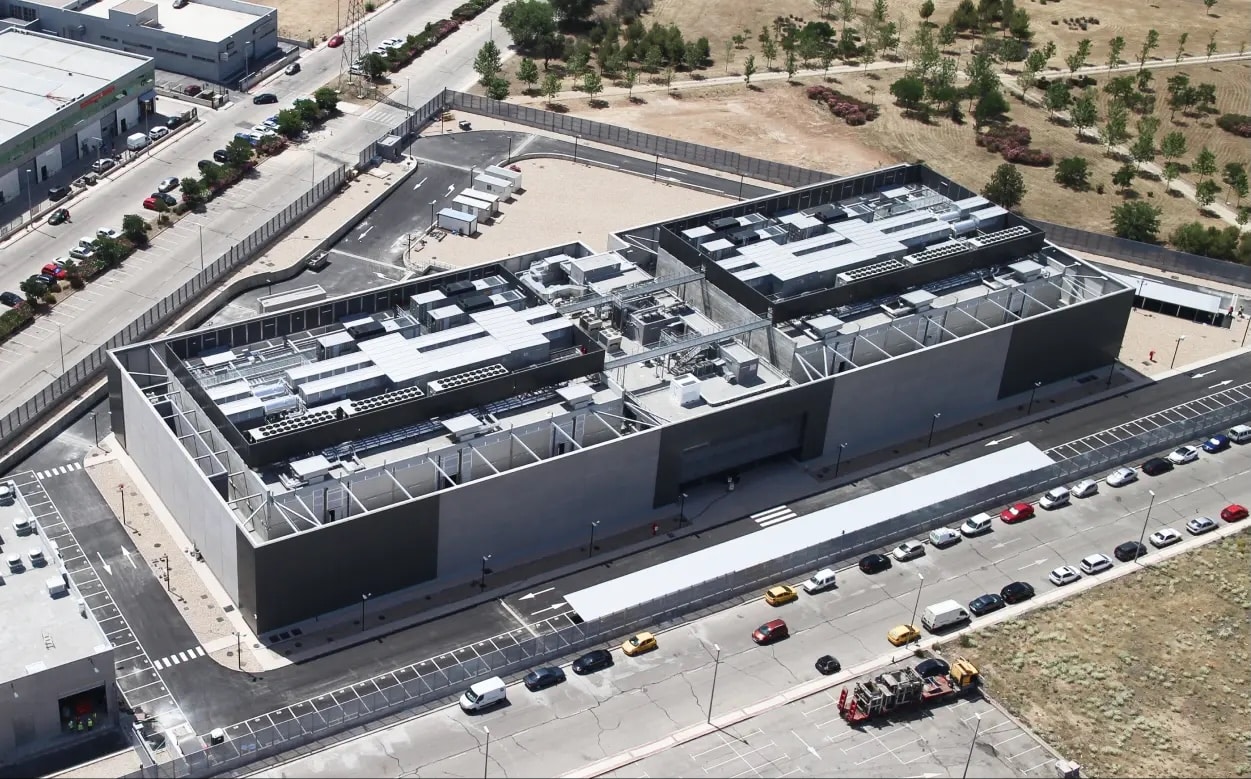
Templus aims to strengthen Valencia’s position on the European data center map. The company announced it will quadruple the capacity of its facility at the Paterna Technology Park, increasing from 1 MW to 4 MW of power and expanding from the current 400 square meters of IT rooms to over 1,600 square meters. This expansion positions the infrastructure as a key element for the digital growth of the Valencian Community and for companies that require connectivity, availability, and proximity without always relying on traditional major hubs.
The center’s inauguration was attended by the Regional Minister of Industry, Tourism, Innovation, and Commerce, Marián Cano; Templus Customer Success VP, Jaime Ciudad; and Spain DC CEO, Begoña Villacís. During the event, Cano highlighted that data centers have become “critical infrastructures for the operation of an advanced economy” and linked these projects with industrial competitiveness, logistics, healthcare, tourism, public administration, and artificial intelligence.
Paterna Gains Significance as a Mediterranean Digital Node
Templus’s move comes at a time of strong sector growth in Spain. The demand for cloud services, business digitalization, increased data traffic, and the expansion of artificial intelligence are putting pressure on the physical infrastructure supporting the digital economy. In this context, Valencia seeks to position itself as a complementary node to Madrid, Barcelona, and other European centers.
The location within Paterna Technology Park is strategic. The area concentrates business activity, connectivity, tech talent, and proximity to a diverse industrial fabric. For Templus, such sites fit with its regional data center model: facilities close to economic activity, capable of providing colocation services, advanced connectivity, high availability, and support for hybrid environments.
Jaime Ciudad stated during the inauguration that Spain’s digitalization “must go through the Valencian Community” and emphasized the region’s potential to become one of the main tech hubs in the Mediterranean. His message points to a clear trend: data centers are no longer concentrated solely in large hyper-connected hubs but are spreading to regions where companies, administrations, and operators need lower latency, data sovereignty, and local capacity.
The Valencia data center will feature Tier III certification, a standard associated with high availability, redundancy, and maintenance without complete service interruption. This certification is important for business clients as it helps gauge the resilience of the installation and its suitability for critical workloads. The company also highlights advanced connectivity services and high availability, comparable to Europe’s leading tech nodes.
Sustainability and Efficiency as Core Design Elements
The expansion has also been presented with a sustainability focus. According to information from the Generalitat, the data center will operate on 100% renewable energy, feature a closed water circuit, and have its own photovoltaic plant for self-consumption. In an industry increasingly scrutinized for its electrical and thermal consumption, these elements will be crucial for maintaining social and regulatory acceptance of new infrastructure.
Cano emphasized that industrial growth, technological innovation, and environmental sustainability must advance together. This aligns with a growing concern across Europe: data centers are essential for digitalization, but their development requires energy planning, efficiency, territorial integration, and transparency regarding resource consumption.
The reference to a closed water circuit is particularly relevant. Cooling has become one of the most debated aspects of data centers, especially in regions facing water stress or high temperatures. Although each facility has its technical characteristics, designs that reduce water use or reuse circuits can improve the center’s environmental compatibility.
Renewable energy and photovoltaic self-consumption do not eliminate all energy challenges but help reduce operational footprints and provide greater predictability for infrastructure that requires stable 24-hour supply. As workloads from AI and rack density grow, energy efficiency shifts from branding points to operational necessities.
A European Network Focused on Proximity
Templus positions itself as a European network of regional data centers with presence in Spain, the UK, France, Italy, the Netherlands, Denmark, and Switzerland. Its corporate website emphasizes proximity, interconnection, data sovereignty, and readiness for AI workloads as core elements of its value proposition. Its locations include centers in Madrid, Barcelona, Valencia, Lisbon, London, Paris, Milan, Amsterdam, Copenhagen, Leeds, and Zurich.
The Valencia expansion fits into this strategy. Not all clients need to deploy workloads in a large hyperscale campus; many companies require nearby, connected, and managed infrastructure with uniform standards. This is especially beneficial for regional businesses, technology providers, governments, industrial services, hybrid environments, and projects combining private cloud, colocation, communications, and multi-carrier access.
For the Valencian Community, the project also has an economic dimension. Increased local data center capacity can help sectors like automotive, logistics, healthcare, smart tourism, advanced industry, and AI access higher availability infrastructures without relocating their entire digital operation elsewhere. While not replacing large hubs, it enhances the territory’s technological autonomy.
The key will be in how the expansion is executed and the types of clients it attracts. Power capacity and space are important, but the real value of a data center also depends on its connectivity, operators present, interconnection agreements, security, technical support, energy efficiency, and ability to integrate into hybrid architectures. These factors play a significant role in competition among regional providers and large cloud platforms.
Templus thus enters a phase where its challenge is not just adding capacity but demonstrating that proximity data center models can meet the needs of a more distributed digital economy. Valencia, given its geographic position and business fabric, has compelling arguments to participate in this evolution. The expansion to 4 MW cements Paterna as a more visible piece of that strategy.
Frequently Asked Questions
What has Templus announced in Valencia?
Templus will quadruple the capacity of its Paterna Technology Park data center, reaching 4 MW of power and over 1,600 square meters of IT rooms.
Why is this data center important for the Valencian Community?
Because it reinforces local digital infrastructure and can help companies, administrations, and tech providers access connectivity, high availability, and infrastructure hosting services close to their operations.
What does Tier III certification mean for the center?
It indicates that the facility is designed with redundancy and availability standards that allow maintenance without completely stopping operation, which is crucial for critical workloads.
What sustainability measures does the project highlight?
The Generalitat and Templus emphasize the use of 100% renewable energy, a closed water circuit system, and an on-site photovoltaic plant for self-consumption.
via: GVA
