
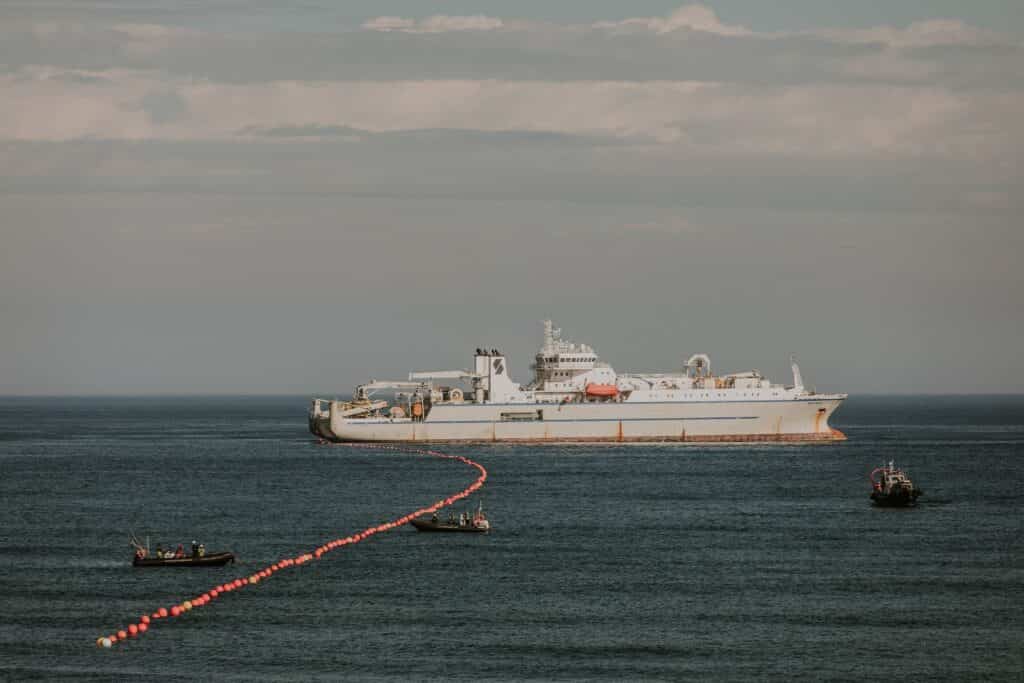
The Strait of Hormuz has always been an awkward word for energy markets. A vital part of Gulf oil trade passes through this area, and any military tension there often translates into nerves among shipping companies, insurers, and governments. Now, the risk extends to a less visible but equally sensitive layer: the underwater Internet cables connecting the Gulf with Asia, Europe, and Africa.
Iranian media linked to the Revolutionary Guard have recently raised the possibility of charging fees, imposing licenses, and exerting local control over the fiber-optic cables crossing the region. The proposal was disseminated by Tasnim, an agency considered close to the Islamic Revolutionary Guard Corps, and reported by Iran International. According to this information, the plan would include three measures: initial licenses and annual renewals for foreign operators, requiring tech giants like Meta, Amazon, or Microsoft to operate under Iranian law if they use this infrastructure, and exclusive control over maintenance and repairs by Iranian companies.
There’s no evidence that these ideas have become official regulations. For now, they are part of a discursive offensive amid the ongoing regional crisis, but it’s wise not to dismiss them as mere propaganda. In critical infrastructure, threats also carry strategic value: increasing insurance costs, complicating routes, delaying deployments, and prompting operators and governments to review contingency plans.
From Energy Bottleneck to Digital Pressure Point
Submarine cables often go unnoticed until they fail. The International Telecommunication Union reminds us that these infrastructures carry about 99% of global Internet traffic and support essential services such as financial communications, cloud computing, government activities, and basic digital services.
While the Strait of Hormuz does not host all of the world’s Internet, it is a sensitive point for Gulf connectivity. Reuters identified in April several key systems in the region, like Asia-Africa-Europe 1 (AAE-1), FALCON, and Gulf Bridge International, along with ongoing projects linked to regional operators. TeleGeography, specialized in mapping and analyzing submarine cables, also warns that conflict could delay new deployments, including routes designed to bypass the Red Sea by connecting through the Gulf.
The figure of 10 trillion dollars in daily transactions passing through these cables, cited by Iranian media, should be approached with caution. It’s a common estimate used to describe the overall economic importance tied to submarine cables but not necessarily a verified measure of the exact financial traffic moving through Hormuz each day. The nuance matters because recognizing the economic relevance of the infrastructure differs from asserting a basis for collecting tolls.
The closest precedent is in the Red Sea. In 2024, several damaged cables caused connectivity issues and increased latency in parts of Asia and the Middle East. The Associated Press reported impacts on systems like SMW4, IMEWE, and FALCON, with complex repairs due to maritime security concerns. That episode demonstrated that global Internet has redundancy but not immunity: when multiple cables are affected in a sensitive region, traffic is rerouted, response times increase, and some networks come under pressure.
What Tasnim Proposes and Why It Would Be Difficult to Implement
The proposal circulated by Tasnim contemplates a form of sovereign monetization of the seabed. Iran’s argument is based on the idea that cables traverse an area that Tehran considers strategic and, thus, should generate income for the country. Fars, another Iranian media outlet aligned with security interests, reportedly published even more aggressive messages about interrupting cables and causing economic losses, according to Iran International and outlets tracking this coverage.
| Proposed Measure | Practically What It Means | Main Risk |
|---|---|---|
| Annual licenses and fees | Charging foreign cable operators or owners | Legal conflicts and increased route costs |
| Applying Iranian law to tech companies | Requiring compliance with local regulations for companies using the infrastructure | Jurisdictional clashes, sanctions, and breach of international contracts |
| Exclusive maintenance by Iranian companies | National control over physical repairs and operations | Operational risks, delays, and loss of trust |
| Threat of disruption | Using cables as leverage for pressure | Regional and global disruptions, including Gulf countries |
The legal viability is questionable. The United Nations Convention on the Law of the Sea governs straits used for international navigation and recognizes transit passage rights for ships and aircraft, but the specifics regarding cables add technical and legal complexities depending on whether they lie in territorial waters, exclusive economic zones, the continental shelf, or established routes. The core issue is that unilateral taxes based on the data flow value would be very difficult to reconcile within international law without triggering a significant diplomatic and commercial conflict.
Moreover, the impact would not be limited just to major U.S. tech companies. An outage or restriction in Hormuz would affect banks, telecom operators, regional clouds, governments, hospitals, airlines, e-commerce, and local Gulf businesses. Countries such as the UAE, Qatar, Bahrain, Kuwait, and Saudi Arabia depend heavily on these routes for their digital economies. Hence, a threat to the cables functions as pressure on the West but also serves as a warning to Arab neighbors who have invested billions in data centers, cloud computing, and artificial intelligence.
A Risk for Cloud, Finance, and Artificial Intelligence
The debate extends beyond domestic connectivity. Submarine cables are the physical backbone of the global cloud. Every query to a remote service, regional synchronization, international financial transaction, and corporate data flow relies on optical routes with landing points, ground stations, permissions, and specialized repair ships.
In the Gulf, this dependency has become even more evident with the growth of data centers, cloud regions, and AI projects in the UAE, Saudi Arabia, and Qatar. If Hormuz turns into a digital pressure point, it’s not just about end-user Internet access. The promise of transforming the region into a technological hub connecting Asia, Africa, and Europe also faces serious challenges.
The threat doesn’t necessarily require physical sabotage to cause costs. Simply increasing perceived risk can delay new cables, raise maritime insurance premiums, demand alternative routes, or inflate maintenance costs. TeleGeography already pointed out that hostilities in the Gulf could postpone planned installations and impact efforts to diversify routes beyond the Red Sea.
The more cautious view is that Iran is trying to expand its definition of Hormuz. No longer solely a maritime passage for oil and gas, Tehran now considers it a strategic space where data, payments, and digital services also circulate. Reuters recently reported that officials linked to the Revolutionary Guard have started describing the strait as a much larger operational zone than its traditional definition—consistent with Iran’s intent to increase regional pressure.
For companies and governments, the message is clear: digital resilience can’t rely solely on nice maps with submarine lines without considering geopolitics. Route diversification, rerouting capabilities, repair agreements, physical protection of landing stations, and international coordination are no longer secondary technical issues—they are essential to business continuity.
Iran may not realistically turn Hormuz cables into a national cash register, but it can transform them into a credible threat within broader negotiations. In a world where the digital economy travels through fiber buried at the ocean’s bottom, geography once again proves to be an uncomfortable factor.
Frequently Asked Questions
What does Iran want to do with the submarine cables in Hormuz?
Linked Iranian media have proposed charging licenses and fees to foreign operators, subjecting major tech firms to Iranian laws, and reserving maintenance to Iranian companies. So far, these are not official measures approved by authorities.
Why are Internet submarine cables important?
Because they carry about 99% of international data traffic. They support financial communications, cloud services, utilities, e-commerce, video calls, and much of the global digital economy.
Which cables pass through the Hormuz area?
Recent analyses highlight systems such as AAE-1, FALCON, and Gulf Bridge International, along with regional projects and planned routes that could be affected by Gulf tensions.
Can Iran cut off global Internet if it acts on these cables?
Not entirely, because alternative routes and rerouting capacity exist. However, damage or blocking of multiple cables in the Gulf could cause increased latency, congestion, regional outages, and significant costs for operators, businesses, and governments.
via: tomshardware
