
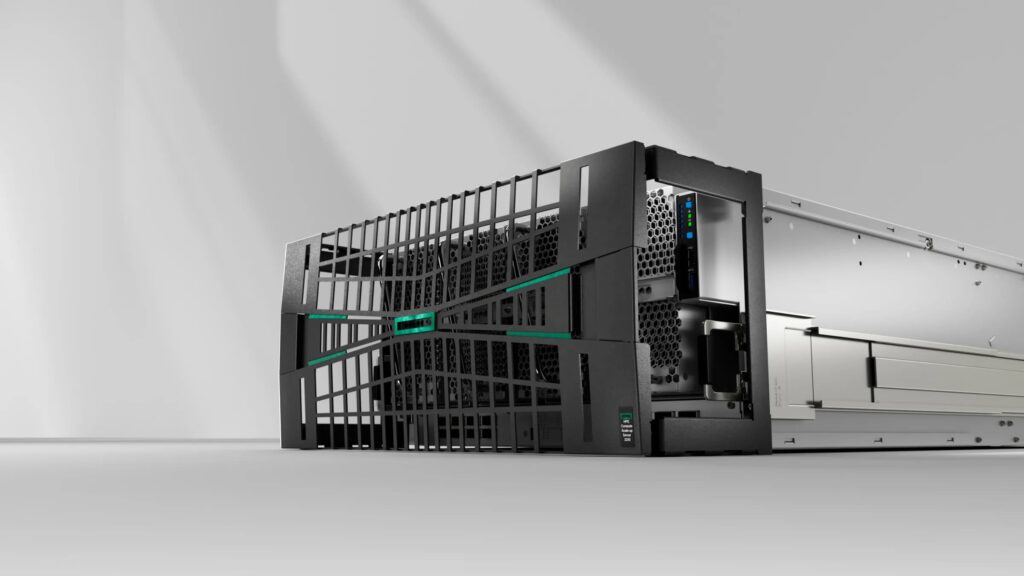
HPE has announced the Compute Scale-up Server 3250, a server designed for large in-memory databases and critical business workloads, with a figure that clearly illustrates where enterprise infrastructure is headed: up to 64 TB of DDR5 memory in a scale-up architecture. The system, based on Intel Xeon 6 processors, is especially targeted at environments SAP HANA, SAP Cloud ERP, RISE with SAP, and transactional or analytical applications that cannot afford extended downtimes.
The announcement comes at a time when many companies are reviewing their SAP platforms, not only due to migration to S/4HANA or managed cloud models but also driven by data growth, the pressure of real-time analytics, and the need to consolidate workloads that were previously spread across multiple systems. HPE aims to address this scenario with a large shared-memory server, designed for companies that prefer vertical scaling over fragmenting specific workloads across multiple nodes.
The HPE Compute Scale-up Server 3250 succeeds the HPE Scale-up Server 3200 based on Intel and is presented as the first scale-up server validated by the SAP BW edition HANA benchmark with at least 48 TB of memory. The company states that the system is available in configurations from a minimum of four sockets up to a maximum of 16, with a modular architecture focused on in-memory databases, ERP, CRM, financial services, logging systems, and emerging AI agent-based workloads.
Why Do 64 TB of Memory Matter in SAP HANA
SAP HANA relies on an in-memory architecture to accelerate analytical and transactional operations. Put simply, the more relevant data that can be kept in memory, the less dependent the system is on disk accesses, and the higher its capacity to execute queries, financial close processes, planning, analysis, or business workflows with low latency. In large corporations, this difference can directly impact closing times, inventory analysis, reporting, user experience, and operational continuity.
The scale-up approach aims to concentrate large volumes of memory and CPU capacity in a single logical system. This can simplify certain environments compared to scale-out architectures, where load is distributed across multiple nodes, making network coordination of data, transactions, and queries more critical. This doesn’t mean scale-up is always preferable: in many scenarios, horizontal scaling still makes sense. But for very large in-memory databases and critical workloads with strict requirements for consistency, latency, and simplified management, a 64 TB scale-up system offers scope for consolidation.
HPE emphasizes that the server includes an external dedicated node controller that, according to their data, offers performance improvements up to 100 times greater than Ethernet in scale-out deployments. This is a proprietary claim that should be understood within the context of their testing and architecture but clearly indicates a priority: reducing reliance on general interconnections when working with demanding shared-memory workloads.
Memory isn’t the only factor. The system is based on Intel Xeon 6 processors, which are designed to improve density, efficiency, and performance in data centers. For SAP, the combination of CPU, memory, I/O subsystem, resilience, and certifications is critical. It’s not enough to just add RAM: companies need validated platforms with manufacturer support and guaranteed compatibility with certified SAP HANA environments.
Security, Resilience, and Operation in Critical Workloads
HPE positions security and availability as core aspects of the server. The Compute Scale-up Server 3250 integrates protection through HPE Integrated Lights Out (iLO), with a silicon-based root of trust, dedicated security processor, and validated firmware. The company also mentions future-proof protection via post-quantum cryptography, aligning with growing concerns over the lifespan of sensitive data in corporate environments.
In resilience, the system includes advanced memory error detection and correction, along with memory healing and deconfiguration functions. These features allow for isolating or managing memory faults to reduce the risk of complete system failure. For critical SAP workloads, this resilience is often as important as raw performance: a platform may be fast but impractical if it cannot gracefully handle faults, especially in near-zero downtime processes.
Availability is especially relevant for RISE with SAP and organizations moving critical systems to hybrid or managed cloud models. While AI receives much attention, many companies still rely heavily on ERP, databases, finance, supply chain, order processing, billing, and customer systems. These workloads are less glamorous than generative models but are the backbone of daily operations.
The new server also strengthens HPE’s position in certified SAP infrastructure. The company was recognized as a leader in the IDC MarketScape Worldwide SAP HANA-Certified Servers & Appliances 2026 Vendor Assessment, as referenced in the press release. While such recognitions do not replace a technical evaluation, they influence decision-making among large clients seeking vendors with proven SAP HANA expertise, global support, and integration capabilities.
Context: SAP Modernization, Real-Time Data, and Enterprise AI
The launch aligns with broader trends. Companies are modernizing their SAP platforms while increasing the volume of data they want to analyze in real time. Additionally, the pressure of enterprise AI requires reliable data, consistent historical records, and well-integrated transactional systems. Before deploying agents or advanced analytics, many companies need to ensure their core systems respond quickly and are available.
HPE positions the Compute Scale-up Server 3250 as a foundation for this stage—not just for SAP HANA but also for analytics workloads, logging systems, and critical applications requiring large memory footprints. The mention of AI agent workloads should be interpreted cautiously: the server isn’t a GPU training platform but can serve as a data and transaction infrastructure where business agents query, process, or automate operations on critical systems.
For CIOs, choosing scale-up over other architectures involves more than technical considerations. Cost, licensing, availability, operational models, integration with RISE with SAP, sovereignty requirements, support, energy consumption, and hybrid cloud strategies play vital roles. In some cases, consolidating workloads on a large server simplifies operation; in others, distributed architectures offer greater flexibility. Success depends on tailoring the design to actual workload demands rather than following generic trends.
The HPE Compute Scale-up Server 3250 is now available and can be purchased through HPE Financial Services’ 90/9 Advantage program, offering 90 days without payments and nine additional months at 1%. This financing approach highlights an important aspect of the market: modernizing critical infrastructure isn’t driven solely by performance but also by how it fits into multi-year budgets.
The race for AI acceleration has largely focused on GPUs, accelerators, and massive data centers. However, HPE’s announcement serves as a reminder that critical enterprise infrastructure still requires specialized servers, massive memory, and certified platforms. The digital transformation of many companies begins not with training a model but with ensuring their business data is accessible, protected, and ready for real-time operation.
Frequently Asked Questions
What is the HPE Compute Scale-up Server 3250?
A large shared-memory server designed for in-memory databases, SAP HANA workloads, SAP Cloud ERP, RISE with SAP, and critical business applications.
How much memory does it support?
HPE states it can be configured with up to 64 TB of DDR5 memory, in configurations ranging from four sockets to a maximum of 16.
Why is it relevant for SAP HANA?
Because SAP HANA operates entirely in-memory. Having large RAM capacities on a certified platform helps run demanding analytical and transactional workloads with lower latency.
Does it replace a scale-out architecture?
Not necessarily. Scale-up and scale-out serve different needs. The new server is suited for workloads where concentrating memory and CPU in a large system simplifies operations and enhances performance.
via: hpe
