
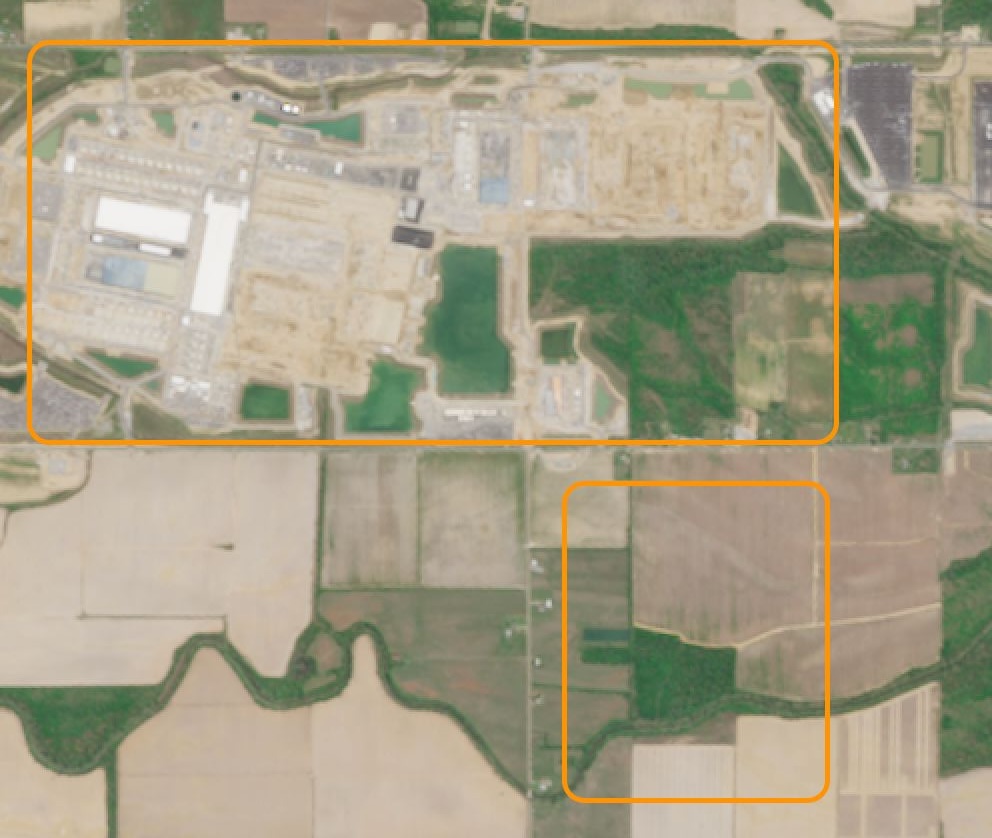
The race to build artificial intelligence data centers is transforming the landscape of digital infrastructure. For years, major nodes concentrated near economic capitals, interconnection points, and large business markets. Madrid, London, Frankfurt, Amsterdam, Paris, Ashburn, and Dallas were the natural references. But AI has changed the rules: now, proximity to the client is no longer the only factor; availability of land, energy, water, fiber, permits, and capacity for large-scale growth are equally important.
In the United States, developers are increasingly looking toward rural land or undeveloped areas outside municipal boundaries. The explanation is straightforward: these locations offer larger parcels, fewer immediate neighbors affected, and often fewer bureaucratic hurdles related to city councils, rezoning votes, or local urban planning reviews. This doesn’t mean they can build without permits, but some negotiations shift from municipal authorities to county commissions, water agencies, utilities, and state agencies.
Spain is beginning to experience a similar shift. Madrid remains the major national hub for connectivity, business demand, and operator presence, but a new wave of AI-related projects is redirecting interest towards Aragon, Extremadura, Castilla-La Mancha, Catalonia, Basque Country, and other regions with more available land and electrical capacity. Digital infrastructure decisions are no longer made solely in financial centers but also in industrial parks, science parks, former energy zones, and logistics corridors away from big capitals.
The countryside as a new frontier for computing
The rural movement in the U.S. is not driven by aesthetic preference but by regulatory and social pressures. Many municipalities are imposing moratoriums, revising ordinances, or tightening conditions due to the impact of data centers on electricity, water, noise, and rates. A survey by Redfin and Ipsos found that 47% of Americans oppose building an AI data center near their homes, which explains why developers seek locations with less neighborhood exposure.
The scale of new projects helps explain this reaction. In Utah, the Stratos project, led by O’Leary Digital and WestGen in Box Elder County, is planned as a campus up to 9 GW on undeveloped land. In Louisiana, Meta is developing its large data center in Richland Parish, tied to AI workloads and accompanied by new electrical agreements. In Texas, Hut 8 has signed a 15-year lease for $9.8 billion for its Beacon Point campus, with an initial 352 MW and plans for up to 1 GW.
These projects reveal an uncomfortable reality: an AI data center is no longer just a technological facility; it’s energy infrastructure. It may require substations, high-voltage lines, dedicated generation, cooling systems, large civil works, and long-term power contracts. Consequently, developers seek large, relatively remote spaces with room to build around the data center everything that was previously taken for granted.
But relocating campuses to rural areas doesn’t eliminate conflict; it shifts it. Where discussions once took place in municipal sessions, they now occur in counties, planning boards, water management agencies, utilities, or state legislatures. Rural communities may have smaller populations but not necessarily less opposition. Impact on water, agriculture, landscapes, noise, real employment, and energy costs can be even more sensitive where the local economy depends on natural resources.
Spain looks beyond Madrid
In Spain, the phenomenon has its own nuances. It’s less about avoiding municipal authorities and more about finding energy, land, and permitting in a country where the data center market has grown rapidly from a still-limited base. Spain DC estimates that direct and indirect investments in the sector could reach €66.9 billion by 2030, with 439 MW of installed IT capacity by the end of 2025—24% more than the previous year.
Madrid remains a key market due to its connectivity, operators, corporate clients, and role as a national hub. However, pressures on land, electrical capacity, and timelines are reshaping the map. Colliers reports that the Iberian Peninsula has nearly 14 GW of announced IT projects, with Aragon, Madrid, and Barcelona leading in new projects designed for AI workloads. It also warns that the new energy regulation framework in Spain and Portugal adds pressure to build quickly and riskily, securing capacity sooner.
Aragon stands out prominently. AWS has made the region one of its major European hubs, with data centers in Huesca, El Burgo de Ebro, and Villanueva de Gállego, and Amazon increased its expansion plan in March 2026 to €33.7 billion through 2035. The Aragon government has approved new phases of the General Interest Plan to facilitate building in Walqa, Huesca, and Villanueva de Gállego, including substations, water treatment plants, and technical infrastructures. The approach is very similar to the US model: large sites, energy, capacity for expansion, and coordinated permitting.
Microsoft has also targeted Aragon with projects near Zaragoza and other locations, while other operators and developers are exploring sites in municipalities where land and power offer more potential than in saturated corridors. Aragon is now competing not only with Madrid but also with becoming a European computing platform.
Extremadura is emerging as another attractive region. Its land, energy availability, and strategic position have attracted large-scale projects. FRV announced Lusitanus, an AI data processing center in ExpacioMérida, with an initial €2.8 billion investment and 240,000 square meters. Merlin Properties, via Edged Energy, plans campuses in Navalmoral de la Mata and Valdecaballeros with potentially very large scales. These projects show how AI is shifting data center debates into territories that previously weren’t on the sector’s main map.
Castilla-La Mancha offers another example with Meta’s campus in Talavera de la Reina. Declared a project of singular interest, it is located on the Torrehierro industrial estate, about 12 kilometers west of the city, and is one of the company’s major data centers in Europe. Environmental permitting has lowered water consumption estimates and prompted revision of cooling solutions, illustrating how technological investments are increasingly scrutinized for their resource use and local impact.
AI seeks not just low latency but megawatts
The shift in location also reflects a technical evolution. Traditional digital services prioritized latency near end-users. For streaming, e-commerce, gaming, or financial services, proximity to large urban areas offered clear advantages. For AI, however, the picture is more complex. Training workloads can be situated far from users if they have cheap energy, available land, and robust backbone connectivity. Conversely, inference workloads—especially real-time applications—may still demand proximity.
This creates a two-tier market: large training and heavy AI campuses in regions rich in energy and land, and smaller nodes closer to cities for inference, edge computing, enterprise connectivity, and latency-sensitive services. Madrid, Barcelona, and Lisbon will continue to be interconnection hubs, but much of the massive capacity will move to where it can be built faster and with fewer physical restrictions.
The problem is that many rural or semi-urban areas were not prepared to host global AI infrastructure. They require reinforced electrical grids, water planning, roads, fiber networks, housing for workers during construction, and mechanisms to generate local value from investment. If a project consumes hundreds of megawatts but creates few permanent jobs, social debate is inevitable.
Here, Spain faces both opportunity and risk. The opportunity is to become a European digital infrastructure hub leveraging renewable energy, international connectivity, and available land outside saturated urban cores. The risk is to repeat an extractive model: regions supplying energy, water, and land for platforms operated by tech giants, while stable employment, intellectual property, and high-value services are concentrated elsewhere.
The key will be strategic planning. Data centers cannot be treated as mere industrial buildings or fleeting investment trends. They require coherent policies on energy, urbanism, transparent fiscal agreements, vocational training, local impact clauses, heat reuse (when feasible), responsible water use, and coordination with the electric grid. An honest discussion about who bears the infrastructure costs and who benefits is essential.
The migration of data centers to rural areas is not an anomaly but a natural consequence of an industry competing for gigawatts. The US is seeing this in its rural counties; Spain is beginning to see it in Aragon, Extremadura, Talavera, and other regions on the AI radar. Digital infrastructure is moving away from urban showcases but remains central to public debate: as demand for computing grows, so does the importance of deciding where, with what resources, and at what cost.
Frequently Asked Questions
Why do AI data centers seek rural or remote locations?
Because they require large land parcels, electrical capacity, space for substations, and fewer physical constraints than urban areas. In some countries, these locations can also streamline municipal procedures and approval processes.
Is something similar happening in Spain?
Yes, although with specific characteristics. Madrid remains the main node, but regions like Aragon, Extremadura, Castilla-La Mancha, Catalonia, and Basque Country are attracting projects due to land, energy, and expansion potential.
What is the main bottleneck for new data centers?
Energy. Without available capacity, grid connection, substations, and electrical agreements, projects can be delayed even if land and financing are in place.
What risks does bringing data centers to rural areas pose?
Energy and water consumption, noise, impact on agricultural land, pressure on electrical networks, limited permanent employment, and potential local opposition if benefits are not clearly communicated and shared.
