
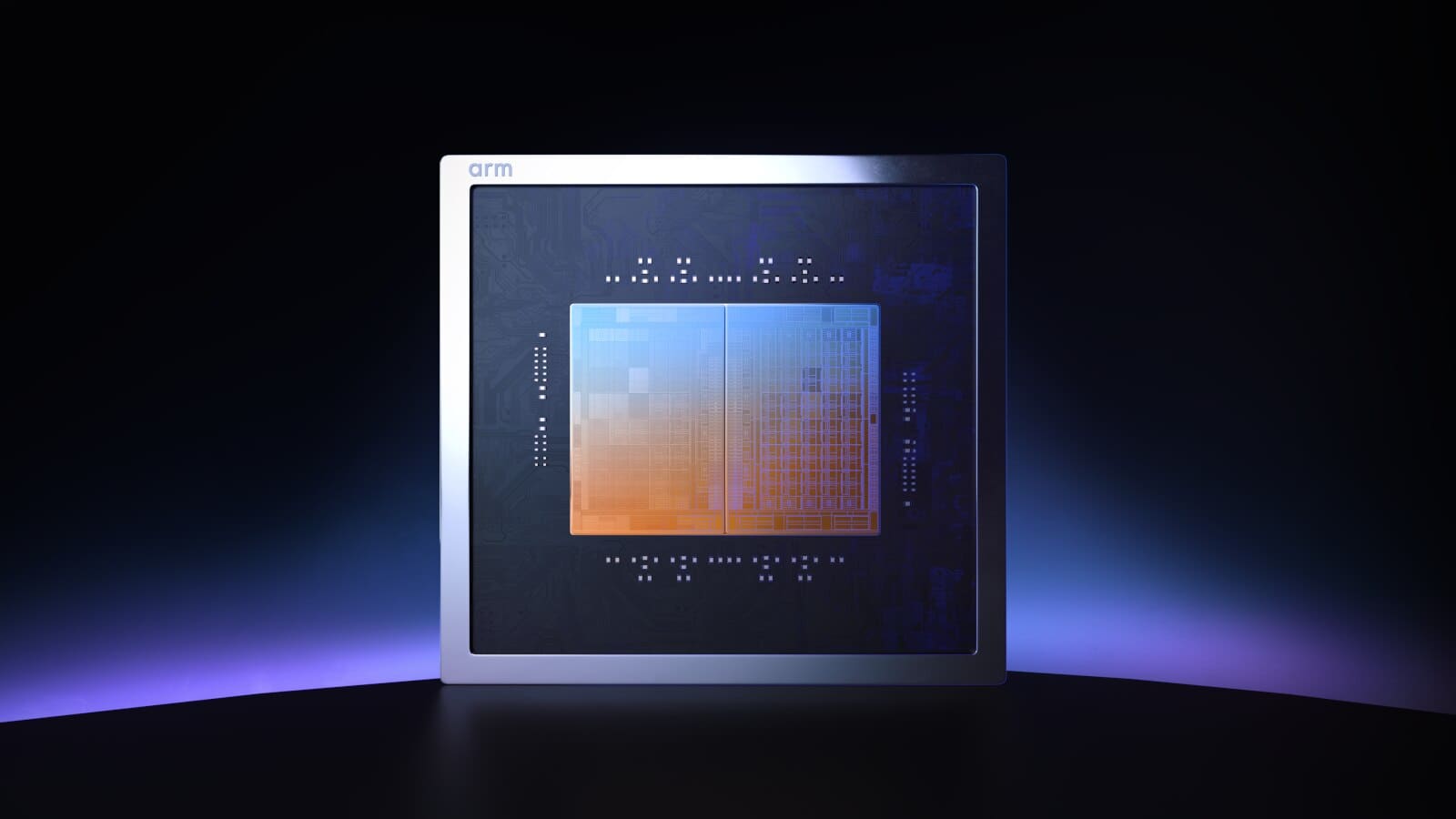
ARM wants the conversation about artificial intelligence to move beyond just GPUs. The British company, known for decades for licensing efficient architectures for mobile devices, embedded systems, and custom chips, is raising its voice in data centers with a very specific idea: the next big battle won’t be measured solely by the number of processors sold, but by the number of CPU cores deployed to coordinate, power, and manage increasingly complex AI systems.
Rene Haas, CEO of ARM, argued during the company’s latest earnings call that the growth of agent-based AI will multiply the need for CPUs in data centers. According to his thesis, AI agents don’t just execute a single query; they orchestrate tasks, move data, manage memory, coordinate accelerators, and launch parallel processes. In this context, ARM sees a near future with chips featuring 256 and even 512 cores—numbers that just a few years ago would have sounded more like supercomputing than commercial infrastructure.
The CPU Returns to the Center of AI
ARM’s message arrives at a time when the market is beginning to correct an overly simplified idea: AI infrastructure isn’t powered solely by GPUs. GPUs and specialized accelerators remain the most visible components, especially for massive training and inference, but they need CPUs around them. These CPUs act as control nodes; they coordinate workflows, prepare data, manage networking, security, memory, storage, and task scheduling.
ARM asserts that data centers will require more than four times their current CPU capacity as AI agents scale. The company estimates this shift could open a market opportunity worth over $100 billion in data center CPUs by 2030. Meanwhile, AMD has raised its own server CPU market forecast to more than $120 billion for the same year, with an annual growth rate exceeding 35%, driven by AI infrastructure demand.
The figure of 500 cores doesn’t refer to a specific product with a launch date or commercial name but rather a technical horizon set by Haas. During the analyst call, the executive mentioned that the ARM AGI CPU already has 136 cores, compared to NVIDIA’s Vera with 88 cores, and that he could imagine designs with 256 or 512 cores in the coming years. The key, according to ARM, isn’t just increasing the raw number but doing so efficiently per core.
This detail is important. Talking about a “500-core CPU” may sound spectacular, but this isn’t an official announcement of a particular chip for 2030. It’s a strategic signal: ARM believes the AI market will demand general-purpose processors with many cores, and its architecture has an advantage when it comes to scaling efficiency, density, and power consumption.
ARM vs x86: Less Dependency and More Customization
The underlying battle is against the long-standing dominance of x86 in servers—a territory controlled for decades by Intel and increasingly by AMD. ARM isn’t just competing on performance. It offers a licensing model that allows major clients to design their own chips or adopt solutions tailored to very specific workloads.
This is where hyperscalers come in. AWS has been developing Graviton for years. Google has introduced Axion. Microsoft works with Cobalt. NVIDIA uses ARM CPUs in Vera. According to ARM, Amazon, Google, and NVIDIA already incorporate ARM-based CPUs alongside their AI acceleration platforms. The clear message is that large cloud operators don’t want to depend solely on Intel and AMD for all their compute layers.
This doesn’t mean x86 will disappear. AMD is experiencing a strong period with EPYC processors, and Intel retains a huge installed base, deep business relationships, and significant industrial capacity. But it does mean the market is fragmenting. In the past, many companies purchased relatively standard servers. Now, major players are designing their infrastructure as a custom product: CPU, accelerators, networking, memory, storage, cooling, and software are optimized together.
ARM aims to hold a central position in this new stack. Its strategy no longer merely involves selling IP for others to manufacture chips. With the ARM AGI CPU, the company has taken the step into designing its own silicon for data centers while maintaining its traditional licensing and royalty business. This is a delicate shift—it could create tensions with some customers also designing ARM chips—but the company insists both lines are complementary.
Haas himself noted that ARM projects over $2 billion in demand for its AGI CPU in fiscal years 2027 and 2028, more than double what was announced at launch. However, Reuters highlighted an important nuance: the company has capacity secured to fulfill the initial $1 billion demand but not yet the second. Demand exists, but supply chain constraints remain a limiting factor.
CPU Cores Are Not GPU Cores
The comparison between CPU cores and GPU cores must be approached with caution. A CPU core is not equivalent to a CUDA core, a shader, a Tensor Core, or a dedicated unit in a modern GPU. They serve different purposes, operate with different models of parallelism, and have very different relationships between control, latency, memory, and massive computation.
Therefore, ARM’s idea shouldn’t be understood as “CPUs will surpass GPUs.” That’s not the point. What the company proposes is that, even if the physical ratio between CPU and GPU chips doesn’t change much, the ratio of deployed CPU cores can grow significantly. In large AI-focused data halls, entire racks of CPUs dedicated to orchestration, agent management, and auxiliary inference could appear alongside racks of accelerators.
The NVIDIA Vera rack exemplifies this. Haas cited NVIDIA’s Vera rack with 256 Vera chips, each with 88 cores, housed in a liquid-cooled rack consuming 200 kW—designed to work alongside Vera Rubin systems. This architecture shows that even NVIDIA, a symbol of the GPU era, is strengthening its CPU layer around its AI platforms.
The reason is straightforward: AI agents aren’t just massive matrix multiplications; they also require logic, coordination, memory, API calls, database interactions, security, queues, parallel tasks, and chained decisions. For these workloads, many efficient CPUs can be as important as accelerators running models.
Implications for Servers, Cloud, and PCs
For the data center market, the trend points toward increasingly dense chips with more cores, more memory, higher bandwidth, and designs optimized for efficiency per rack. The metrics that will matter aren’t just performance per socket but performance per watt, per rack, per dollar spent, and per actual AI workload.
For enterprise clients, this could mean more options. Cloud instances could be based on x86, ARM, proprietary accelerators, and increasingly tailored combinations. Customers might not buy a 512-core CPU directly but will consume cloud services built on that architecture. Decisions will shift toward cost per task, latency, software compatibility, and energy efficiency.
For PCs and laptops, the outlook is different. The “500-core CPU” race belongs to data centers, not personal devices. In client devices, ARM will continue pushing through Qualcomm, Apple, and other partners, focusing on autonomy, local AI, and efficient designs. It wouldn’t make sense to directly port a multi-hundred-core CPU to a notebook. These are different markets, even if they share architecture and development tools.
ARM’s challenge will be demonstrating scaling without losing the advantages that make it attractive. More cores mean increased complexity in memory, coherence, interconnects, software, compiler support, and scheduling. Hardware only gains value if the ecosystem can utilize it effectively. In servers, x86 maintains a historical edge in compatibility, but Linux, Kubernetes, modern databases, runtimes, and cloud-native workloads have significantly lowered that barrier for ARM.
ARM’s move is ambitious because it coincides with a key turning point. Agent-based AI is not only increasing demand for GPUs but also restoring the CPU’s role as the coordinator of infrastructure. If ARM succeeds in turning efficiency and customization into greater market share, Intel and AMD will face a more challenged competitor in the most critical area: the data center.
The 512-core CPU isn’t a product that we can order today; it’s a statement about industry direction. The plan is clear: more cores, better efficiency, deeper integration, and a shift away from traditional server architecture toward controlling the entire AI infrastructure.
Frequently Asked Questions
Has ARM officially announced a 500-core CPU?
Not as a concrete product. Rene Haas, ARM’s CEO, has indicated that designs with 256 or 512 cores may be feasible in the coming years, as part of the evolution of CPUs for data centers and AI.
Why does AI need so many CPUs if GPUs already exist?
GPUs perform the majority of intensive calculations, but CPUs coordinate tasks, manage memory, data, networks, security, orchestration, and agents. Agent-based AI significantly increases that generalist workload.
Can ARM truly compete with Intel and AMD in servers?
Yes, especially in cloud and hyperscale environments, where customized ARM chips like AWS Graviton, Google Axion, Microsoft Cobalt, and NVIDIA Vera are already in use. However, x86 remains very strong in enterprise and traditional servers.
Will we see 500-core CPUs in laptops?
Unlikely. That scale is targeted at data centers. In laptops and PCs, ARM will continue focusing on efficiency, autonomy, and local AI with much smaller chips. These markets are different, even if they share architecture and tools.
via: MyDrivers
