
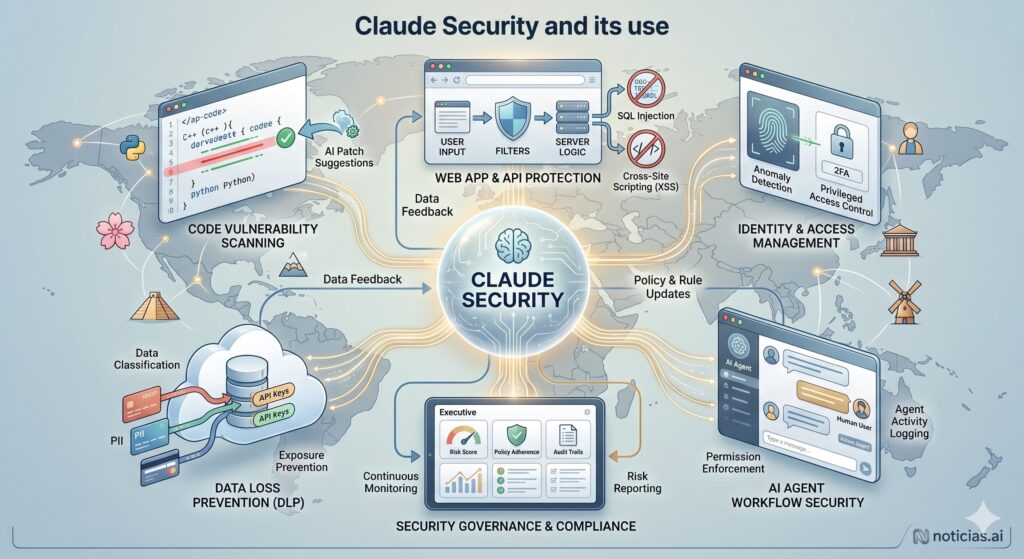
Claude Security is one of the clearest indicators of where software cybersecurity is headed: Artificial Intelligence tools capable of reviewing entire repositories, tracking data flows between files, detecting logical vulnerabilities, and proposing patches for human review. Anthropic has made it available in public beta, but with an important restriction: for now, it’s only accessible to Claude Enterprise customers.
This decision excludes many advanced users working solo, in small businesses, or within technical teams without access to Enterprise contracts. These profiles do pay for powerful plans like Claude Max and could greatly benefit from a tool like this to audit their own code, review internal projects, or reinforce products before release. The logical question is: when will Claude Security be available for Max accounts?
The short answer is that no public release date has been announced yet. Anthropic has confirmed that Claude Security is currently in public beta for Enterprise clients, and several specialized outlets mention that support for Team and Max will come later, described as “coming soon.” This means Max users are on the roadmap, but there’s no official window or specific schedule yet.
A beta primarily designed for companies
Claude Security is integrated within Claude.ai and leverages Claude Code on the web. To use it today, one needs a Claude Enterprise account, web-enabled Claude Code, activated additional usage for consumption-based billing, the Anthropic GitHub app installed, and authorized access to the repositories intended for scanning. Currently, it only works with repositories hosted on GitHub.com.
The enterprise focus makes sense from an operational standpoint. Scanning sensitive code requires permissions, access control, spending limits, integration with GitHub, webhooks, traceability, roles, audit logs, and findings management. Large organizations need to control who can launch scans, which repositories are analyzed, how much each review costs, how results are exported, and what happens to the data.
Each finding generated by Claude Security includes a title, explanation, location, impact, reproduction steps, recommended fix, severity, status, category, associated repository, branch, and creation date. Additionally, a Claude Code session can be opened to work on a specific correction. Anthropic also allows exporting results in CSV or Markdown and connecting them with internal systems via webhooks.
The tool searches for vulnerabilities such as SQL injection, command execution, XSS, XXE, ReDoS, SSRF, path traversal, IDOR, BOLA, CSRF, race conditions, memory flaws, unsafe deserialization, cryptographic errors, and protocol issues. Severity is not only based on category but also on the actual exploitability within the codebase.
This last point is significant. Many traditional analyzers identify patterns but produce excessive noise. Claude Security attempts to reason about context, attack routes, and real conditions. Anthropic states that findings go through a multi-step verification process before being shown, yet also acknowledges that scans are stochastic by design. They do not always behave like a classic SAST tool with identical results every run.
Why Max users make sense for this feature
Introducing this to Max would be important because there’s a segment of users who don’t fit into Enterprise but aren’t incidental either. Independent developers, consultants, small SaaS companies, open-source teams with their own repositories, sysadmins, freelance security officers, tiny startups, or internal plugin and tool creators may need advanced security reviews without signing a corporate plan.
Claude Max was created precisely for power users. Anthropic marketed it as a plan for those who need more usage than Pro, with limits up to five or twenty times higher depending on the mode, plus priority access to new features. In practice, it’s the most advanced step for individual professionals or small teams without large organizational structures.
Therefore, it would make sense for Claude Security to eventually arrive at Max with certain limitations—not necessarily the same administrative capabilities as Enterprise, but with a tailored model: scans of self-owned repositories, GitHub integration, clear spending caps, findings export, and correction sessions in Claude Code. For many professionals, that would meet a real need.
The challenge lies in balancing access and security. Anthropic restricts use to code owned by the user or their company and for which they have scanning rights. This restriction will be even more delicate on individual accounts, where administrative control is limited. The company will need to prevent the tool from being used to review third-party repositories without permission or to find vulnerabilities in external projects.
Cost management will also be key. Claude Security is charged based on token consumption, with no additional platform fee, according to support documentation. In large repositories, thorough scans can be significant in token use. Anthropic will need to provide transparent limits for Max users to prevent billing surprises.
AI-assisted security shouldn’t be exclusive to large enterprises
The fundamental issue extends beyond a specific feature. AI-powered code review capabilities shouldn’t be reserved solely for big corporations. If advanced models can detect complex vulnerabilities before attackers do, they should also be accessible to small teams maintaining critical software, popular plugins, internal libraries, or publicly exposed services.
The recent experience of Mozilla with the Claude Mythos Preview in Firefox highlighted this potential. Mozilla fixed hundreds of security issues in just one month using advanced models and an internal analysis, triage, and review workflow. It wasn’t just automated scanning: infrastructure, human judgment, and patching capacity were involved. But it clearly demonstrated that AI can identify weaknesses overlooked by traditional methods for years.
Claude Security is a more accessible version of that concept tailored for businesses, though it doesn’t necessarily use the same level of models or the same restricted program. Its value lies in bringing that code reasoning to teams that cannot develop their own internal auditing pipelines with border-crossing models.
For a tech publication, the key news isn’t just that Anthropic launches another feature. It’s that software security enters a new phase. Up to now, AI has been heavily marketed as a tool for writing more code. The next, more critical step is using it to write code that’s less vulnerable and to review existing code.
In this context, Max accounts could play an interesting role. They are high-usage users—many are technical—but without the purchase structure of Enterprise. If Anthropic opens Claude Security to Max in the coming months, as current references to Team and Max suggest, it could create a new layer of assisted security for independent professionals and small organizations.
For now, it’s wise to be cautious. No official date, no public details about limits, exact pricing per scan on Max, maximum repository count, size limits, or administrative features are available. The confirmed plan is that Enterprise will come first, with Team and Max scheduled for later. For Max users interested in Claude Security, the advice is to follow official documentation and not assume immediate access.
The push to open it will be strong. If AI security remains exclusive to those who can afford Enterprise contracts, the gap between big companies and others will grow. In cybersecurity, this gap matters: many vulnerabilities originate not in tech giants’ code, but in small projects, dependencies, internal tools, and services maintained by small teams.
Claude Security could become a very useful tool. Its real impact, however, will depend on who gets access, what limits are imposed, and what guarantees are provided. Software security isn’t only about protecting large companies; it’s about giving better tools to those maintaining the code everyone uses.
Frequently Asked Questions
Is Claude Security available for Claude Max?
Not yet. The public beta is available to Claude Enterprise clients. Anthropic has indicated support for Team and Max will come later, but no specific date has been announced.
What’s the difference between Claude Max and Enterprise?
Claude Max is an advanced plan for intensive individual users, with higher limits than Pro. Enterprise is designed for organizations, offering administration, access controls, user management, and corporate features.
What does a company need to use Claude Security today?
A Claude Enterprise account, web-enabled Claude Code, activated consumption billing, Anthropic’s GitHub app installed, and authorized access to the repositories on GitHub.com they want to scan.
Does Claude Security replace a security team?
No. It helps detect vulnerabilities and suggest patches, but findings and changes must be reviewed by humans. It should be used as an additional layer within the security process.
