
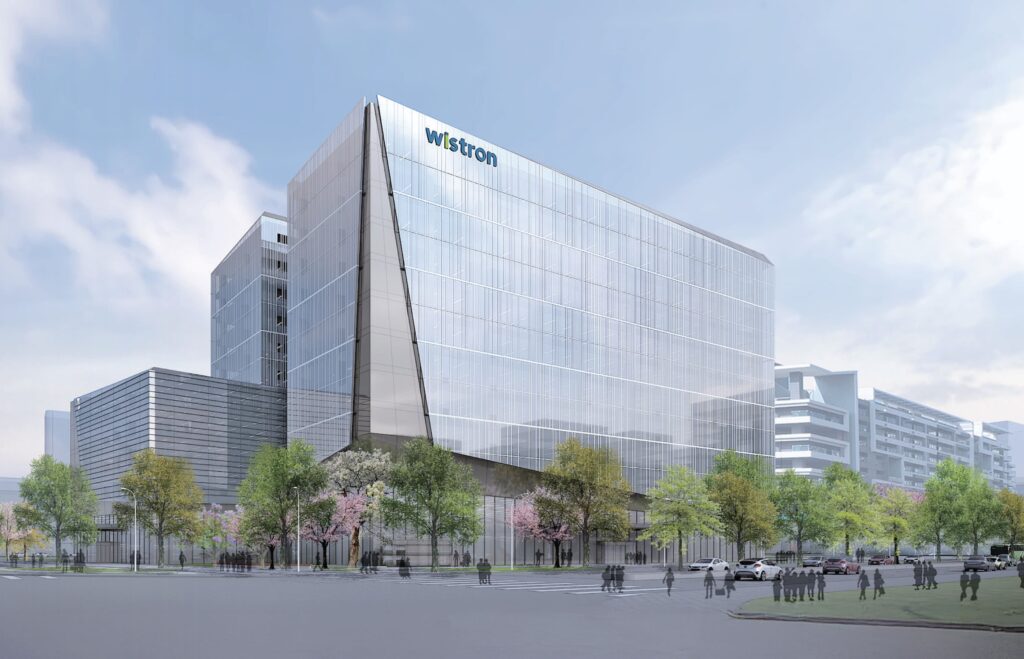
Wistron has closed a first quarter that well summarizes how the tech supply chain in Taiwan is changing. The company, traditionally associated with contract electronics manufacturing, has seen servers become the core of its business thanks to the momentum of artificial intelligence. In the first quarter of 2026, its consolidated revenues reached 846.3 billion New Taiwan Dollars, with an operating profit of 29.1 billion and a net profit of 9.63 billion. Earnings per share were NT$3.06.
The most revealing data lies in the composition of the business. According to DigiTimes, servers accounted for 79% of Wistron’s quarterly sales, a figure that shows how much Taiwanese manufacturers are shifting their focus from consumer electronics to data center infrastructure. AI is not only boosting companies like NVIDIA, AMD, or major cloud providers; it’s also reshuffling manufacturers that assemble, test, and deliver the physical systems powering this new demand.
AI Servers Change Wistron’s Profile
Wistron is not new to the server business, but the current cycle has given it a different level of significance. The demand for data center systems, AI racks, network switches, and high-performance platforms has grown at a much faster pace than more mature segments such as laptops or consumer devices. This is reflected in their financials: the first quarter shows a strong jump in revenue and a significant improvement in profitability.
Year-over-year comparison helps measure the magnitude of this change. According to data from S&P Capital IQ and MarketScreener, Wistron recorded NT$846.3 billion in revenue in Q1 2026, compared to NT$346.5 billion in the same period of 2025. Net profit increased from NT$5.33 billion to NT$9.63 billion, a growth of over 80%. It’s not just more volume; it’s a transformation in the types of products driving the business.
The AI boom has prompted major clients to secure capacity across the entire supply chain. Accelerators are the most visible part, but complete servers, boards, cooling systems, network modules, cabling, integration, logistics, and testing are also needed. Companies like Wistron, Quanta, Foxconn, and Inventec are gaining prominence as industrial partners for the new AI infrastructure.
In February, Wistron’s president, Simon Lin, stated that artificial intelligence was not a bubble but the beginning of a new era, and affirmed that the company’s order situation remained solid through 2027. It was also announced that their new facilities in the U.S. for NVIDIA-related server manufacturing would begin volume production in the first half of 2026. This context helps explain why the quarterly results aren’t seen as an isolated rebound but rather part of a broader trend.
Increased Investment in Vietnam, California, and AI Networks
Along with its results, Wistron approved three investment moves that reveal its priorities. First, an additional capital expenditure of $19 million for Wistron InfoComm (Vietnam), a wholly owned subsidiary, aimed at expanding capacity in the network switch business. This decision aligns with the bottleneck in AI infrastructure: adding GPUs isn’t enough; increased network capacity is needed to transfer data between servers, racks, and clusters.
The second move is a $30 million injection into WisLab EMS Corporation, Wistron’s subsidiary, to support financing needs at its factory in California. The location is significant. Pressure to manufacture more AI infrastructure in the U.S. has increased for commercial, logistical, and geopolitical reasons. NVIDIA has already announced plans to produce AI systems domestically with partners like Wistron and Foxconn, and Taiwanese assemblers are adapting their industrial footprint to this new reality.
The third move is an additional $20 million investment in Eridu Corporation, a company focused on advanced AI networking solutions, through a SAFE—an agreement for future equity participation. This point is particularly interesting as it suggests Wistron does not want to limit itself to hardware assembly alone. It also aims to position itself in higher-value layers within the AI-connected network infrastructure.
The network has become a critical piece. Modern clusters require transferring enormous amounts of data with low latency and high stability. If the network fails, becomes congested, or doesn’t scale well, GPUs can be underutilized. In a system where each rack costs millions, losing efficiency due to network issues is unacceptable. That’s why investments in switches and advanced networking solutions are as important as those in servers.
Taiwan Gains Weight in the New Global AI Manufacturing
Wistron’s case fits into a broader transformation of the Taiwanese sector. For decades, many of these companies grew around PCs, smartphones, and consumer electronics. Now, growth is increasingly driven by AI servers, data center networks, and high-performance systems. Reuters already pointed out in 2025 that firms like Foxconn, Quanta, and Wistron are pivoting toward AI infrastructure, with Taiwan becoming one of the most important industrial bases for global servers.
This shift presents both advantages and risks. The advantage is clear: demand for AI remains strong, customers are large, contracts can be sizable, and capacity needs extend over several years. The risk involves the demanding nature of the market, with margins squeezed by component costs, high investments, reliance on a few major clients, and significant exposure to hyperscalers’ spending cycles.
Wistron is responding by diversifying geographically and technologically. Vietnam enhances networking capacity. California supports industrial deployment in the U.S. The investment in Eridu reflects a bet on advanced AI networks. And the quarterly results show the firm is capturing current demand for large-scale servers.
For end customers, these moves might seem distant. Yet, they determine whether there will be enough capacity to deploy new data centers, AI services, cloud platforms, and inference systems. Digital infrastructure is built not just with cutting-edge chips, but with factories, assemblers, logistics, testing, energy, cooling, and networks. Wistron’s rising importance stems from operating where AI demand turns into tangible hardware.
The question now is whether this pace will be sustained. Orders seem solid, but the sector must manage bottlenecks in components, memory, substrates, switches, electrical capacity, and regional manufacturing. If AI demand continues to grow, Wistron could become one of the clearest industrial beneficiaries. Conversely, if markets cool or hyperscalers adjust investments, the company will have to prove its new capabilities aren’t reliant on a single cycle.
For now, the numbers point clearly: AI is reshaping the tech industry’s landscape, and Wistron is no longer just a manufacturer in the supply chain but an increasingly vital player in building the physical infrastructure of AI.
Frequently Asked Questions
What results did Wistron report for Q1 2026?
Wistron posted consolidated revenues of NT$846.3 billion, an operating profit of NT$29.1 billion, pre-tax profit of NT$23.5 billion, and net profit of NT$9.63 billion.
Why did its revenues grow so much?
Primarily driven by servers, especially those related to data centers and AI. According to DigiTimes, servers accounted for 79% of its quarterly sales.
What investments has Wistron approved?
They approved $19 million to expand switch capacity in Vietnam, $30 million into WisLab EMS in California, and $20 million into Eridu Corporation, focused on advanced AI networks.
Why are switches and networks important for AI?
Because AI clusters require moving vast amounts of data between servers and accelerators with minimal latency. A slow or congested network can reduce the actual performance of GPUs and entire systems.
via: wistron
