
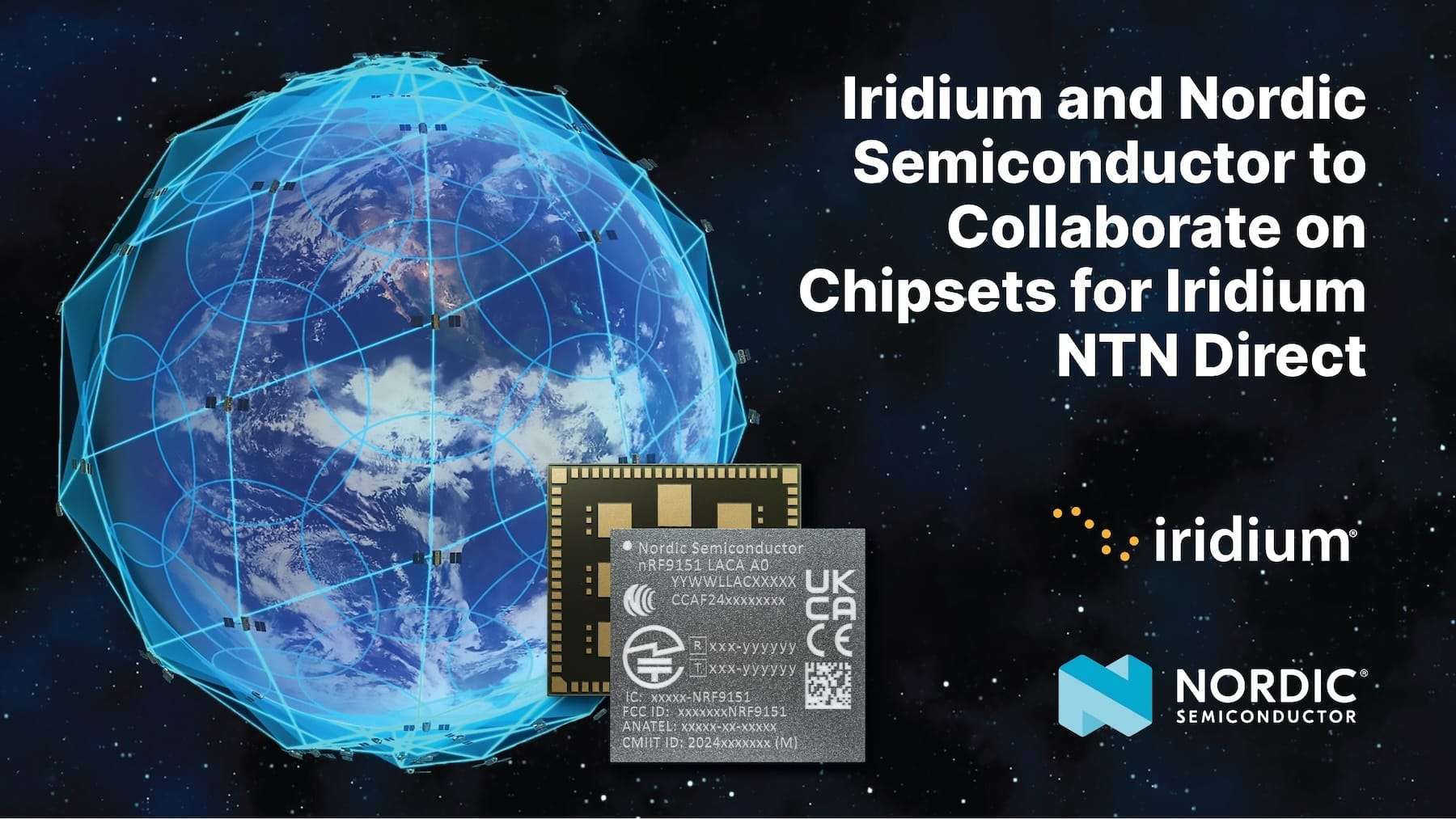
Iridium aims to bring location authentication to a deeper layer of the digital infrastructure. The satellite company has revealed the development of a new technology, currently called Project Authentic, with the goal of utilizing its satellite network to reliably verify a device’s location and protect critical services from manipulation, impersonation, or interference.
The initiative, as reported by Data Center Dynamics, is still in early stages but targets a very specific market: data centers, 5G networks, financial infrastructures, and systems where time and location are not just metadata but essential components of security and operational continuity. Iridium presents Project Authentic as an evolution of its PNT services, which stand for positioning, navigation, and timing.
Matt Desch, Iridium’s CEO, explained that the company is transforming its PNT technology into a reliable source of location and authentication. The proposal combines the signal from the Iridium constellation, a device capable of receiving it, and an authentication server installed in the data center. The goal is to cryptographically demonstrate that a device is where it claims to be.
Why Time Matters So Much in a Data Center
Data centers rely on precise time synchronization. Servers, distributed databases, storage systems, networks, firewalls, payment platforms, audit logs, and cloud services need to share a consistent temporal reference. Even slight deviations in timing can cause hard-to-diagnose errors: disordered transactions, inconsistent logs, replication failures, certificate issues, or security discrepancies.
For years, many infrastructures have used GPS and other GNSS systems as time sources. However, these signals can be interfered with, spoofed, or blocked. In low-criticality environments, such issues may be inconvenient, but in a data center, stock exchange, power grid, or telecom infrastructure, they can pose operational risks.
Iridium acquired Satelles in 2024 precisely to strengthen this area. Satelles was a company specializing in secure satellite-based time and location services, using a technology known as Satellite Time and Location. Iridium already owned about 20% of Satelles and paid approximately $115 million for the remaining shares. After the acquisition, the service was integrated into Iridium’s portfolio as Iridium STL.
What differentiates Iridium from traditional GPS is its architecture. Its constellation operates in low Earth orbit, uses the L-band, and provides global coverage. The company claims its signal can serve as an alternative or backup to GNSS, offering better resilience in environments where traditional signals are vulnerable or unreliable. Additionally, Iridium STL can operate with small hardware and, in certain deployments, without the need for external antennas.
Project Authentic: Physical Presence Authentication
Project Authentic aims to go beyond just time synchronization. The idea is to use the satellite signal not only to determine the time or approximate position but also to demonstrate that a device is physically located at a specific place. For data centers, this opens an interesting application: authenticating that a system, server, appliance, or critical module operates from an authorized location and not from a false or compromised one.
This concept addresses a security vulnerability. Traditional authentication relies on passwords, certificates, keys, tokens, MFA, and identity controls. While all these remain necessary, they do not always prove a device’s true location. In certain attacks, malicious actors can impersonate a valid user or device from another network location. Iridium seeks to incorporate a physical location proof that makes such impersonation more difficult.
Desch has stated that this capability could block attacks originating from unauthorized locations. This is an ambitious claim and should be seen as a promising technological development rather than a fully deployed commercial solution. Project Authentic is still in its early stages, with the company exploring how to bring it to market.
The proposal aligns with a broader trend: security is shifting from solely verifying identity and credentials to including contextual signals. Who accesses matters, but so does where, with what device, at what time, under what network conditions, and with what level of physical trust. An authenticated PNT source could add an extra layer within zero-trust architectures, operational continuity, and protections for critical infrastructure.
A New ASIC to Bring PNT to More Devices
Iridium plans to launch a new PNT ASIC by mid-2026. The company describes this chip as a way to integrate positioning, navigation, and timing capabilities into smaller devices with global coverage and interference/impersonation resistance. This is important because widespread adoption of alternative PNT shouldn’t rely solely on expensive or complex equipment.
If the chip successfully reduces size, cost, and integration difficulty, Iridium could introduce its technology to more sectors: data centers, telecom, energy, transportation, defense, maritime, aviation, and industry. The company points to a broad market, as many infrastructures depend on precise timing and reliable localization, often without full awareness of their fragility.
In data centers, the immediate use case is as a backup time source. If a facility relies on GNSS for synchronization and that signal degrades, Iridium STL could serve as an alternative layer. The company states its technology is already used in demanding environments, including financial markets where temporal precision and traceability are critical.
Project Authentic would add another feature: location authentication. In the future, operators could verify that critical devices are within specific premises, haven’t been moved, are not being emulated remotely, and maintain a consistent link between digital identity and physical presence. For colocations, private clouds, edge computing, or distributed networks, this capability could be valuable if well integrated with existing security tools.
Opportunities and Open Questions
Iridium doesn’t start from zero. It has a global constellation, experience in satellite communications, and now Satelles’s integrated business. It also arrives at a time when governments and companies are increasingly concerned about GPS dependency risks. GNSS interference has become a recurring concern in aviation, maritime transport, defense, telecom, and energy infrastructures.
However, Project Authentic must answer several questions before becoming a widely adopted solution. The first is technical: what level of accuracy, availability, and robustness can it achieve in complex buildings, cleanrooms, dense racks, and electronically noisy environments? The second relates to integration: how will it connect with identity systems, SIEMs, asset management, BMC, cloud security platforms, and monitoring tools? The third is economic: what will be the cost of deploying it across thousands or millions of devices?
It will also be necessary to assess how it compares to other alternative PNT solutions. Approaches include ground-based systems, telecommunications signals, local atomic clocks, fiber-optic methods, eLoran in certain markets, and hybrid architectures. Iridium claims many alternatives are local or regional, whereas its network offers global coverage. This can be advantageous for multinational corporations, but each case depends on specific requirements.
The core idea is clear: as digital infrastructure becomes more critical, trusting not only who connects but also when and from where is essential. Data centers in AI, cloud, banking, telecom, and public administration depend on precise synchronization and trustworthy signals. If Iridium manages to develop a robust product from Project Authentic, it could open a new category in physical-digital security.
Future authentication will not rely on a single test but will have multiple layers: identity, device, key, behavior, network, time, and location. Iridium aims to fill the last gap with a satellite-based proposal that transforms PNT from just navigation into a trust signal for supporting the backbone of the digital economy.
Frequently Asked Questions
What is Iridium’s Project Authentic?
Project Authentic is the provisional name for Iridium’s technology to authenticate a device’s physical location through its satellite network and an authentication server installed in the data center.
What does PNT stand for?
PNT means positioning, navigation, and timing. In critical infrastructures, it’s used to determine location, maintain precise time synchronization, and protect systems from errors or manipulation.
Why do data centers need a reliable time source?
Because servers, networks, databases, logs, certificates, and security systems depend on accurate time. Manipulated or unstable signals can cause operational failures and security risks.
When will Iridium release its new PNT ASIC?
Iridium expects to have its new PNT ASIC commercially available by mid-2026, according to the company’s published information.
via: datacenterdynamics
