
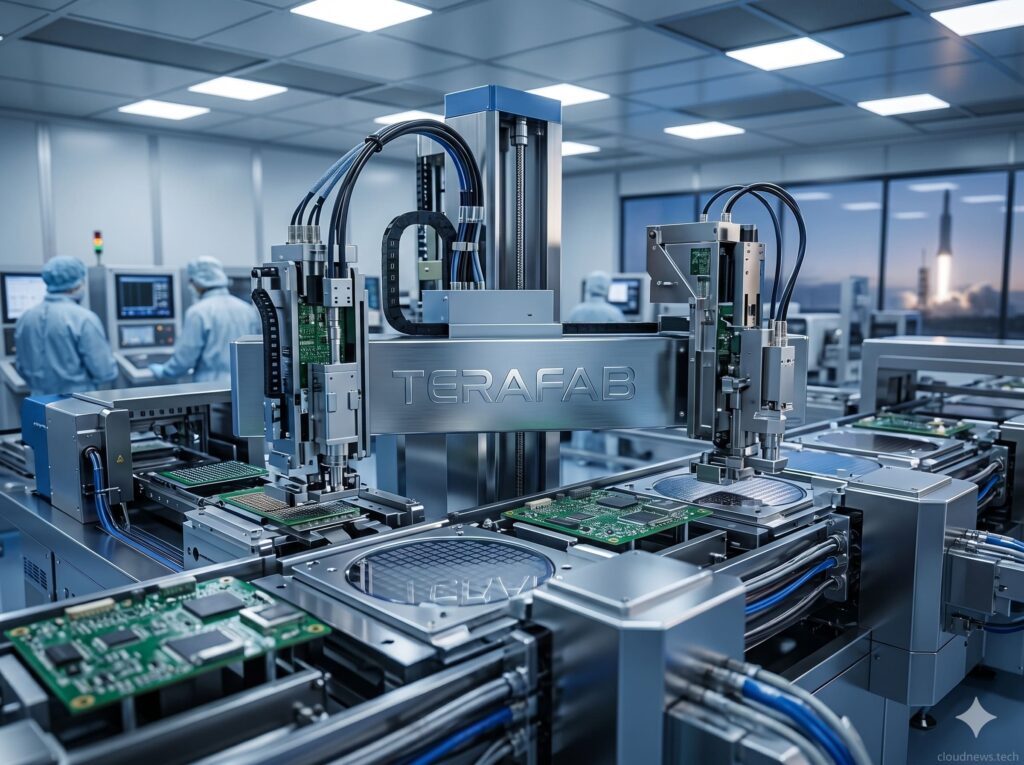
Elon Musk aims to scale semiconductor manufacturing to a level that even this industry finds hard to absorb. A public notice from Grimes County, Texas, identifies Space Exploration Technologies Corp., the parent company of SpaceX, as the applicant for a tax exemption for a project described as a multi-phase, vertically integrated advanced semiconductor and computing facility. The estimated initial investment amounts to $55 billion, and the total cost could reach $119 billion if additional phases are built.
The proposed location is SpaceX Reinvestment Zone No. 1 – 2026-001, around Gibbons Creek Reservoir. A public hearing is scheduled for June 3, 2026, when county commissioners will review the property tax reduction agreement. The document doesn’t include technical details about nodes, customers, annual production, or launch schedule, but it confirms the economic scale of a project that, if moving forward, would rank among the most ambitious industrial endeavors in recent tech history.
A project beyond a conventional factory
The term “fab” may fall short in describing what the documentation proposes. An advanced chip factory is, in itself, an enormously complex undertaking. It requires clean rooms, ultrapure water, massive power supplies, special gases, photolithography, etching, deposition, inspection, metrology, particle control, packaging, testing, and a highly specialized workforce. The TeraFab aims to combine several of these layers within a single ecosystem.
The idea of vertical integration aligns with how Musk has built other businesses. Tesla reduced dependency on suppliers for batteries, software, electronics, and some manufacturing. SpaceX did something similar with rockets, engines, electronics, and satellites. Extending this logic to chip manufacturing is much more challenging because the semiconductor industry is fragmented for a reason: each step requires decades of expertise and suppliers with highly specialized technology.
TSMC, Samsung, and Intel don’t just manufacture chips. They operate supply chains involving ASML, Applied Materials, Lam Research, KLA, Tokyo Electron, chemical suppliers, mask producers, wafer specialists, packagers, and design houses. Replicating this coordination from scratch is not just a matter of money; it also involves equipment, patents, talent, manufacturing performance, and years of learning.
That’s why the $55 billion figure is impressive but doesn’t guarantee success. In semiconductor manufacturing, initial capital is only part of the equation. The difference between a promising fab and a competitive one lies in yield—the percentage of good chips per wafer. An advanced process may be technically feasible yet not profitable if it produces too many defects or cannot achieve stable volume.
Intel 14A, critical suppliers, and a race against time
Various reports have linked the TeraFab with Intel 14A process technology, an upcoming Intel Foundry process still in early industrial validation. Contacts with major equipment providers like Applied Materials, Tokyo Electron, and Lam Research have also been reported to discuss pricing and delivery timelines. These are signs of real planning, though the factory is still far from operational at large scale.
Intel’s involvement would make strategic sense for both sides. For Musk, it could leverage U.S.-based process technology without solely depending on TSMC or Samsung. For Intel, having a high-profile client tied to Tesla, SpaceX, and AI projects would be a significant validation for its foundry business, which aims to challenge Asian leaders in third-party manufacturing.
However, many uncertainties remain. It’s unclear whether SpaceX or Tesla would license Intel’s technology, whether Intel would manufacture part of the chips, if the TeraFab would operate as a plant with transferred technology, or what responsibilities each company would hold. In an industry where foundry agreements are often confidential, it’s important to distinguish between strategic intent and a finalized contract with timelines, capacities, and deliverables.
Time is another critical factor. The most advanced manufacturing tools have long lead times. Major fabs plan their orders years in advance, competing for EUV systems, inspection equipment, etching, deposition, and advanced packaging tools. A TeraFab of this scale would need to join that queue, attract suppliers, secure personnel, and negotiate permits, energy, and water access in Texas.
Could Musk lower chip costs or make the sector more accessible?
The hypothesis is attractive: if Musk has reduced costs for rockets and has stretched sectors with Tesla and SpaceX, perhaps he could also push down the cost of manufacturing advanced chips. In theory, a large, integrated facility designed to produce AI chips could shorten development cycles, eliminate middle margins, and tailor hardware to the specific needs of his companies.
This effect would be more evident within Musk’s own ecosystem. If Tesla, SpaceX, or xAI can design and produce high-quality accelerators at scale for autonomous driving, robotics, data centers, or space systems, they could reduce dependence on NVIDIA, TSMC, Samsung, or other suppliers. They would also gain control over schedules, production priorities, and chip architecture.
However, democratizing the market is a different story. For a TeraFab to produce chips for third parties at lower costs, it would need to offer external capacity, compete on price, demonstrate quality, and meet demanding customer standards. If the factory mainly supplies Musk’s internal needs, the impact would be more indirect—fostering competitive pressure, increasing investments in U.S. manufacturing, and possibly encouraging vertical integration models, but not necessarily lowering prices across the entire market.
Additionally, semiconductors don’t share the same cost structure as reusable rockets or electric vehicles. Much of the expense depends on specialized machinery, rare materials, and processes where each generation demands more capital. Even if Musk accelerates some cycles and simplifies internal decisions, he will still depend on suppliers like ASML, Lam Research, Applied Materials, or Tokyo Electron. Vertical integration doesn’t eliminate that dependency—it shifts it elsewhere in the supply chain.
The biggest potential change might be in the cost per unit of AI compute. If the TeraFab can produce chips optimized for specific workloads, with integrated packaging, memory, networking, and power consumption tailored to his data centers, the savings could come not just from chip price but from efficiency—performance per watt and per dollar across infrastructure. That’s where Musk might attempt a familiar move: redesigning the entire system rather than competing component-by-component.
A massive gamble with equally high risks
The TeraFab emerges when the U.S. is seeking to regain semiconductor manufacturing capacity. The CHIPS Act, investments by Intel, TSMC’s Arizona plant, Samsung’s Texas facilities, and new advanced packaging projects reflect shared concern: dependence on Asia for critical technology vital to defense, cloud, automotive, telecommunications, and AI.
In this context, a SpaceX project in Texas with a potential investment of up to $119 billion carries both industrial and geopolitical implications. It would not just be a factory for Musk’s companies but a strategic move to boost national capacity amid persistent AI chip shortages.
Yet, the gap between the public notice and an operational mega-factory is vast. Permits, technical agreements, funding, suppliers, final designs, construction schedules, and industrial validation still need to be secured. It remains to be seen how the project aligns with Tesla, SpaceX, xAI, and Intel, and whether local incentives will be enough to support such a large-scale endeavor.
Elon Musk can influence markets with a word and accelerate sectors through aggressive investments. But chip manufacturing is one of the most challenging fields to turn vision into profitable production. If the TeraFab progresses, it might shift the balance among AI clients, foundries, and equipment suppliers. If it falters, it will serve as a reminder that semiconductor industry dominance requires more than ambition and capital.
Frequently Asked Questions
What is Elon Musk’s TeraFab?
It is a project for a large-scale semiconductor and advanced computing factory linked to SpaceX, planned in Grimes County, Texas, described as a multi-phase, vertically integrated facility.
How much would the TeraFab cost?
The public notice estimates $55 billion for initial phases and up to $119 billion if more phases are added.
Where would the factory be located?
In the Gibbons Creek Reservoir area within Grimes County, Texas, under the designation SpaceX Reinvestment Zone No. 1 – 2026-001.
Could it lower AI chip costs?
It could reduce internal costs for Musk’s companies if it produces chips at scale, but its impact on the broader market remains uncertain. Success depends on whether it can supply third parties, its manufacturing performance, and its ability to compete with TSMC, Samsung, and Intel.
