
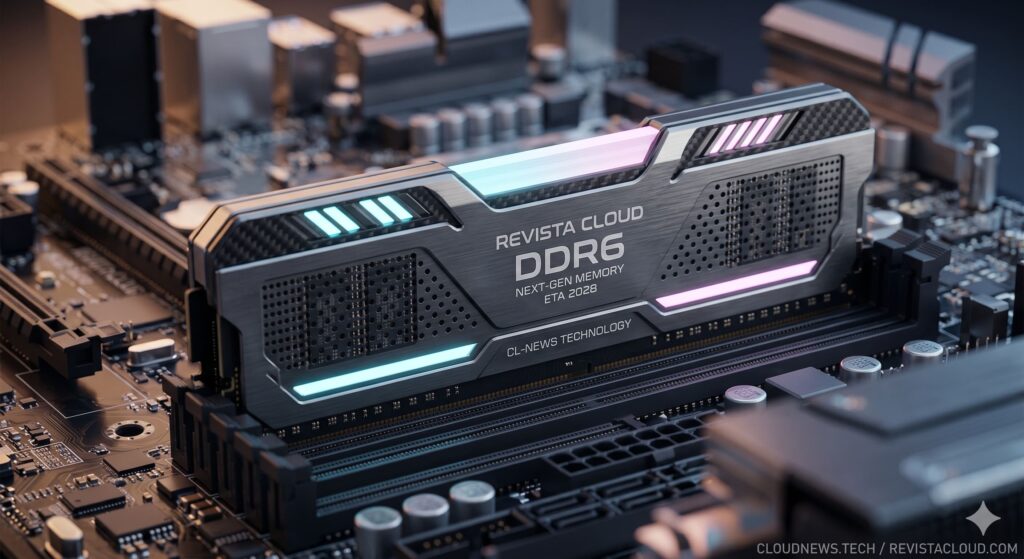
DDR6 memory is beginning to gain serious traction in the industry, although it’s not yet a product ready for stores, servers, or workstations. Samsung, SK hynix, and Micron have reportedly asked substrate suppliers to initiate preliminary developments for the next generation of DRAM, aiming to validate designs, study module thickness, internal stacking, wiring, and initial prototypes before the standard is finalized.
This movement comes at an unusual time. The memory market is experiencing strong tension due to demand from artificial intelligence, servers, and HBM, while prices for DRAM and NAND are pressuring manufacturers of PCs, mobiles, and data centers. Nonetheless, the technological timeline continues. The transition from DDR5 to DDR6 won’t be immediate, but memory manufacturers must start now if they want to influence the final specifications and be ready for platforms emerging later this decade.
An Emerging Standard with a Clear Direction
DDR6 is not yet a definitive JEDEC specification—the body responsible for standardizing primary memory technologies. According to The Elec, JEDEC is expected to distribute an initial draft by late 2024, but key parameters such as the final number of input/output lines, signaling, module thickness, and other electrical and physical details remain to be decided.
For this reason, manufacturers are accelerating preliminary development. In memory, reaching the standard early is crucial. If a company can align part of its technical approach with JEDEC’s final direction, it can gain advantages in performance, validation, yields, and time-to-market. They can also collaborate earlier with CPU, motherboard, server, and large client manufacturers.
Joint development with substrate suppliers is a logical phase. At such high speeds, the memory module can no longer be treated as just a support for DRAM chips. Signal integrity, electrical distribution, temperature, thickness, trace distances, and encapsulation directly influence stability. DDR6 won’t be just “faster DDR5”—it will require a thorough redesign of the module.
Current forecasts place DDR6 commercialization between 2028 and 2029, though this timeline depends on standard maturity, validation with CPU platforms, and the overall memory market situation. The Elec points to this window for production, while other industry analyses also mention deployments towards the late part of the decade, especially for servers and high-performance platforms.
From 8,800 to 17,600 MT/s: The Leap Forward from DDR5
The technical promise of DDR6 is ambitious. Initial speeds are rumored to be around 8,800 MT/s, with future evolutions reaching 17,600 MT/s. That means DDR6 would start near DDR5’s official maximum and have room to double that performance as controllers, modules, and platforms mature.
Comparing to DDR5 helps illustrate the jump. DDR5 launched around 4,800 MT/s, gradually scaling with official versions and high-performance modules. In the consumer market, kits exceeding those figures already exist via overclocking profiles like XMP or EXPO, but the base standard for stable platform design—especially for servers, workstations, and mainstream PCs—remains different.
Furthermore, performance improvements won’t be limited to nominal speed. One of the most notable rumored changes around DDR6 is the possible transition from two 32-bit subchannels, as in DDR5, to four 24-bit subchannels. If confirmed, this would increase total module bandwidth from 64 to 96 bits, potentially boosting effective bandwidth far beyond a simple MT/s increase.
| Generation | Reference Speeds | Module Organization | Main Focus |
|---|---|---|---|
| DDR4 | Up to 3,200 MT/s per JEDEC specs | Traditional 64-bit channel | PCs, servers, mature platforms |
| DDR5 | Starting around 4,800 MT/s, scaling higher later | 2 subchannels of 32 bits | Higher bandwidth, better efficiency, increased capacity |
| DDR6 | Estimated 8,800 to 17,600 MT/s | Potential 4 subchannels of 24 bits | Servers, AI, high performance, future client platforms |
This restructuring will be significant for modern workloads. Current processors need more memory capacity, but also greater concurrency and sustained bandwidth. In AI servers, in-memory databases, simulations, data analysis, dense virtualization, or workstations, the bottleneck is often not the number of CPU cores but how quickly those cores receive data.
CAMM2, SOCAMM, and the Future of DIMM Formats
The traditional DIMM form factor has been the de facto standard for desktop and server memory for decades. However, DDR6 could accelerate an ongoing transition: smaller, flatter modules with shorter electrical paths. That’s where CAMM2 comes in—a standardized JEDEC format for DDR5 and LPDDR5/LPDDR5X, aiming to gradually replace SO-DIMM in laptops and compact devices. The CAMM2 standard defines electrical and mechanical requirements for these modules and envisions their use as primary memory in computers, laptops, and other systems.
CAMM2’s advantage lies in its design. Being placed more flat on the motherboard, it can save space, shorten traces, and improve signal integrity compared to vertical formats. This is especially useful as speeds increase and every millimeter of electrical path counts. For high-performance laptops, compact stations, and designs where thickness is critical, CAMM2 makes sense.
This doesn’t mean DDR6 will immediately kill traditional desktop DIMMs. Desktop PCs have more space, well-established supply chains, and a large installed base of vertical module designs. But it’s reasonable to expect DDR6 to usher in a period where multiple formats coexist depending on the device type.
In servers, the landscape could differ. The pressure from AI and high-density memory demands is pushing towards compact formats to bring capacity and bandwidth closer to CPUs, accelerators, and specialized system boards. SOCAMM and future standardized variants may gain importance in AI platforms where power consumption, density, and physical proximity are as critical as total capacity. Recent reports suggest JEDEC is working on standardizing SOCAMM2 for AI servers—an evolution of compact designs aimed at broader industrial adoption.
From Servers and AI to Consumer PCs
DDR6 won’t reach mainstream users immediately. As with DDR5, major deployments are expected first in servers, data centers, professional platforms, and systems where extra bandwidth justifies paying more for new technology. Heavy AI workloads, advanced inference, scientific computing, and high-performance databases are natural early adopters.
Later, workstations, enthusiast systems, high-end laptops, and then consumer PCs will follow. This process could take several years. DDR5 began its commercial transition around 2020-2021 but didn’t quickly become ubiquitous across all segments. In servers, adoption accelerated when CPU platforms adopted DDR5 en masse. On desktops, DDR4 remained dominant longer due to cost, availability, and compatibility.
The same pattern may happen with DDR6. Even if the memory is ready by 2028 or 2029, adoption will depend on Intel, AMD, motherboard makers, OEMs, cloud providers, and key market players. New memory requires integrated controllers in CPUs, BIOS validation, compatible motherboards, stability profiles, certified modules, and sufficient volume to lower costs.
The current memory market tension adds uncertainty. If demand for HBM, advanced LPDDR, and server DRAM continues to take capacity, DDR6 might first become popular among clients with the greatest need and technical margin. Consumer adoption would come later, as usual.
What Should Users Expect?
For today’s PC users, DDR6 isn’t a reason to delay buying a new system. DDR5 will remain the dominant memory for years and still has room to grow in speed and capacity. DDR6 is more aligned with platform cycles at the end of the decade, not the immediate upgrade path for current systems.
For manufacturers and data centers, however, the development process matters now. Memory has become a critical part of overall system performance. It’s no longer enough to have faster CPUs or more accelerators; systems must supply those chips with data at sufficient speed and reasonable power consumption. DDR6 aims directly at that: higher bandwidth, greater internal parallelism, and new formats capable of supporting more demanding frequencies.
The design of motherboards, laptops, and servers may also evolve. If CAMM2, SOCAMM, or other compact formats gain ground, future memory modules could look less like traditional vertical DIMMs that many users are accustomed to. It won’t be an immediate, uniform change, but DDR6 might be the generation that makes these alternatives more common.
The prudent view is that DDR6 has already begun its industrial rollout but isn’t yet widespread commercially. Manufacturers are validating designs before the standard is finalized; in semiconductors, lagging behind the standard can mean missing the market. For users, the key date isn’t just when DDR6 is approved but when real platforms can leverage it without excessive costs.
Frequently Asked Questions
When will DDR6 memory arrive on the market?
Current forecasts point to 2028-2029 for commercialization, initially in servers, data centers, and professional platforms. Consumer markets will follow later.
What speeds will DDR6 reach?
Initial speeds are rumored to be around 8,800 MT/s, with future scaling potentially reaching 17,600 MT/s, though final specifications are not yet locked in.
Will DDR6 replace traditional DIMMs?
Not immediately. DDR6 could accelerate adoption of formats like CAMM2 or SOCAMM in laptops, compact systems, and high-density servers; however, traditional DIMMs might still be present for years.
Is it worth waiting for DDR6 to buy a new PC?
For most users, no. DDR5 remains the main option for now and offers room for growth. DDR6 is targeted at the next-generation platforms and will take time to become affordable and widespread.
via: thelec.kr
