
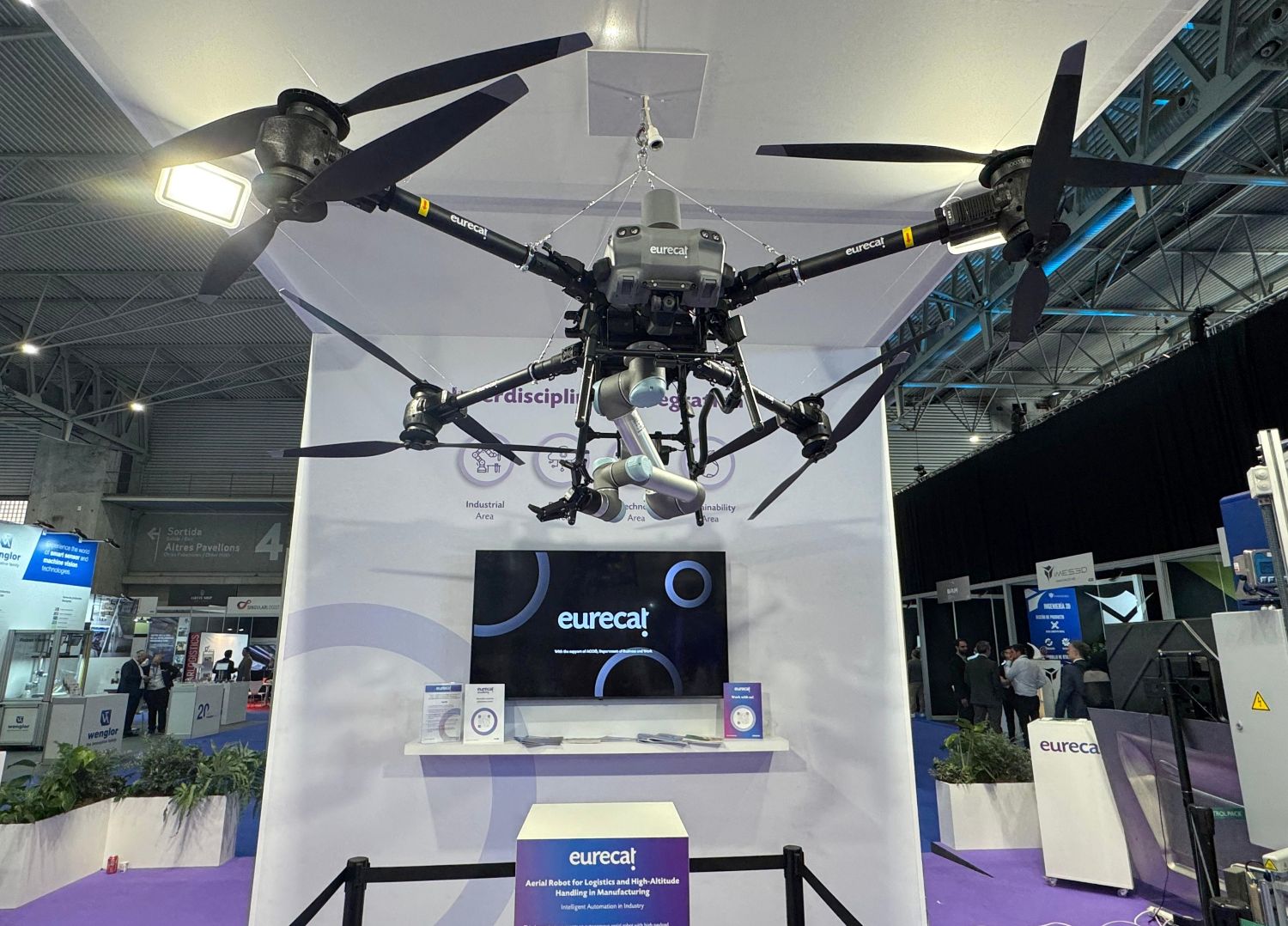
The Eurecat Technology Center will participate in the Advanced Factories exhibition, beginning tomorrow in Barcelona, where it will showcase various solutions developed in collaboration with companies such as Codorníu, Metalogenia, Carpel, Rotimpress, and Pröll. These innovations represent key advancements in industrial transformation, aimed at improving competitiveness, efficiency, and sustainability through cyber-physical systems and the application of artificial intelligence to robotics.
Among the proposals, Eurecat will display autonomous robotic applications based on proprietary software for inspection and maintenance of infrastructure and industrial facilities. These solutions utilize quadruped robots equipped with sensors capable of autonomous movement in complex environments, collecting data that enables early anomaly detection and facilitates predictive maintenance.
Additionally, the center will present a tool developed with Metalogenia that monitors the number of complete cycles performed by an excavator, making it easier to track its activity and optimize its performance remotely and in real time.
Another notable demonstration will be a production system capable of handling Codorníu cava bottles, showcasing its ability to develop flexible and modular architectures focused on manipulating various types of industrial components, including delicate objects, with greater efficiency.
Furthermore, Eurecat, in collaboration with Carpel, will introduce the world’s first scale prototype of an interior cabin panel for aircraft services, developed using plastronic technology.
The Digital Product Passport: a tool to advance toward more transparent, responsible, and competitive production models
Eurecat has developed the Digital Product Passport, a platform that allows the registration, structuring, and sharing of all relevant information about a product throughout its lifecycle in a traceable manner. This tool can be deployed across various industrial sectors, adapting to the specificities of each value chain, product type, and regulatory context.
This technological solution, tested in real cases such as battery management and the textile industry, facilitates decision-making aimed at decarbonization and minimizing the carbon footprint, aligning with European regulatory requirements related to sustainability and circular economy.
Artificial intelligence, digital twins, and photonics to facilitate manufacturing processes
Eurecat has developed a multi-criteria platform based on the concept of digital twins, applying artificial intelligence to support decision-making and thus optimize processes and resources for companies operating in complex production environments.
It also integrates vision and AI supported by photonic technology to predict manufacturing defects, within the framework of zero-defect manufacturing schemes.
